
In Today’s Science News, we learn about the risk of global water scarcity being greater than previously thought and the discovery of six likely rogue worlds made by the James Webb Space Telescope. However, first we learn about water scarcity and dehydration.

Water Scarcity and Dehydration
„[A]round 1.1 billion people lack access to safe drinking water around the world, and a total of 2.7 billion find water difficult to access for at least one month of the year.“ (BBC)
For 2.4 billion people inadequate sanitation is also a problem, leading to the exposure of water-born illnesses such as cholera and typhoid fever. And each year, two million people – mostly of whom are children – die from diarrheal diseases alone.
„By 2025, two-thirds of the world’s population may face water shortages. And ecosystems around the world will suffer even more.“ (WWF)
It’s a dire situation, there’s no denying that and the climate crisis will only worsen it if we do not develop strategies to mitigate the damage that has already been done and prevent worse from happening by drastically reducing our Co2-emissions.
Now to the second point to this unusual start of Science News: Dehydration.
The human body consists between 60-70% of water – it is essential to our survival.
The BBC article above mentions three stages of dehydration, here summarized:
- Stage 1: 2% of body weight is lost
– Kidneys send less water to the bladder -> darkened urine
– Less sweat -> body temperature increases
– Blood becomes thicker and sluggish
– Heart rate increases to maintain oxygen levels - Stage 2: 4% of body weight is lost
– Risk of overheating increases
– Blood pressure drops, fainting can occur
– Kidney try to compensate by retaining water -> less urination
– Cells shrink in size as water moves to the bloodstream - Stage 3: 7% of body weight is lost
– Body troubles to maintain blood pressure
– Blood flow to non-vital organs like kidneys and gut is slowed, which causes damage
– Kidneys don’t filter blood -> cellular waste quickly builds up
Source: https://www.bbc.com/future/article/20201016-why-we-cant-survive-without-water
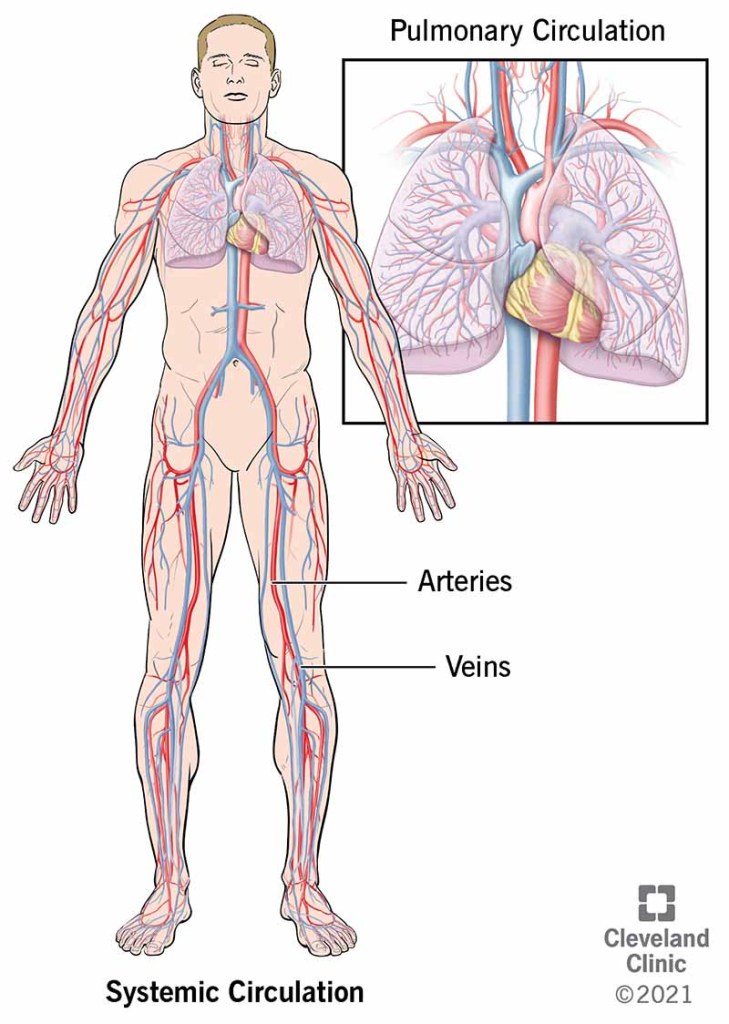
Cardiovascular System:
https://my.clevelandclinic.org/health/body/21833-cardiovascular-system
Article 1: The risk of global water scarcity is greater when accounting for the origin of rain
SD-Date: September 2, 2024
Et-Date: September 7, 2024
ScienceDaily-Summary: „Securing the world’s water supply is one of the greatest challenges of our time. Researchers are now presenting an alternative method for quantifying the global risk of water scarcity. Results indicate higher risks to water supply than previously expected if accounting for the environmental conditions and governability where rain is produced.“
Open-Access: https://www.nature.com/articles/s44221-024-00291-w
Method of Research
When we think of the global water supply, the common idea is rain falling on the earth’s surface and then stored in aquifers, lakes, and rivers. Usually, this is used to assess water security and the risk of water scarcity. The new study, which was published in Nature Water, focuses on where the water supply originates from and how governance and environmental conditions present upwind affect the water risks.
Upstream perspective
Used when a lake or river is shared between different countries or authorities.
As the name already implies, the conditions ‚in the direction upriver from the water body‘ matter and therefore the assessments and regulations mainly applied here.
Upwind perspective
This perspective is introduced by the team of this research paper.
It takes into account the areas ‚where evaporated water is transported before ending up as rain‘. The term for this area, which can cover large areas of the earth’s surface, is called precipitationshed.
The research team around Fernando Jaramillo (associate professor in physical geography at Stockholm University) examined 379 hydrological basins worldwide.
As pointed out in the study (see Open-Access), 40% of the continental rain originates in evaporation from land. In some regions of Eurasia, South America and Africa it increases to 80-90%. Moreover: Irrigation, for instance, increases the precipitation downwind while deforestation has the opposite effect.
Findings
- A very high risk face 32,900 km³/year of water requirements worldwide
- This is a 50% increase of the previous 20,500 km³/year
Consequences
Evaporation from plants play an important role to the availability of water downwind.
Meaning that areas where deforestation and agricultural development are predominant, the amount of moisture vegetation provides may decrease which in turn reduces rainfall and increases the risk to water security.
It depends from country to country, of course.
The Philippines receives most of its water from the sea, so a change of land-use poses very little risk to water security.
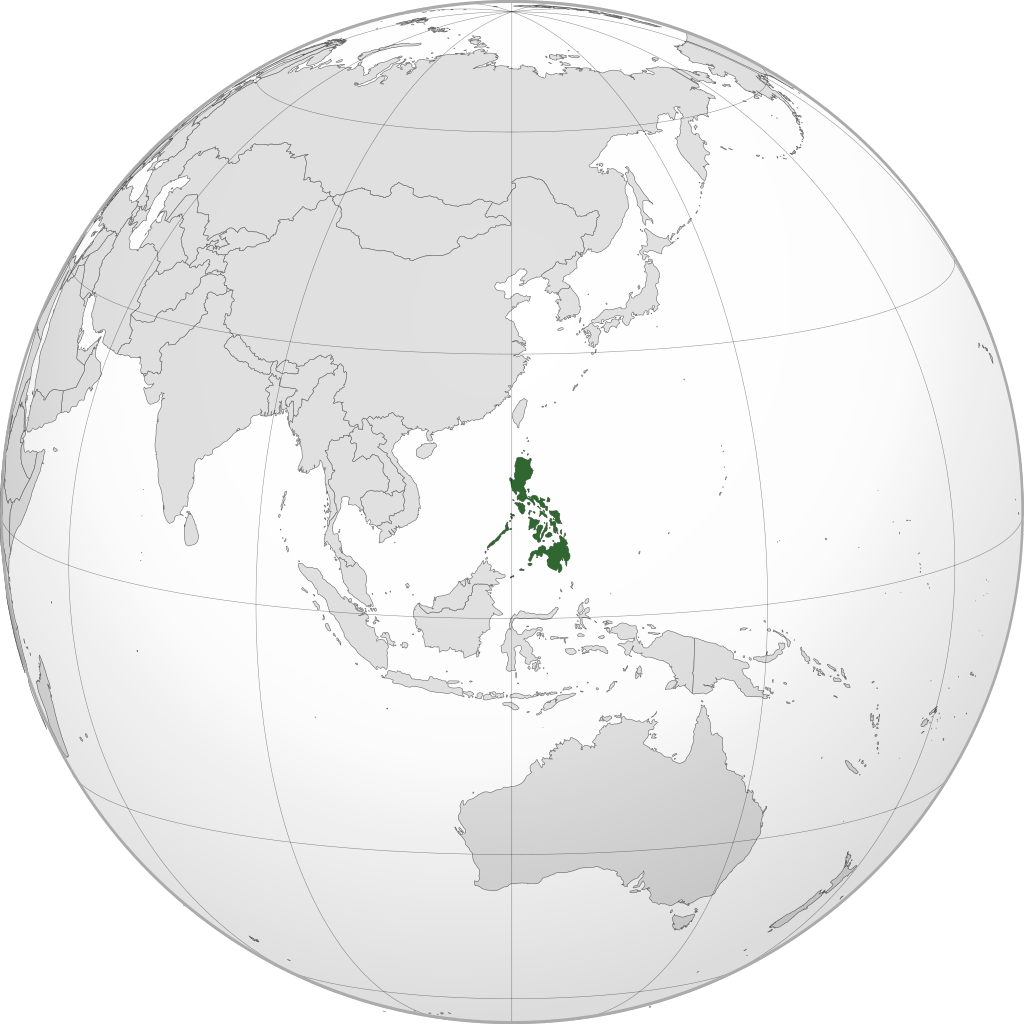
Many land-locked countries are more vulnerable to water security.
In Niger, the moisture for rainfall comes primarily from neighbouring countries such as Nigeria and Ghana. In other words: a change of land-use means higher risks.
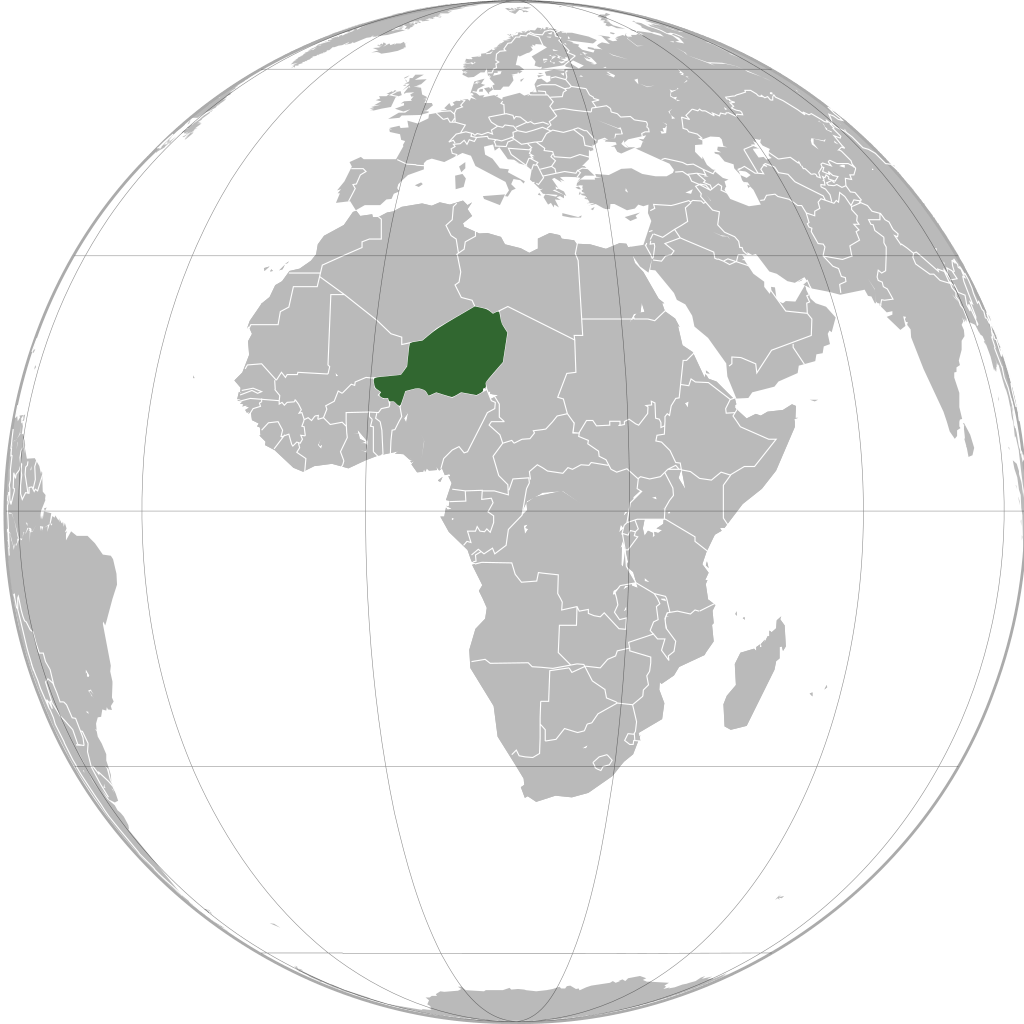
Water safety is thus affected by political factors: regulations and environmental management in areas where moisture first evaporates.
„For instance, the Congo River basin, heavily reliant on moisture from neighboring countries with low environmental performance and governance according to global indicators, faces considerable risks due to potential deforestation and unregulated land use changes in neighboring areas,“ says Lan Wang-Erlandsson, researcher at the Stockholm Resilience Centre at Stockholm University and co-author of the study. (ScienceDaily)
To summarize: there exists an interdependence between countries. We should therefore not only account for how one’s own country manages water resources, but also how the neighbours do it. International cooperation is essential: „We hope that the findings of this study can help identify where and to whom cooperation strategies and efforts can be directed to mitigate the causes of water-related tensions, including atmospheric water flows in transboundary decision-making and water governance frameworks. We stress the need for international cooperation to effectively manage upwind moisture sources“ – Fernando Jaramillo
Sources
Upwind moisture supply increases risk to water security
https://www.nature.com/articles/s44221-024-00291-w
The risk of global water scarcity is greater when accounting for the origin of rain
https://www.sciencedaily.com/releases/2024/09/240902111759.htm
Article 2: Six new rogue worlds: Star birth clues
SD-Date: August 27, 2024
Et-Date: September 8, 2024
ScienceDaily-Summary: „The James Webb Space Telescope [JWST] has spotted six likely rogue worlds — objects with planet-like masses but untethered from any star’s gravity — including the lightest ever identified with a dusty disk around it. The elusive objects offer new evidence that the same cosmic processes that give birth to stars may also play a common role in making objects only slightly bigger than Jupiter.“
Paper can be Accessed: https://arxiv.org/abs/2408.12639
It has been accepted for publication in The Astronomical Journal.
Background
Before we move on to the study, let’s re-visit how stars and planets are formed.
Stars form through the contraction of a cloud of gas and dust.
The brighter and more illuminous a star is, the shorter its lifespan.
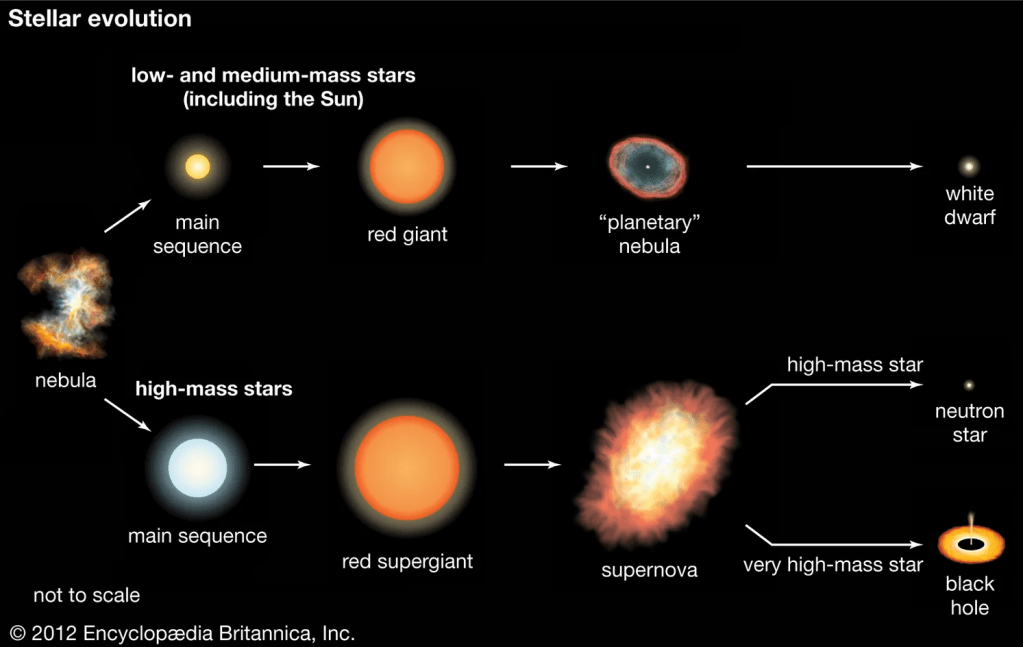
Generally, planets form in disks of gas and dust around young stars.
Planets with a solid surface usually form closer to the star, gas planets outside.
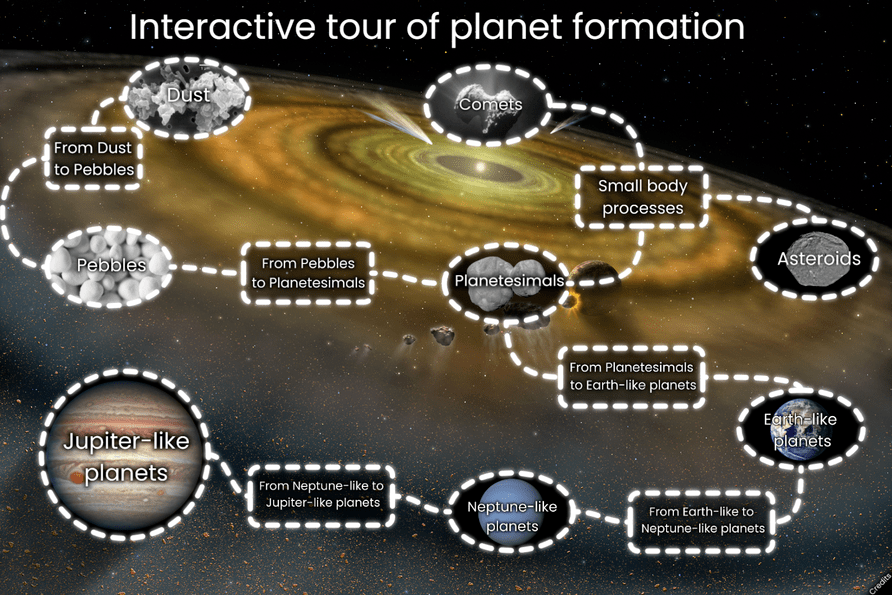
Don’t ask me about the interactive tour, I think it may have loaded incorrectly in my case.
Jupiter-sized planets can become hot Jupiters which orbit their star closely, as TIC 241249530 b is currently observed to turn into: „The new planet, which astronomers labeled TIC 241249530 b, orbits a star that is about 1,100 light-years from Earth. The planet circles its star in a highly “eccentric” orbit, meaning that it comes extremely close to the star before slinging far out, then doubling back, in a narrow, elliptical circuit. If the planet was part of our solar system, it would come 10 times closer to the sun than Mercury, before hurtling out, just past Earth, then back around. By the scientists’ estimates, the planet’s stretched-out orbit has the highest eccentricity of any planet detected to date.“ (MIT News)
It will take about one billion years until the planet migrates to a much tighter, circular orbit. Currently, it takes 167 days for the planet to revolve around the star once.
Discovery
The star-forming cluster NGC 1333 was surveyed by the James Webb Space Telescope.
This young nebula is about 960 light-years away and on the edge of the Perseus molecular cloud. It wasn’t the first time that this nebula has been surveyed, the Hubble Telescope observed it with visible light and the Spitzer Space Telescope in infrared-light.
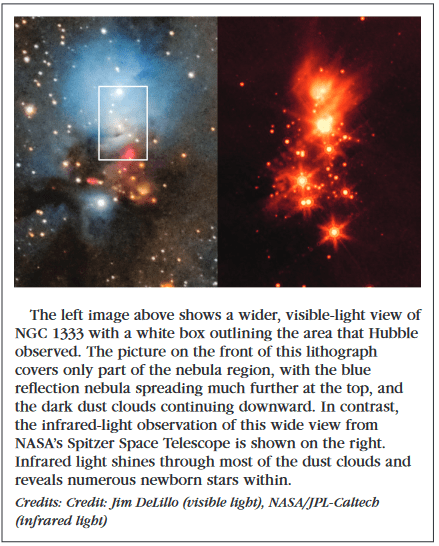
Thanks to the JWST, we were now able to search for even the faintest members of this nebula due to its extremely sensitivity at infrared wavelengths! And here is it where we also learn that gas giants can form differently. For this survey the Near Infrared Imager and Slitless Spectrograph (NIRISS) instrument of the JWST was used.
Findings
The lead author of this study was Adam Langeveld who works as an astrophysicist at the Johns Hopkins University, many more were involved in this study.
- 6 gas giants with masses 5-10 times bigger than Jupiter’s, found to have grown ‚from a process that would generally produce stars and brown dwarfs‘
- No objects lower than 5 Jupiter masses were found, despite JWST having instruments which could detect them -> strong indication for a threshold: lighter stellar objects may form like planets do
- Lightest object of the 6 was estimated to have the mass of 5 Jupiters
-> virtually certain the presence of a dust disk means it formed like a star - 19 brown dwarfs (failed stars) were re-analyzed
- Rare finding: a newly discovered brown dwarf had a planetary-mass companion
- The masses of these rogue planets overlap with gas giants and brown dwarfs, thus blurring classification -> they make up 10% of the celestial bodies in the cluster
More might be published on this, because the group was rewarded time on the JWST:
„In the coming months, the team will study more of the faint objects‘ atmospheres and compare them to heavier brown dwarfs and gas giant planets. They have also been awarded time on the Webb telescope to study similar objects with dusty disks to explore the possibility of forming mini planetary systems resembling Jupiter’s and Saturn’s numerous moons.“ (ScienceDaily)
As it is indicated above, rogue planets either form like stars in the beginning but lack the mass for nuclear fusion or they were disks of gas and dust around stars which merged into planet-like orbits and were later ejected from their star system.
Sources
Star formation and evolution
https://www.britannica.com/science/star-astronomy/Star-formation-and-evolution
Interactive tour of planet formation
https://www.tu-braunschweig.de/en/igep/news/detailansicht-nachrichten/interaktive-tour-durch-die-entstehung-von-planeten
NGC 1333 (PDF-file, 2 pages)
https://science.nasa.gov/wp-content/uploads/2024/05/hubble-ngc1333-litho.pdf
Six new rogue worlds: Star birth clues
https://www.sciencedaily.com/releases/2024/08/240827104959.htm
 Baroque