
In this blog entry we will learn about the origins of the Advent Calendar. Afterwards, I’ll share the advent calendar I made for my Discord Server. It features poets and their poems and some interesting facts (all on one DIN A4 page) – it was quite a lot of fun. I’ll elaborate on the poets, of course (short summaries of their biographies, that is).
For the facts, it was quite challenging to compromise enough information in it to make it interesting. Feel free to give feedback!
I hope that the poets whose poems I show here, as well as the interesting facts like about evolution or Speculaas, spark interest to dive deeper into these (or similar) topics. I’ll link to the sources at the end of each „Türchen“ (Little Door, as they are called in German).
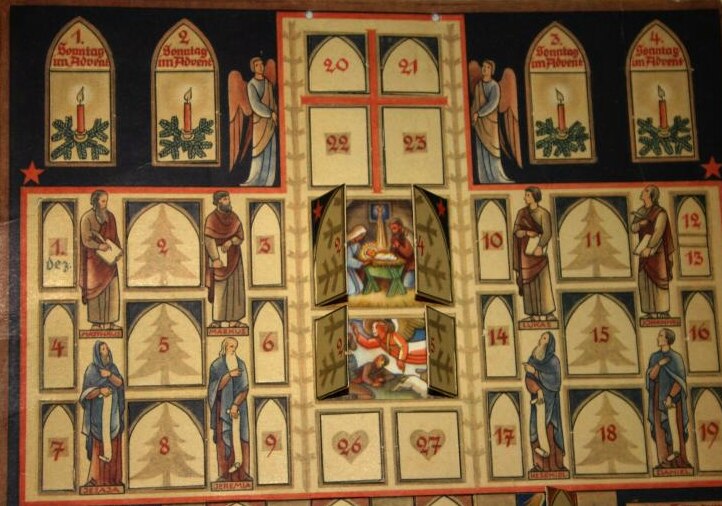
(Image source: Wikipedia)
History of the Advent Calendar
Before we move on to the actual advent calendar, let’s see how we’ve got here in the first place. Advent is latin and means „coming“, it originates from Christian customs to prepare spiritually for Christmas. It’s both for the celebration of the birth of Jesus Christ and the in preparation of the Second Coming of Christ (-> „Early Christians believed the Advent to be imminent, and most Christian theologians since then have believed that the visible appearance of Jesus may occur at any moment and that Christians should be ever ready for it“).
It is uncertain, however, when Advent was observed for the first time. The Encyclopedia Britannica mentions sources which dates it to the 4th century CE „when it was a period of preparation for the baptism of new Christians during Epiphany in January“. It was associated with Christmas by the time of Middle Ages (5th to 15th century).
Note: Most commercial advent calendars do not cover the entirety of the Advent season, because they usually begin on December 1. In Western churches, however, the Advent season begins on the Sunday nearest to November 30 (St. Andrew’s Day).
As for the origin of the analogous Advent calendar: German Protestants were known for counting down the days until Christmas. In this case not a calendar with little doors, but through activities like lighting a candle, placing a straw in a Nativity crib, ticking walls or doors with chalk, or hanging a devotional image on the wall.
There’s another story as well where a Munich housewife created the analogue calendar, because she was tired of „having to answer endlessly when Christmas would come“.
But to keep it short, here a timeline:
- Early 20th century: Appearance of first commercially printed calendars.
- 1920s: German publisher Gerhard Lang (1881-1974) added small doors with pictures behind it; other publishers included Bibel verses.
- 1939-1945: The Nazi-party banned the printing of calendars with images due to paper rationing. Only a few publishers began printing traditional calendars again after the war, like the Richard Sellmer Verlag which produces them to this day.
- 1950s: Introduction of chocolate behind the little doors.
- 21st century: Children are no longer the main target demographic, as companies began to start first small sample sizes of their products in festive packaging.
Adults can now count down to Christmas too with specialized Advent calendars that contain everything from gourmet foods to beauty products and fitness gear.
Baroque’s Advent Calendar
As I already explained in the introduction, I’ll elaborate on the poets and on my reasoning why I chose to write about X or Y in the Advent calendar. And well, that way you also see why I was busy and didn’t write anything until now.
First I’ll post the screenshot – as I did on my server -, then write the original text beneath it (in case it is difficult to read, since I had to screenshot it) and finally I’ll add the comment or elaboration. Every little door except one will be available as a PDF-file.
Little Door Nr. 1
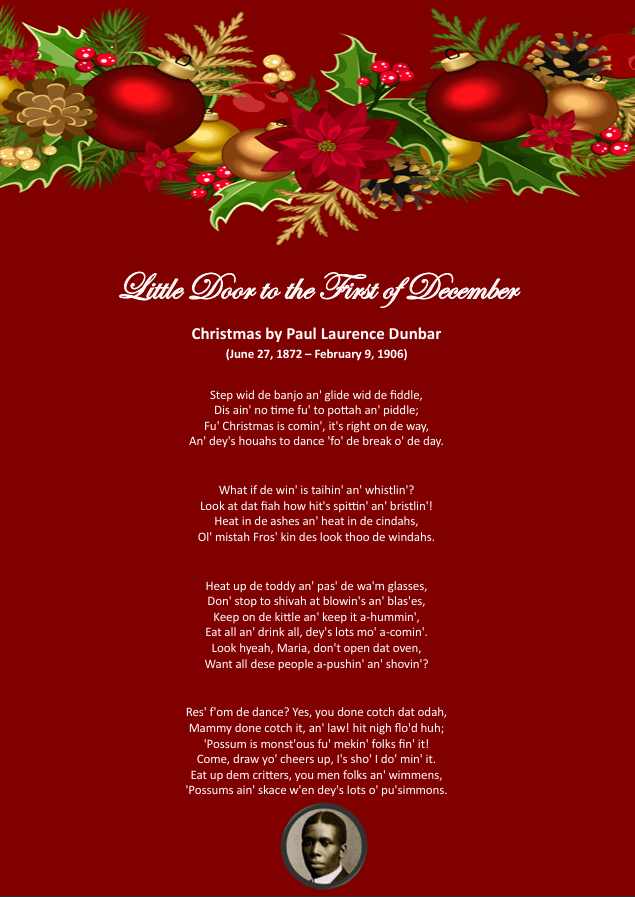
Christmas by Paul Laurence Dunbar
Step wid de banjo an‘ glide wid de fiddle,
Dis ain‘ no time fu‘ to pottah an‘ piddle;
Fu‘ Christmas is comin‘, it’s right on de way,
An‘ dey’s houahs to dance ‚fo‘ de break o‘ de day.
What if de win‘ is taihin‘ an‘ whistlin‘?
Look at dat fiah how hit’s spittin‘ an‘ bristlin‘!
Heat in de ashes an‘ heat in de cindahs,
Ol‘ mistah Fros‘ kin des look thoo de windahs.
Heat up de toddy an‘ pas‘ de wa’m glasses,
Don‘ stop to shivah at blowin’s an‘ blas’es,
Keep on de kittle an‘ keep it a-hummin‘,
Eat all an‘ drink all, dey’s lots mo‘ a-comin‘.
Look hyeah, Maria, don’t open dat oven,
Want all dese people a-pushin‘ an‘ shovin‘?
Res‘ f’om de dance? Yes, you done cotch dat odah,
Mammy done cotch it, an‘ law! hit nigh flo’d huh;
‚Possum is monst’ous fu‘ mekin‘ folks fin‘ it!
Come, draw yo‘ cheers up, I’s sho‘ I do‘ min‘ it.
Eat up dem critters, you men folks an‘ wimmens,
‚Possums ain‘ skace w’en dey’s lots o‘ pu’simmons.
Short Biography
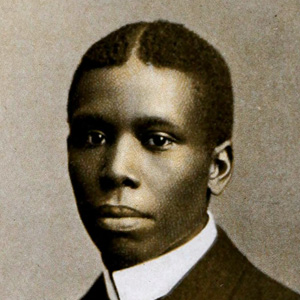
Born: June 27, 1872 at 311 Howard Street in Dayton, Ohio
Died: February 9, 1906 in Dayton, Ohio
Before the American Civil War (April 12, 1861 – April 26, 1865), his parents were enslaved in Kentucky. His mother Matila moved to Dayton with other family members after her emancipation and his father Joshua escaped from Kentucky before the war ended.
In Massachusetts he volunteered for the 55th Massachusetts Infantry Regiment, one of the first two black units to serve in the war. Later, he’d also serve in the 5th Massachusetts Cavalry Regiment. His mother left his father soon after receiving her second child and the father died on August 16, 1885 at the age of 12.
At the age of 6 years he wrote his first poem and at the age of 9 years he gave his first public recital. During his years at Central High School in Dayton, Dunbar was the only African-American student. Fortunately, he was well-accepted and was elected as president of the school’s literary society, became editor of the schools newspaper and member of the debate club.
1888: Published Our Martyred Soldiers and On The River in The Harald newspaper.
1890: Writer and Editor of The Tattler, Dayton’s first weekly African-American newspaper.
1891: Completed formal schooling, then took job as an elevator operator for 4$/hour.
Couldn’t study law due to his mother’s limited finances and racial discrimination at work.
1893: United Brethren Publishing House printed Dunbar’s first collection of poetry called Oak and Ivy.
1896: Published his second collection of poetry called Majors and Minors, Attorney Charles A. Thatcher and psychiatrist Henry A. Tobey supported him throughout.
One June 27 of that year, the positive review of William Dean Howells in Harper’s Weekly gained him national attention: „Though Howell praised the „honest thinking and true feeling“ in Dunbar’s traditional poems, he particularly praised the dialect poems. The new literary fame enabled Dunbar to publish his first two books as s collected volume, titled Lyrics of Lowly Life, which included an introduction by Howells.“ (Textarchiv)
1897: Traveled to England for a literary tour where he met oung black composer Samuel Coleridge-Taylor. In October of that year he took a job in the Library of Congress in Washington, DC.
1898: Publication of Folks From Dixie, first collection of short stories. It wasn’t his first novel, but The Uncalled from the same year was not a commercial success.
On March 6, he married Alice Ruth Moore who was a teacher and poet from New Orleans.
He met her three years earlier.
1900: Doctors diagnosed him with tuberculosis (TB), at the time it was often fatal.
His doctors recommended him to drink whiskey to alleviate his symptoms.
On advice of his doctors, he also moved to Colorado with his wife, because the cold and dry mountain air was considered favourable for TB patients.
1902: Dunbar and his wife separated, but never divorced. His dependence on alcohol increased due to his depression and declining health.
1904: Returned to in Dayton to be with his mother. Two years later, at the age of 33, he died of tuberculosis.
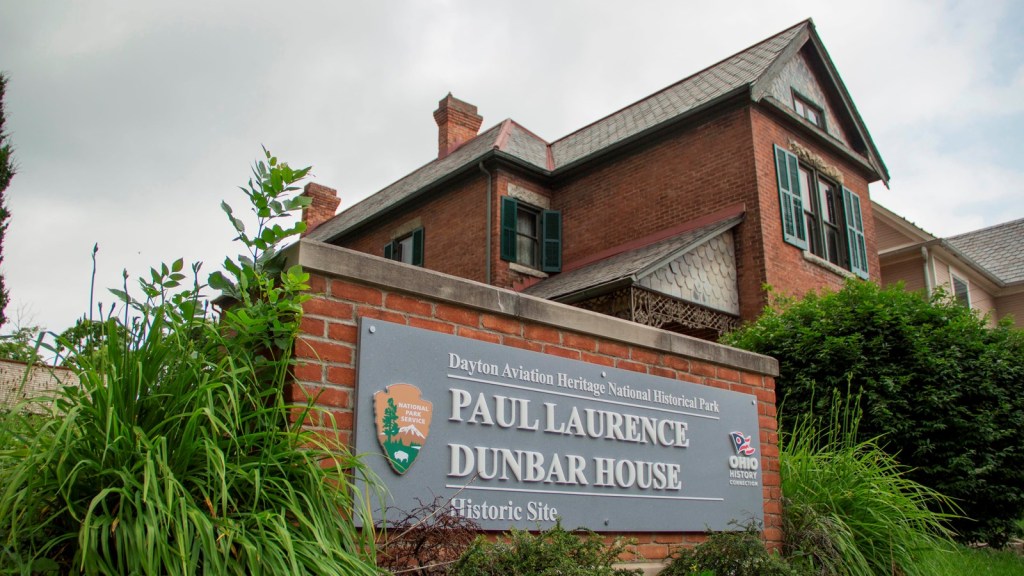
(Source: National Park Service)
PDF-File:
Sources:
Paul Laurence Dunbar
https://www.textarchiv.com/paul-laurence-dunbar
American Civil War
https://www.britannica.com/event/American-Civil-War
Tuberculosis Fact Sheet
https://www.who.int/news-room/fact-sheets/detail/tuberculosis#:~:text=Overview,been%20infected%20with%20TB%20bacteria.
Paul Laurence Dunbar House Historic Site
https://www.nps.gov/places/dunbar-house.htm
Little Door Nr. 2
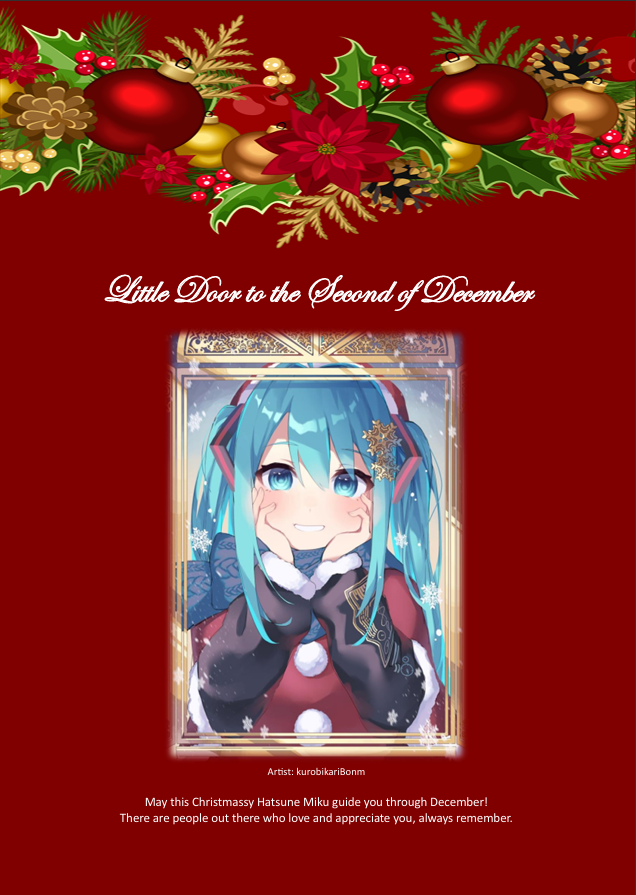
The second ‚Little Door‘ features an artwork of Hatsune Miku in Christmas-themed clothing and a motivational text which says: „May this Christmassy Hatsune Miku guide you through December! There are people out there who love and appreciate you, always remember.“
The artist is called kurobikariBonm whose adorable artworks you can also find on zerochan (-> https://www.zerochan.net/kurobikariBonm?p=1). Naturally, I didn’t want to include the download to a PDF-file that largely consists of their artwork. Moreover, since this is also a blog that talks about politics they very likely wouldn’t appreciate it – so, only the screenshot for completion sake (unless the artist wants it to be blurred out) of this Advent calendar will be featured here. I do have some Hatsune Miku songs to recommend, though.
Recommended Songs
Aether_Eru – 初音ミク – End and Start
https://www.youtube.com/watch?v=Fd6AYEz1WCc
PinocchioP – Ghosts Play to the Audience feat. Hatsune Miku
https://www.youtube.com/watch?v=M92c6pl10u0
KIRA – Digital Girl ft. Hatsune Miku (Original Song)
https://www.youtube.com/watch?v=_fC4gB841VI
Deco*27 – Salamander feat. Hatsune Miku
https://www.youtube.com/watch?v=-H2PCK7DJsQ
To i Hola – Arranged by daniwell feat. Hatsune Miku
https://www.youtube.com/watch?v=IoSzz-zr2eA
運命生命共鳴体 // テンタクル忍者 feat.初音ミク
(it got a really cool music video)
https://www.youtube.com/watch?v=O-gr-22V0r0
Deco*27 – HAO feat. Hatsune Miku
(a favourite of mine)
https://www.youtube.com/watch?v=3GzRDW3hZ1k
[MV] TAK ‘mochimochi‘ feat. 初音ミク
(an adorable music video about the Japanese sweet mochi)
https://www.youtube.com/watch?v=tQM8pfwmcU0
アンテナ39 / 柊マグネタイト feat. 初音ミク【マジカルミライ 2024】
(Magical Mirai Miku 2024, a very cute design)
https://www.youtube.com/watch?v=7yJRsFFRoQY
40meterP – DO RE MI FA Rondo
https://www.youtube.com/watch?v=bphS6_wayug

To the left you see Magical Mirai Miku 2024. A song showing once more that public transportation is the best thing to exist and that I envy the Japanese and Swiss for their punctual trains.
Public transportation is a public good worth every penny, also environmentally friendly.
Little Door Nr. 3
Mid-Winter by Madison Cawein
All day the clouds hung ashen with the cold;
And through the snow the muffled waters fell;
The day seemed drowned in grief too deep to tell,
Like some old hermit whose last bead is told.
At eve the wind woke, and the snow clouds rolled
Aside to leave the fierce sky visible;
Harsh as an iron landscape of wan hell
The dark hills hung framed in with gloomy gold.
And then, towards night, the wind seemed some one at
My window wailing: now a little child
Crying outside my door; and now the long
Howl of some starved beast down the flue. I sat
And knew ‚twas Winter with his madman song
Of miseries on which he stared and smiled.
Short Biography
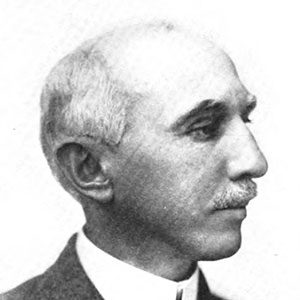
Born: March 23, 1865 in Louisville, Kentucky
Died: December 8, 1914
Madison was the fifth child of William and Christiana (Stelsly) Cawein.
He developed a love for nature due to the profession of his father who made patent medicines from herbs.
He worked as a cashier in Waddill’s New-market in Louiseville after graduating from Highschool. He worked in a pool hall for 6 years and saved his pay in order to return home to start writing. Over the course of his life, he would publish 36 books and 1,500 poems, earning him the nickname „Keats of Kentucky“ due to the similarity to Percy Bysshe Shelley and John Keats. By 1900, his income was $100/month.
In 1907 he purchased a home in Louisville (a 2 1/2 story-brick house).
In 1912, he was forced to sell his home, as well as some of his library, after losing money in the 1912 stock market crash (a minor economic depression mostly affecting the stock market). One year later he published a poem called Waste Land in a Chicago magazine.
„Scholars have identified this poem as an inspiration to T. S. Eliot‚s poem The Waste Land, published in 1922 and considered the birth of modernism in poetry.“ (Textarchiv)
In 1914, the Authors Club of New York City placed him on their relief list.
On December 8 of the same year, he died.
PDF-File:
Sources
Madison Cawein
https://www.textarchiv.com/madison-cawein
Finance Panic of 1910–1911
https://handwiki.org/wiki/Finance:Panic_of_1910%E2%80%931911
Little Door Nr. 4
On the fourth day of December, I’d like to talk about Mesopotamia and cite a surviving translation of their creation myth. In case you do not know yet who the Mesopotamians were: they were one of the earliest civilizations on Earth (3500-1750 B.C.) with cities like Uruk and Ur that emerged during this time (one goddess you may know: Inanna or Ishra).
The following account, however, serves as an introduction to the story of „The Huluppu-Tree“. I’ll link to it below the post again for you to check out.
In the first days when everything needed was brought into being,
In the first days when everything needed was properly nourished,
When bread was baked in the shrines of the land,
And bread was tasted in the homes of the land,
When heaven had moved away from the earth,
And earth had separated from heaven,
And the name of man was fixed;
When the Sky God, An, had carried off the heavens,
And the Air God, Enlil, had carried off the earth . . . (Wolkstein 4)
Ki was a Sumerian goddess and personification of the earth, she was the daughter of the Primordial waters, Nammu.
She then mated with her brother An and produced Enki, Enlil, and other Sumerian deities.
(source: Oxford Reference)
Comment: I’ve been interested in Mesopotamia for four years now and already read a book about it. An ancient city in particular, Uruk, was the first city in the world and sparks my fascination in particular: „It would be true to say that Uruk was Mesopotamia’s – and the World’s – first city. It seems to have started as two separate settlements, Kullaba and Eanna, which coalesced in the Uruk period to form a town covering 80 hectares; at the height of its development in the Early Dynastic period, the city walls were 9.5 km long, enclosing a massive 450 hectares, and may have housed some 50,000 people.
In the heart of the city are two large temple complexes: the Anu (god of the sky) sanctuary, belonging originally to Kullaba, and the Eanna sanctuary, dedicated to Ishtar, known by scholars as the Mosaic Temple of Uruk, which rises to a height of 16 m on a square base measuring 60×60 m. Both complexes have revealed several successive temple-structures of the Uruk period, including the White Temple in the Anu sanctuary and the Limestone and Pillar Temples in the Eanna sanctuary. A characteristic form of decoration involves the use of clay cones with painted tops pressed into the mud plaster facing the buildings – a technique known as clay cone mosaic.“ (History of Uruk, Western Sydney University)
Consequently, it is not just the history of Iraq but mankind too.
Keeping the memory alive is therefore quite important to me and perhaps I can visit these historic sites one day. The book I read about was published by the Reclam Verlag, it is in German so it may not be of much use for most people reading this.
PDF-File
Sources
Sumerian Myth
https://faculty.gvsu.edu/websterm/SumerianMyth.htm
Ki
https://www.oxfordreference.com/display/10.1093/oi/authority.20110803100036831
History of Uruk
https://staff.cdms.westernsydney.edu.au/~anton/Research/Uruk_Project/History.html
Little Door Nr. 5
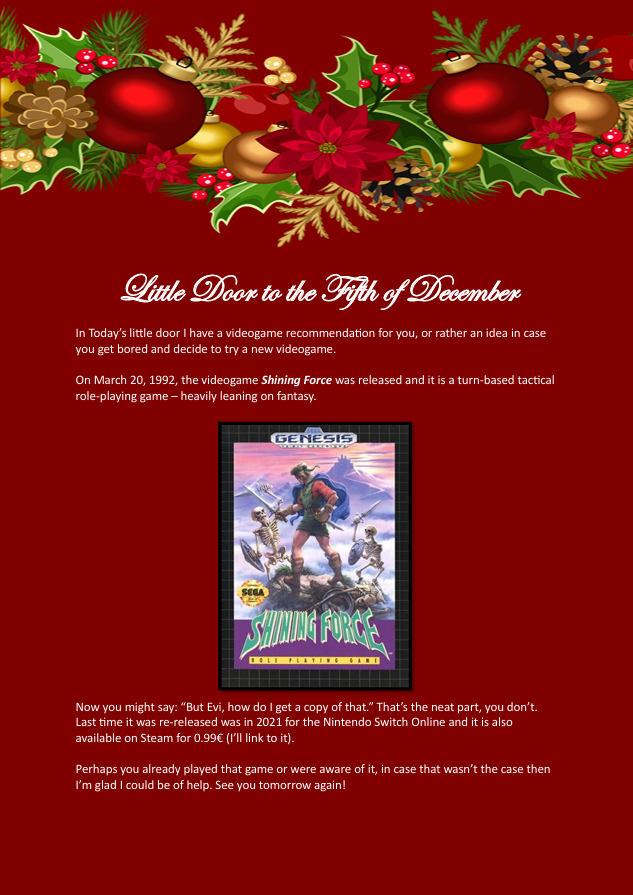
In Today’s little door I have a videogame recommendation for you, or rather an idea in case you get bored and decide to try a new videogame.
On March 20, 1992, the videogame Shining Force was released and it is a turn-based tactical role-playing game – heavily leaning on fantasy.
Now you might say: “But Evi, how do I get a copy of that.” That’s the neat part, you don’t.
Last time it was re-released was in 2021 for the Nintendo Switch Online and it is also available on Steam for 0.99€ (I’ll link to it).
Perhaps you already played that game or were aware of it, in case that wasn’t the case then I’m glad I could be of help. See you tomorrow again!
Note: Unfortunately, the game is no longer available on Steam. A good friend of mine informed me on Discord (also a member of my server) that Sega ceased support for it on December 6. So, you’ll have to resort to an emulator, a physical modern copy or older ones if you can still find them. Btw: Evi is my nickname on the server.
The reason I wrote about this was the following post by Retro Computers on BlueSky:
https://bsky.app/profile/retrocomps.bsky.social/post/3lclayqgcfm24

PDF-File
Source
Shining Force
https://en.wikipedia.org/wiki/Shining_Force
Little Door Nr. 6
Today we talk about a Christmas song you most likely have listened to: Driving Home for Christmas. Well, not about the song itself but how it came to be.
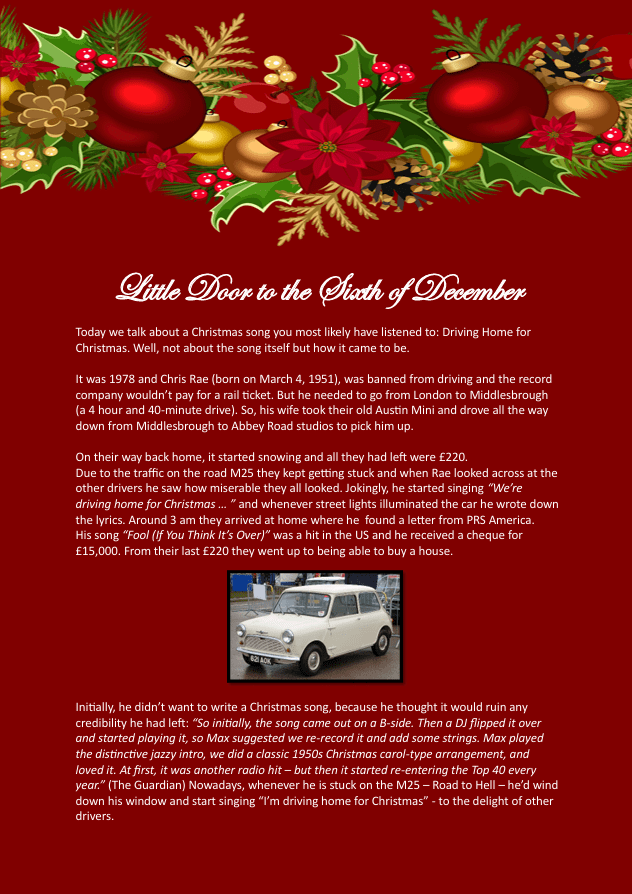
It was 1978 and Chris Rae (born on March 4, 1951), was banned from driving and the record company wouldn’t pay for a rail ticket. But he needed to go from London to Middlesbrough (a 4 hour and 40-minute drive). So, his wife took their old Austin Mini and drove all the way down from Middlesbrough to Abbey Road studios to pick him up.
On their way back home, it started snowing and all they had left were £220.
Due to the traffic on the road M25 they kept getting stuck and when Rae looked across at the other drivers he saw how miserable they all looked. Jokingly, he started singing “We’re driving home for Christmas … ” and whenever street lights illuminated the car he wrote down the lyrics. Around 3 am they arrived at home where he found a letter from PRS America. His song “Fool (If You Think It’s Over)” was a hit in the US and he received a cheque for £15,000. From their last £220 they went up to being able to buy a house.

Initially, he didn’t want to write a Christmas song, because he thought it would ruin any credibility he had left: “So initially, the song came out on a B-side. Then a DJ flipped it over and started playing it, so Max suggested we re-record it and add some strings. Max played the distinctive jazzy intro, we did a classic 1950s Christmas carol-type arrangement, and loved it. At first, it was another radio hit – but then it started re-entering the Top 40 every year.” (The Guardian) Nowadays, whenever he is stuck on the M25 – Road to Hell – he’d wind down his window and start singing “I’m driving home for Christmas” – to the delight of other drivers.
Comment: In SWR3 (a German radio station), they sometimes explain the history of songs and while I don’t remember if it was this song in particular or even that radio broadcaster, it did give me the idea to write about it. SWR2 Kultur, Bayern 1 and SWR4 are possible candidates too.
PDF-File
Sources
Chris Rea: how we made Driving Home for Christmas
https://www.theguardian.com/culture/2016/dec/19/chris-rea-how-we-made-driving-home-for-christmas
Mini (car)
https://en.wikipedia.org/wiki/Mini
Chris Rae
https://en.wikipedia.org/wiki/Chris_Rea
Fool (If You Think It’s Over)
https://www.youtube.com/watch?v=wjruFXixTFE
Little Door Nr. 7
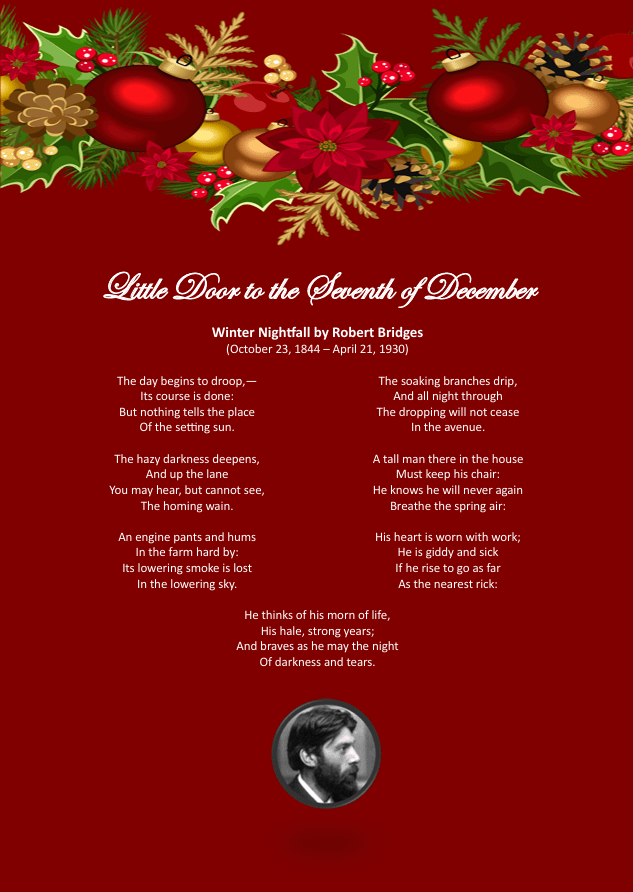
Winter Nightfall by Robert Bridges
The day begins to droop,—
Its course is done:
But nothing tells the place
Of the setting sun.
The hazy darkness deepens,
And up the lane
You may hear, but cannot see,
The homing wain.
An engine pants and hums
In the farm hard by:
Its lowering smoke is lost
In the lowering sky.
The soaking branches drip,
And all night through
The dropping will not cease
In the avenue.
A tall man there in the house
Must keep his chair:
He knows he will never again
Breathe the spring air:
His heart is worn with work;
He is giddy and sick
If he rise to go as far
As the nearest rick:
He thinks of his morn of life,
His hale, strong years;
And braves as he may the night
Of darkness and tears.
Short Biography
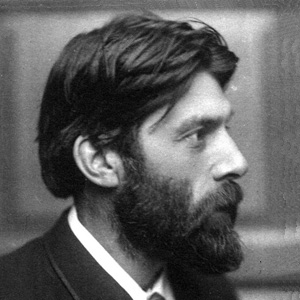
Born: October 23, 1844 in Walmer, Kent, in England
Died: April 21, 1930
Robert was the eigth of nine children of John Thomas Bridges and Harriet Elizabeth Bridges née Affleck. He was educated at Eton College and Corpus Christi College, Oxford. Then went on to study medicine in London at St Bartholomew’s Hospital with the goal of practising it until the age of 40 so he can focus on poetry in retirement.
- 1869: Enrolled at St Bartholomew’s Hospital Medical School at a time when a more rigorous curriculum was being introduced reflecting the recent medical advances.
- 1873: Final examination in Oxford, but failed the written tests. Spent the next year traveling in Italy and studied medicine in Dublin.
- 1874: Retook his final exam and passed.
- 1874-1876: Worked as a house physician to Patrick Black (1813 – 1879). Despite his busy medical life, he wrote poetry throughout his training and resigned as a house physician in June 1876. For Black he wrote a farewell poem in Latin called Carmen elegiacum.
- 1877-1878: Worked in the casualty ward of St Bartholomew.
In 1878, he wrote an article for the St Bartholomew’s Hospital Reports where he described the conditions on the ward and the ‚almost impossible task of seeing all patients‘. He wrote that of the more than 151,000 patients ‚relieved‘ at the hospital between 1877 and 1878, he had only seen 30,940 (or 140 a day). Moreover, he described the vivid soundscape of a Victorian ward: ‘…the rattle of carts in the street, the hum of voices inside, the slamming of doors, the noise of people walking about, the coughings of all kinds, the crying of babies, the scraping of impatient feet, the stamping of cold ones, the chinking of the bottles and zinc tickets, and, after eleven o’clock, the hammering, sawing, and tinkering of the carpenters and blacksmiths who came not unfrequently at that hour to set things generally to rights.‘ - 1879: Became full physician at the Great Northern Hospital.
- 1881: His successful medical career came earlier to an end, because he caught a severe case of pneumonia and took a leave of absence from his post.
- 1884: Married Monica Waterhouse, first settling down at Yattendon on the Berkshire Downs, and then at Boar’s Hill, near Oxford.
- June 1885: Retired formally after the trip to Italy where he had hoped to recover from his illness. Now wrote full-time. Over the next five decades he wrote several poetry collections, verse drama and criticism.
- December 1894: He very much valued his experience as a doctor and maintained the friendship with the physician Samuel Gee (1839 – 1911) through letters. Encouraging Gee im December to keeping him up-to-date about his medical work.
- 1913: Appointment of Bridges to post of the poet laureate after Rudyard Kipling refused the honour. Bridges would hold this title until his death.
- April 21, 1930: Day of death of Robert Bridges.
Sources
Robert Bridges
https://www.textarchiv.com/robert-bridges
Robert Bridges, the Poet Laureate physician
https://history.rcp.ac.uk/blog/robert-bridges-poet-laureate-physician
Little Door Nr. 8
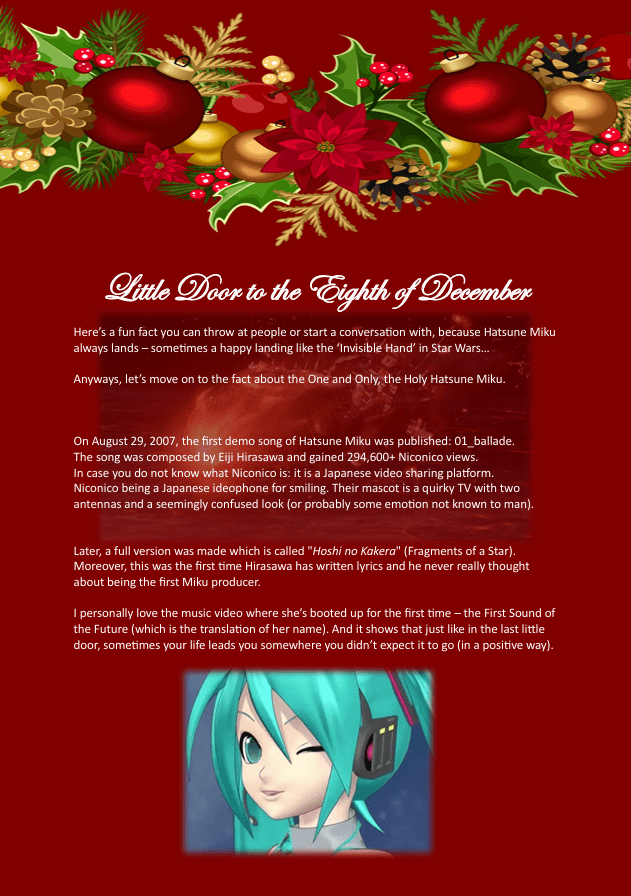
Here’s a fun fact you can throw at people or start a conversation with, because Hatsune Miku always lands – sometimes a happy landing like the ‘Invisible Hand’ in Star Wars…
Anyways, let’s move on to the fact about the One and Only, the Holy Hatsune Miku.
On August 29, 2007, the first demo song of Hatsune Miku was published: 01_ballade.
The song was composed by Eiji Hirasawa and gained 294,600+ Niconico views.
In case you do not know what Niconico is: it is a Japanese video sharing platform.
Niconico being a Japanese ideophone for smiling. Their mascot is a quirky TV with two antennas and a seemingly confused look (or probably some emotion not known to man).
Later, a full version was made which is called „Hoshi no Kakera“ (Fragments of a Star).
Moreover, this was the first time Hirasawa has written lyrics and he never really thought about being the first Miku producer.
I personally love the music video where she’s booted up for the first time – the First Sound of the Future (which is the translation of her name). And it shows that just like in the last little door, sometimes your life leads you somewhere you didn’t expect it to go (in a positive way).

Note: By ‚last little door‘ I was actually referring to Little Door Nr. 6. Since the original posts didn’t have any biographies it probably made more sense which post I meant.
This little fact may be interesting for all those who are into Vocaloid music (the voice of characters like Hatsune Miku was taken through samples of a real person, then altered to make something new; moreover those who use Hatsune Miku, Megurine Luka or others still have to tune them and add instruments – nothing writes itself, you make them sing).
Sources
01_ballade
https://vocaloid.fandom.com/wiki/01_ballade
Music video of the first song
https://www.youtube.com/watch?v=bkY_3vXuGBA
Little Door Nr. 9
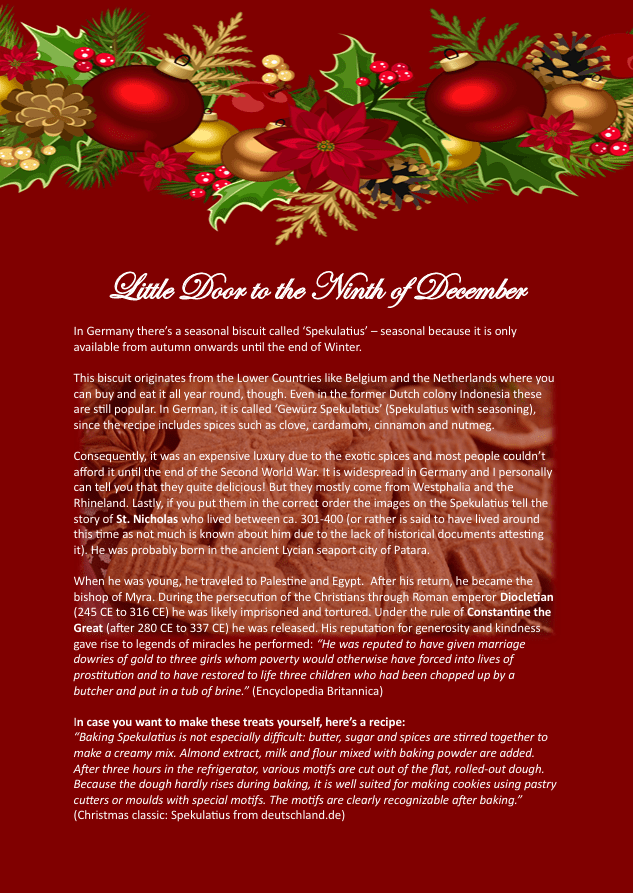
In Germany there’s a seasonal biscuit called ‘Spekulatius’ – seasonal because it is only available from autumn onwards until the end of Winter.
Consequently, it was an expensive luxury due to the exotic spices and most people couldn’t afford it until the end of the Second World War. It is widespread in Germany and I personally can tell you that they quite delicious! But they mostly come from Westphalia and the Rhineland. Lastly, if you put them in the correct order the images on the Spekulatius tell the story of St. Nicholas who lived between ca. 301-400 (or rather is said to have lived around this time as not much is known about him due to the lack of historical documents attesting it). He was probably born in the ancient Lycian seaport city of Patara.
When he was young, he traveled to Palestine and Egypt. After his return, he became the bishop of Myra. During the persecution of the Christians through Roman emperor Diocletian (245 CE to 316 CE) he was likely imprisoned and tortured. Under the rule of Constantine the Great (after 280 CE to 337 CE) he was released. His reputation for generosity and kindness gave rise to legends of miracles he performed: “He was reputed to have given marriage dowries of gold to three girls whom poverty would otherwise have forced into lives of prostitution and to have restored to life three children who had been chopped up by a butcher and put in a tub of brine.” (Encyclopedia Britannica)
In case you want to make these treats yourself, here’s a recipe:
“Baking Spekulatius is not especially difficult: butter, sugar and spices are stirred together to make a creamy mix. Almond extract, milk and flour mixed with baking powder are added. After three hours in the refrigerator, various motifs are cut out of the flat, rolled-out dough. Because the dough hardly rises during baking, it is well suited for making cookies using pastry cutters or moulds with special motifs. The motifs are clearly recognizable after baking.”
(Christmas classic: Spekulatius from deutschland.de)

Comment: I wrote about it, because I ate a lot of Spekulatius the days before.
PDF-File
Sources
St. Nicholas
https://www.britannica.com/biography/Saint-Nicholas
Christmas classic: Spekulatius
https://www.deutschland.de/en/topic/life/lifestyle-cuisine/christmas-classic-spekulatius
Little Door Nr. 10
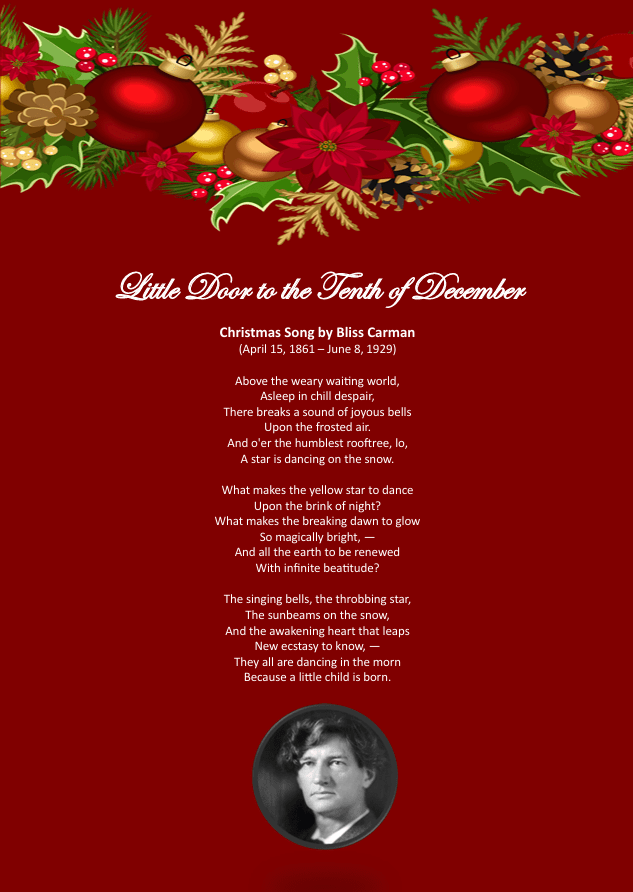
Christmas Song by Bliss Carman
Above the weary waiting world,
Asleep in chill despair,
There breaks a sound of joyous bells
Upon the frosted air.
And o’er the humblest rooftree, lo,
A star is dancing on the snow.
What makes the yellow star to dance
Upon the brink of night?
What makes the breaking dawn to glow
So magically bright, —
And all the earth to be renewed
With infinite beatitude?
The singing bells, the throbbing star,
The sunbeams on the snow,
And the awakening heart that leaps
New ecstasy to know, —
They all are dancing in the morn
Because a little child is born.
Short Biography
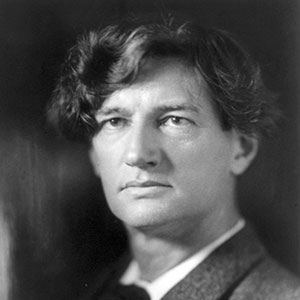
Born: April 15, 1861 in Fredericton, Maritime province of New Brunswick (Canada)
Died: June 8, 1929 in New Canaan, Connecticut (USA)
„Bliss“ was his mother’s maiden name and he was the great grandson of United Empire Loyalists who fled Nova Scotia after the American Revolution (1775 – September 3, 1783), settling in New Brunswick (then part of Nova Scotia). He was educated in at the Fredericton Collegiate School and the University of New Brunswick (UNB) and received a
B.A. in 1881. He was introduced into poetry through George Robert Parkin who also gave him a love of classical literature.
- 1879: First published poem in the UNB Monthly.
- 1882-1883: Attended Oxford and the University of Edinburgh.
- 1884: Returned home and received his M.A. from UNB.
- January 1885: Father died.
- February 1886: Mother died.
- 1886-1887: Enrolled in Harvard University. At Harvard he moved in literacy circles and became close friends with American poet Richard Hovey. Both were members of the „Visionists“ circle along with Herbert Copeland and F. Holland Day who would later found the Boston publishing firm Copeland & Day that launched Vagabondia.
- February 1890: Returned to Boston after briefly visiting Canada. He was unable to find a job, however, and moved to New York City where he became literary editor of the New York Independent. He earned 20$/week. Dismissed 2 years later, as he wasn’t a good fit in the ’semi-religious weekly‘.
- 1893: His first book of poetry, Low Tide on Grand Pré, wasn’t a success. No Canadian company published it and the American company went bankrupt.
- 1894: The Hovey-Carman collaboration called Songs of Vagabondia was published by Copeland & Day and was an immediate success. Both authors quickly found a cult following, especially among college students who responded well to the ‚poetry’s anti-materialistic themes, its celebration of individual freedom, and its glorification of comradeship‘.
- 1895-1900: Carmen publishes two books with Lamson, Wolffe and worked for the Boston Evening Transcript which was published weekly (for the five years of its existence).
- 1896: Met Mary Perry King, she became his ‚greatest and longest-lasting female influence in his life‘. She became his patron: „She put pence in his purse, and food in his mouth, when he struck bottom and, what is more, she often put a song on his lips when he despaired, and helped him sell it.“ (Textarchive)
- 1899: Lamson, Wolffe was taken over by the Boston firm of Small, Maynard & Co.
Carman had a financial stake in the company and when it failed in 1903, he lost all his assets. He was down after that, but kept working – this time with another Boston company called L.C. Page. - 1902-1905: 7 books of new poetry published and 3 books based on Carman’s Transcript columns, as well as one prose work on unitrinianism.
- 1908-1920: Carmen’s literary taste began to shift and his fortunes and health declined.
During the First World War, he was part of a group called the Vigilantes who supported an American entry into the war on the Allied side. - 1920: Impoverished and recovering from a near-fatal attack of tuberculosis. He revisited Canada and went on reading tours.
- 28 October, 1921: Crowned Canada’s Poet Laureate with a wreath of maple leaves by the newly-formed Canadian Authors‘ Association at the Ritz Carlton Hotel in Montreal.
- 1925: He finally found a Canadian publisher, but Page wouldn’t relinquish its copyrights. Only after Carmen’s death an edition of collected poetry was published due to the persistency of his literary executor, Lorne Pierce.
- 1927: Carmen edited the The Oxford Book of American Verse.
Two years later he died of a brain hemorrhage at the age of 68 in New Canaan. - May 13, 1954: A carlet maple tree was planted at his gravesite, as he requested in his 1892 poem „The Grave-Tree“:
Let me have a scarlet maple
For the grave-tree at my head,
With the quiet sun behind it,
In the years when I am dead.
Source
Bliss Carman
https://www.textarchiv.com/bliss-carman
American Revolution
https://www.britannica.com/event/American-Revolution
Little Door Nr. 11
Today we will learn about sharks (which are amazing animals). So, let’s start with this ancient species which has been around for around 450 million years – long before the first trees and the dinosaurs.
The earliest evidence for sharks is scales from the Late Ordovician period – 450 million years ago. It is still debated whether these belong to true sharks or shark-like animals.
420 million years ago chimaeras (cartilaginous fishes) split from the rest of the group.
410 million years ago, in the Early Devonian, the first shark-like teeth appear in the fossil record belonging to an ancient fish called Doliodus problematicus).
380 million years ago, Cladoselache evolved and while we might recognize them as sharks today, they may have been part of the Chimera branch (see image below).

Before this gets too long, let’s talk about the Golden Age of the sharks which began 359 million years ago and ended 252 million years ago with a mass extinction that wiped out 96% of all marine life. The domination sharks enjoyed in the Carboniferous Period was thanks to a mass extinction in the Devonian that killed off 75% of all species on Earth.
Bizarre sharks appeared during this period, such as Helicoprion with a spiral buzz saw-like bottom jaw. Overall, sharks endured 5 mass extinctions due to their great diversity and thus varying diets. The youngest species is the Hammerhead shark which first appeared 23 million years ago during the Neogene (for more information online see: Natural History Museum).
Unfortunately, these great animals are threatened by misinformation, so to clear it up:
Sharks are not immune to cancer and their cartilage is ineffective against human cancer.
Comment: Here, you may already have guessed why I wanted to write about it: because sharks are amazing animals which have been around for millions of years. It was also a great opportunity to remind everyone that they threatened by misinformation – literally.
Source
Shark evolution: a 450 million year timeline
https://www.nhm.ac.uk/discover/shark-evolution-a-450-million-year-timeline.html
Blowing Shark Cartilage out of the Water
https://www.science.org/content/article/blowing-shark-cartilage-out-water
Little Door Nr. 12
Greetings, fellow Eukaryotes. As you may be aware, our planet is 4.6 billion years old. Meaning geologists work on immensely long time scales. So, here’s a quick summary provided by Georgia Tech Biological Sciences (BYA = billion years ago | MYA = million y. a.)
- Hadean (4.6-4.0 BYA): occurred before life arose (or at least, before there is compelling evidence of life)
- Archaean (4.0-2.5 BYA): featured the evolution of early life, including bacteria, archaea, and the first cyanobacteria capable of oxygenic photosynthesis
- Proterozoic (2.5 BYA-542 MYA): featured oxygen accumulation (the Oxygen Revolution), and the first single-celled and multicellular eukaryotes, and the flourishing of early microbial and multicellular life
- Phanerozoic (542 MYA to present): beginning with the Cambrian explosion, features the proliferation of animal and plant life
We currently live in the Phanerozoic eon, included in this eon are the following periods:
Cambrian (542 MYA), Ordovician (488 MYA), Silurian (434 MYA), Devonian (416 MYA), Carboniferous (359 MYA), Permian (299 MYA) which in turn are part of the Paleozoic era (= Paleozoic translates to “old life”); the Triassic (251 MYA), Jurassic (200 MYA) and the Cretaceous (145.5 MYA) may be more familiar to you as the dinosaurs dominated during the last two periods – all three of them are part of the Mesozoic era; lastly, the Tertiary (65.5 MYA) and the Quaternary (2.6 MYA) are part of the Cenozoic era – the era we live in.
So, how’s this relevant to my introduction as my fellow Eukaryotes?
Well, not really relevant but I thought it would be cool to show you the geological time scale.
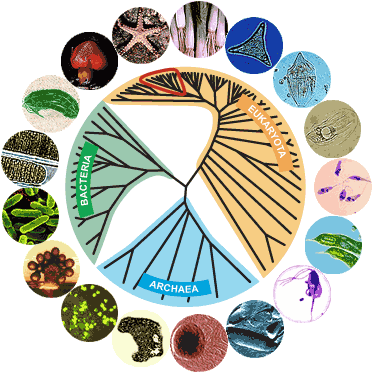
Bacteria and Archaea belong to the Prokaryotes, single-celled microorganisms with no nuclei; to the Eukaryotes belong we humans and all other animals, plants, fungi, and single-celled protists, our cells have nuclei to enclose DNA from the rest of the cell.
And yes, these are the three domains of life on Earth: Bacteria, Archaea and Eukarya.
We do share a single common ancestor, but the first living organisms to appear on our surface were Prokaryotes, one billion years later it was eukaryotes finally appeared.
Comment: My knowledge on pre-historic Earth (by that I mean not just history of humans before written records, but everything else further in the past) is superficial. It is an interest of mine and not a specialization, still I hope to spark a interest in this topic and the thirst to learn a little more about this very old planet where life went through countless phases and faced numerous challenges. Learning can be quite a lot of fun, and even if you don’t remember the details (or only a few details like me), then you can still collect books, bookmark websites or go to the local library to refresh whenever you need the knowledge.
Source
Prokaryotes: Bacteria, Archaea, and Early Life on Earth
https://organismalbio.biosci.gatech.edu/biodiversity/prokaryotes-bacteria-archaea-2/
Little Door Nr. 13
One December by Clinton Scollard
Now that the year unto its close is rounding,
And sleet slants down the breeze,
My mind across the perished past is bounding
As leaps a ship across the racing seas.
It is once more that magical December,
Void of the north wind’s stings,
And lighted by Romance’s quenchless ember,
When first I drank the Orient’s golden springs.
Again I leave the land of Pharoah’s daughter,—
The long, low umber dunes,—
Embarking on a waveless waste of water
Beneath the most inviolate of moons.
I see it, like a lovely lotus, lying
Upon night’s placid pool,
And hark the flapping of flamingoes flying —
Faint scraps of sunset—through the ether cool.
Scarce seems the black bulk of the vessel shifting
So soft we glide along.
While dreamily adown the deck comes drifting
The liquid ripple of Levantine song.
Thus am I borne unto a goal elysian
Across sleep’s shadowy bar,
To find, at waking, burning on my vision,
From out the east, an iridescent star.
The shepherd’s star— not broader and not brighter
The sages saw it shine!—
Now grows the hill-notched sky-line swiftly lighter;
‚Tis Christmas morning over Palestine!
Short Biography
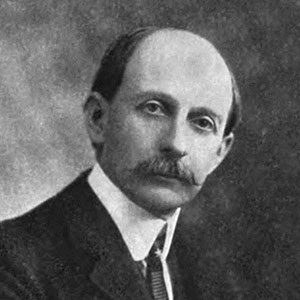
Born: September 28, 1860 at Clinton, New York
Died: November 19, 1932
Clinton was the son of James Isaac and Mary Elizabeth (Stevens) Scollard.
(Since his biography is rather short, we’ll jump immediately to the timeline)
- 1881: Graduation from Hamilton College
He is credited with introducing the curveball to college baseball at Hamilton and was member of the Chi Psi fraternity. Later on, he went to Harvard University. Among his friends were the poets Bliss Carman and Frank Dempster Sherman. - He spent a period of time in Cambridge, Massachusetts and then spent a year at University of Cambridge in England.
- 1888: Clinton became an Associate Professor of English at Hamilton
- 1890: Married Georgia Brown of Jackson from Michigan, together they had one daughter called Elizabeth Scollard Parlon.
- 1896: Left Hamilton College.
- 1906: Granted honorary L.H.D. by Hamilton.
- 1911: Worked in the English Department of Hamilton for a year again.
Then devoted the rest of his life to creative writing. - 1924: Clinton and Georgia divorced early into 1924.
On March 20, he married fellow poet Jessie Belle Rittenhouse with whom he had no children. 8 years later, Clinton Scollard died.
Source
Clinton Scollard
https://www.textarchiv.com/clinton-scollard
Little Door Nr. 14
Sometimes, as odd it may sound, I like to google a random place whose name I’ve heard once. It is unlikely that I’ll ever visit the place, but it is still interesting to learn about a towns or city’s history and see how they developed in other countries – what similarities we share, what the differences are. So, today happens to be New Berlin in Milwaukee (Wisconsin).
The city is located in eastern Waukesha County with an approximated population of 39,584 (in 2010). It is the 16th biggest state in Wisconsin and bordered by the city of Waukesha to the west, Muskego to the south, Brookfield to the north, and West Allis and Greenfield to the east. Since it’s history as two distinct periods (according to Niles Niemuth), I’ll reflect it in the short timeline I present here.
1830s to 1959
- Late 1830s: Yankees and Irish the first to settle in the township of New Berlin
- City was very likely named after New Berlin in NY, not Berlin in Germany
- 1840s: German immigrants settle in the township, first German family in 1840
- 1882: First rail line connecting New Berlin to Milwaukee
- Until 1960: New Berlin’s economy dominated by farming
- Throughout the 120-year period several ethnic farming communities developed
1959 to Present
- 1959: Incorporated as a city to avoid annexation by neighbouring Brookfield
- Since 1960s: promotion of industrial and business parks to attract business
- Introduction of zoning ordinances shifted the economic base towards industry
- 1965: first industrial park opened
- Late 1970s: Interstate 43 runs through the southern portion of the city, now the main connection to Milwaukee
- 1950s – 1970s – 2010s: Growth from 5,334 to 26,901 to 39,584 inhabitants
- 2011: home to 3 industrial parks and 2 business parks

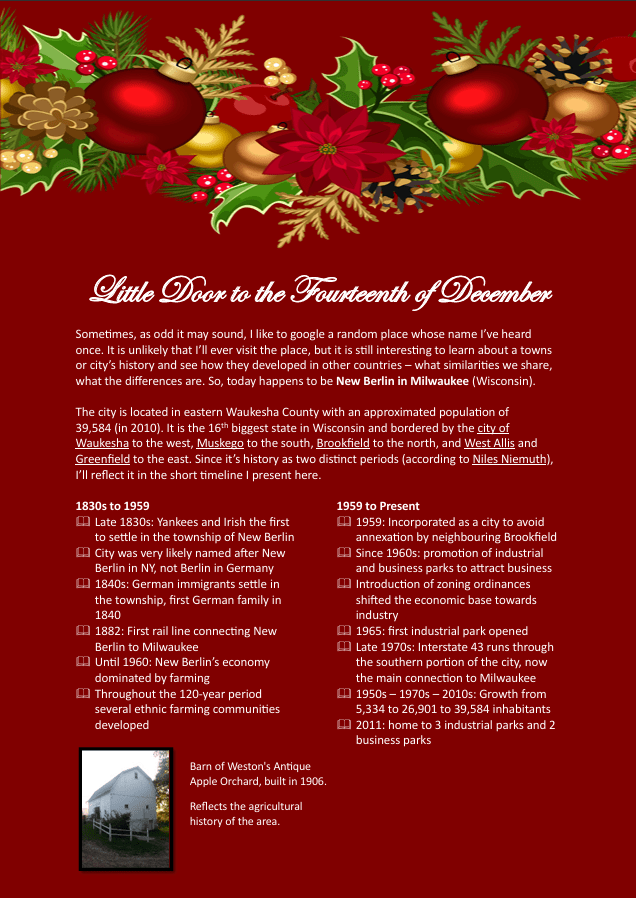
Reflects the agricultural history of the area.
(Image source: Encyclopedia of Milwaukee)
Comment: As I already mentioned in the introductory sentence, sometimes I’m just curious and want to look up cities I have heard about. Whether it is Wuhan in China or a town called New Berlin in a US-state. And well, in some instances if there’s the opportunity I’ll write about it too like I did on December 14.
Source
Encyclopedia of Milwaukee: New Berlin
https://emke.uwm.edu/entry/new-berlin/
Little Door Nr. 15
Gates and Doors by Joyce Kilmer
There was a gentle hostler
(And blessèd be his name!)
He opened up the stable
The night Our Lady came.
Our Lady and Saint Joseph,
He gave them food and bed,
And Jesus Christ has given him
A glory round his head.
So let the gate swing open
However poor the yard,
Lest weary people visit you
And find their passage barred;
Unlatch the door at midnight
And let your lantern’s glow
Shine out to guide the traveler’s feet
To you across the snow.
There was a courteous hostler
(He is in Heaven to-night)
He held Our Lady’s bridle
And helped her to alight;
He spread clean straw before her
Whereon she might lie down,
And Jesus Christ has given him
An everlasting crown.
Unlock the door this evening
And let your gate swing wide,
Let all who ask for shelter
Come speedily inside.
What if your yard be narrow?
What if your house be small?
There is a Guest is coming
Will glorify it all.
There was a joyous hostler
Who knelt on Christmas morn
Beside the radiant manger
Wherein his Lord was born.
His heart was full of laughter,
His soul was full of bliss
When Jesus, on His Mother’s lap,
Gave him His hand to kiss.
Unbar your heart this evening
And keep no stranger out,
Take from your soul’s great portal
The barrier of doubt.
To humble folk and weary
Give hearty welcoming,
Your breast shall be to-morrow
The cradle of a King.
Short Biography
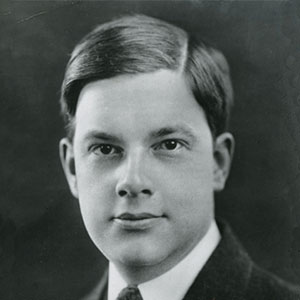
Born: December 6, 1886 in New Brunswick, New Jersey (USA)
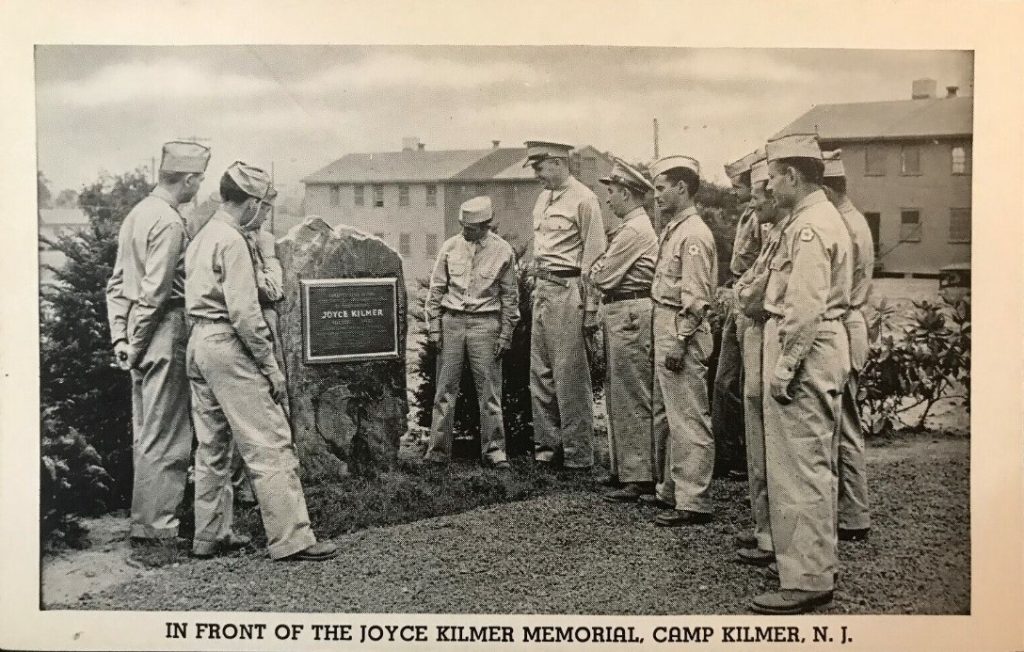
Died: July 30, 1918 by a sniper’s bullet at the Second Battle of the Marne
Joyce was the fourth and youngest child of Annie Ellen Kilburn (1849–1932), a minor writer and composer, and Dr. Frederick Barnett Kilmer (1851–1934), a physician and analytical chemist employed by the Johnson and Johnson.
Kilmer was baptized and his full name was Alfred Joyce Kilmer, named after the two priests Alfred R. Taylor, the curate; and the Rev. Dr. Elisha Brooks Joyce (1857–1926), the rector in Christ Church which is the oldest Episcopal parish in New Brunswick. In the biography of the textarchive, the term ‚parishioner‚ comes up, it means a person who belongs to a parish and goes to a particular local church.
- 1895-1904: Enrollment in Rutgers College Grammar School (now Rutgers Preparatory School). During his time in the Grammar School he was editor-in-chief of the school’s paper, the Argo. He won the Lane Classical Prize, for oratory and obtained a scholarship to Rutgers College which he’d attend the following year. Graduation in 1904.
- 1904-1906: Continued his education at Rutgers College where he associate editor of the Targum, the campus newspaper. He was a member of the Delta Upsilon fraternity.
However, he was asked to repeat his sophomore year after being unable to complete the ‚the curriculum’s rigorous mathematics requirement‘. He eventually transferred to Columbia University in New York City after being put under pressure by his mother. - May 23, 1908: Completed his Bachelor of Arts degree and graduated from the Columbia University. During his time there he was vice-president of the Philolexian Society (a literary society), associate editor of Columbia Spectator (the campus newspaper), and member of the Debating Union.
- June 9, 1908: Kilmer married the fellow poet Aline Murray (1888–1941). He has been engaged to her since his sophomore years in Rutgers. Together, they had five children.
- Autumn 1908 – June 1909: During this time he taught Latin at Morristown High School in Morristown, New Jersey. He submitted essays to Red Cross Notes (among them his first published essay called „Psychology of Advertising“) and poems to literary periodicals. He abandoned any aspirations to teach and instead sought to focus on a writing career. He relocated to New York City.
- 1909-1912: Employed by Funk and Wagnalls where he prepared an edition of The Standard Dictionary that would be published in 1912.
- 1911: Publication of his first book called Summer of Love. He’d later write that „…some of the poems in it, those inspired by genuine love, are not things of which to be ashamed, and you, understanding, would not be offended by the others.“ (Textarchive)
- 1912: He was a special writer for the New York Times Review of Books and the New York Times Sunday Magazine and was also engaged in lecturing. From this time until his death in World War One, he resided in Mahwah, New Jersey.
- 1913: Kilmer’s conversion to Roman Catholicism after their daughter Rose (1912–1917) caught poliomyelitis (also known as infantile paralysis).
In August of this year, he published „Trees“ in the magazine Poetry which made him immensely popular. He wanted to reach a Catholic audience in particular. - 1914: Publication of Trees and Other Poems.
- 1915: Became poetry editor of Current Literature and contributing editor of Warner’s Library of the World’s Best Literature.
- 1916-1917: Kilmer published four more books before the US entered into World War One: The Circus and Other Essays (1916), a series of interviews with literary personages entitled Literature in the Making (1917), Main Street and Other Poems (1917), and Dreams and Images: An Anthology of Catholic Poets (1917).
- 1917-1918 (War Years): A few days after the United States entered World War One, Kilmer enlisted in the 7th Regiment of the New York National Guard.
August: Assigned as a statistician with the U.S. 69th Infantry Regiment (also known as the „Fighting 69th“ and later re-designated the 165th Infantry Regiment) of the 42nd Rainbow division. He quickly rose through to the ranks to sergeant, but refused to the position of an officer as he preferred to be with the Fighting 69th.
Shortly before he was deployed to Europe, his daughter Rose died and 12 days later his son Christopher was born. He also intended to write a book about the war called Here and There with the Fighting Sixty-Ninth, but it would never come to be.
November: The Fighting 69th arrive in France. While he had no time to write for the planned book, he did find time to write prose sketches and poetry towards the end of the year. In 1918, his most notable poem called Rouge Bouquet was published which commemorated the deaths of 21 men of the unit who were killed by German heavy artillery bombardment on the afternoon of March 7.
July: In the last days of July there was heavy fighting taking place during the Second Battle of Marne (May 1, 1918 – August 31, 1918). Kilmer volunteered to accompany Major „Wild Bill“ Donovan when his battalion was sent to lead the day’s attack on the 30th of July. While leading a scouting party find the position of a German machine gun, he was killed by sniper’s bullet – likely killing him immediately.
Source
Joyce Kilmer
https://www.textarchiv.com/joyce-kilmer
The Story of Alfred Joyce Kilmer and Some Trees
https://postcardhistory.net/2023/09/the-story-of-alfred-joyce-kilmer-and-some-trees/
Second Battle of Marne
https://www.awm.gov.au/collection/E84362
Definition & Meaning: parishioner
https://www.britannica.com/dictionary/parishioner
Little Door Nr. 16
Nowadays, we take it for granted: the world wide web.
I could now continue with the introduction, but I won’t because it is about the birth of the internet and not the snowball that turned into an avalanche which regularly buries villages.
So, who invented the World Wide Web?
A British scientist named Tim Berners-Lee in 1989. He’s still alive.
He invented it while working at CERN and it was originally conceived and developed “to meet the demand for automated information-sharing between scientists in universities and institutes around the world” (CERN). What you see below is a recreation of the first website.
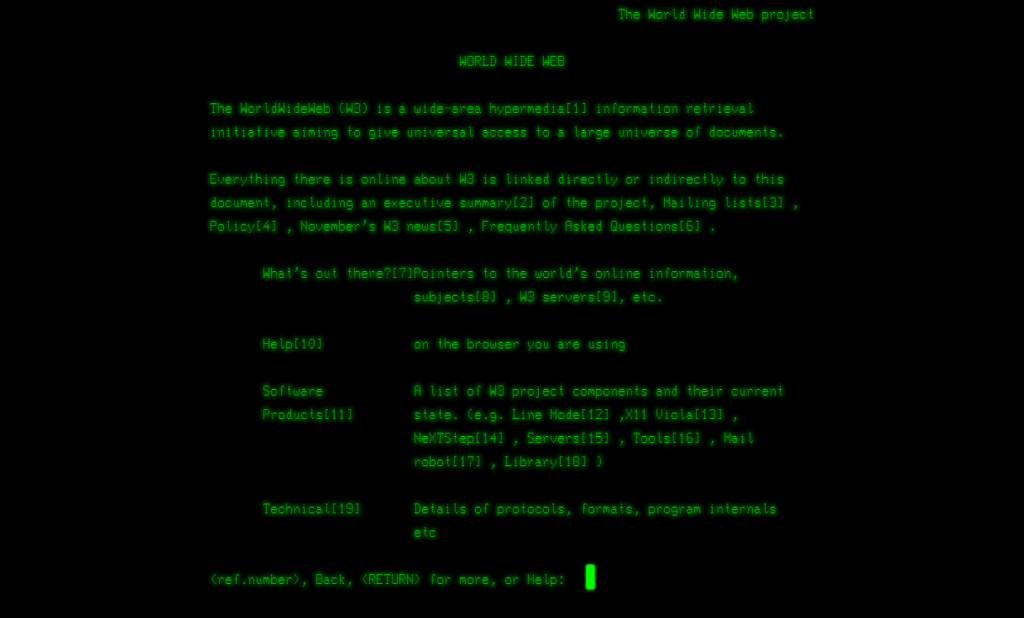
The first website you see above was hosted on Lee’s NeXT computer and on April 30, 1993, CERN put the World Wide Web software in the public domain. Later, in order to maximize its dissemination, they made a release available with an open license. And that’s it, bye!
Comment: I wouldn’t have been able to continue the introduction, because the image took up a lot of space. However, I wanted to write about it, because it is still pretty interesting that is has been rather a short time since it was invented and where it is nowadays.
Source
The birth of the Web
https://home.cern/science/computing/birth-web
Little Door Nr. 17
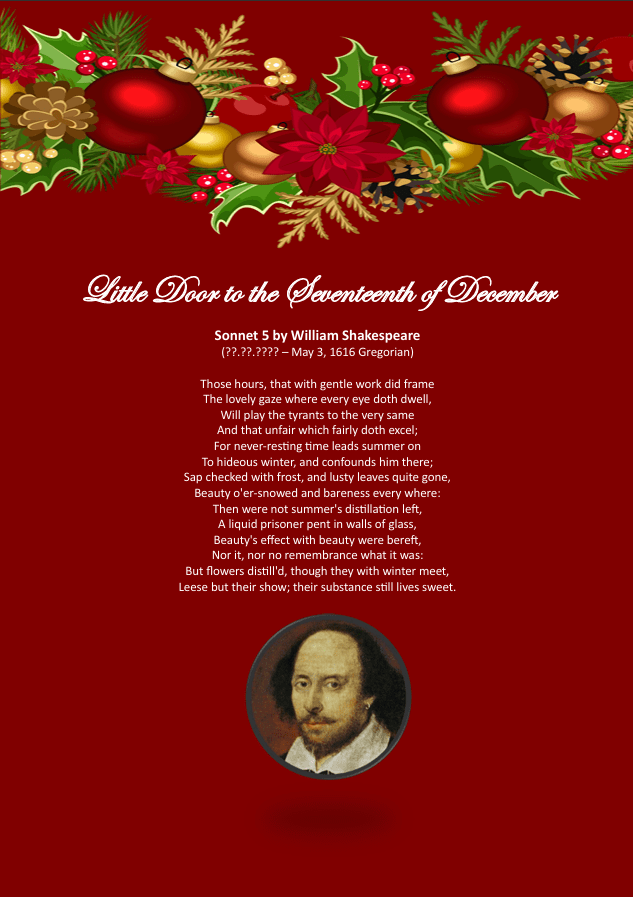
Sonnet 5 by William Shakespeare
Those hours, that with gentle work did frame
The lovely gaze where every eye doth dwell,
Will play the tyrants to the very same
And that unfair which fairly doth excel;
For never-resting time leads summer on
To hideous winter, and confounds him there;
Sap checked with frost, and lusty leaves quite gone,
Beauty o’er-snowed and bareness every where:
Then were not summer’s distillation left,
A liquid prisoner pent in walls of glass,
Beauty’s effect with beauty were bereft,
Nor it, nor no remembrance what it was:
But flowers distill’d, though they with winter meet,
Leese but their show; their substance still lives sweet.
Short Biography
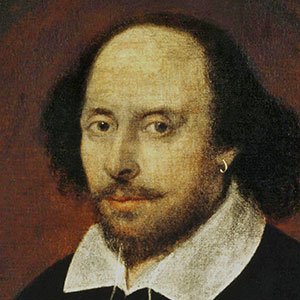
Born: April 23, 1564 in Stratford-upon-Avon
Died: April 23 or May 3, 1616 (Textarchive mentions his date of birth wasn’t recorded, only the day of baptism on April 26, 1564)
Shakespear is probably the most famous English poet; his plays are his most enduring legacy as well as his poems which remain popular to this day (I also own a book of Shakespear quotes called „Lexikon der Shakespear Zitate“ by Katrin Fischer, published by Reclams Verlag). His parents were John Shakespeare married Mary Arden, their infant daughters died making him the eldest child. His father was a glove-maker and became an important public figure in Stratford by fulfilling civic duties. This status made it even more likely that he’d sent his children to the local grammar school.
He lived with his parents until the age of 18 and married the already pregnant Anna Hathaway, who was 26 years old, in a rush. They had three children – two being twins.
One twin died at the age of 11.
Unfortunately, we don’t know much about the time between 1585 – when the twins were baptized – and 1592 – when his reputation was established in London -. Hence these are called ‚The Lost Years‘. His first printed works, however, were ‚Venus and Adonis‚ in 1593 and ‚The Rape of Lucrece‚ in 1594, two long poems. He was a founding member of The Lord Chamberlain’s Men, a company of actors. For almost 20 years, he produced two plays each year. He’d remain in the company for the rest of his career. From 1603 onwards, in evovled into The King’s Men under the patronage of King James I (reigned from 1603-1625).
By 1597, Shakespear accumulated enough wealth to buy New Place, the largest house in the borough of Stratford-upon-Avon. During his lifetime he wrote 38 plays, 2 narrative poems, 154 sonnets, and a variety of other poems.
„It is actually thanks to a group of actors from Shakespeare’s company that we have about half of the plays at all. They collected them for publication after Shakespeare died, preserving the plays. These writings were brought together in what is known as the First Folio (‚Folio‘ refers to the size of the paper used). It contained 36 of his plays, but none of his poetry. „
(Shakespear birthplace trust)
Source
William Shakespeare (in German)
https://www.textarchiv.com/william-shakespeare
William Shakespeare Biography (in English)
https://www.shakespeare.org.uk/explore-shakespeare/shakespedia/william-shakespeare/william-shakespeare-biography/
Stratford-upon-Avon
https://www.shakespeare.org.uk/explore-shakespeare/shakespedia/stratford-upon-avon/
James I (r. 1603-1625)
https://www.royal.uk/james-i
Little Door Nr. 18
Today it’s time for an unusual door: an urban legend from Hongkong.
We write the year 1989, 8 years before Hongkong would end to be a British colony.
In December that year, the Chiu Yong Kee cha chaan teng in Tai Po Tin took a phone order for four people’s worth of food, to be delivered to a unit in Hei Sau Gardens located in western Tai Po Tin. Once on the fourth floor, the delivery man knocked on the door. It opened, but only a small crack, and the food was asked to be left outside. The delivery man placed it in front of the doors, took the money and left.
However, when the owner of the restaurant counted the money that evening, he noticed that there was “hell money” (joss paper burned by Chinese people to help their loved ones in the afterlife). After it happened again on the next day, the owner was convinced that it was a prank so he decided to deliver it the next time himself. As he had predicted, around the same hour the same order came in with the same address. He drove to the place and experienced the same thing: the door only opened slightly, a hand reached out with money and he saw that it was the legal currency. Still, he kept it separate from the rest of the restaurant’s money. What must be, must be. On the next day, it was joss paper again.
Consequently, the owner – still terrified – called the police and told them about these weird occurrences. The police arrived at the unit in Hei Sau Gardens and when no one opened the door they forced their way in. As they entered, they noticed a stench in the air and then saw four dead bodies sitting at a table. They have died while playing mahjong.
Despite being dead for a week, finger prints were found on the “hell money” from two individuals and neighbours noted that they were disturbed by the sounds of mahjong coming from the apartment. Furthermore, an autopsy revealed that food was found in the corpses that had only been digested recently. Authorities were baffled by these findings.
Maybe this urban legend was inspired by a similar story that is said to have occurred in 1953: https://chinesefolktales.blogspot.com/2014/06/a-haunting-in-hong-kong-case-from-1953.html
Comment: I decided to write about this urban legend, because I watched a thrilling video about it on Youtube, unfortunately the narrator used AI-generated images which looked like they were drawn, but I didn’t notice it until I scrolled through the comment section.
Thematically it doesn’t really fit an advent calendar, being sandwiched between poems and actual facts 
Source
Hong Kong’s spookiest ghost stories and urban legends
https://www.timeout.com/hong-kong/things-to-do/top-spooky-ghost-stories-hong-kong
A Haunting in Hong Kong–a Case From 1953
https://chinesefolktales.blogspot.com/2014/06/a-haunting-in-hong-kong-case-from-1953.html
Little Door Nr. 19
The Truce of Christmas by G. K. Chesterton
Passionate peace is in the sky—
And in the snow in silver sealed
The beasts are perfect in the field,
And men seem men so suddenly—
(But take ten swords and ten times ten
And blow the bugle in praising men;
For we are for all men under the sun,
And they are against us every one;
And misers haggle and madmen clutch,
And there is peril in praising much.
And we have the terrible tongues uncurled
That praise the world to the sons of the world.)
The idle humble hill and wood
Are bowed upon the sacred birth,
And for one little hour the earth
Is lazy with the love of good—
(But ready are you, and ready am I,
If the battle blow and the guns go by;
For we are for all men under the sun,
And they are against us every one;
And the men that hate herd all together,
To pride and gold, and the great white feather
And the thing is graven in star and stone
That the men who love are all alone.)
Hunger is hard and time is tough,
But bless the beggars and kiss the kings,
For hope has broken the heart of things,
And nothing was ever praised enough.
(But bold the shield for a sudden swing
And point the sword when you praise a thing,
For we are for all men under the sun,
And they are against us every one;
And mime and merchant, thane and thrall
Hate us because we love them all;
Only till Christmastide go by
Passionate peace is in the sky.)
Short Biography
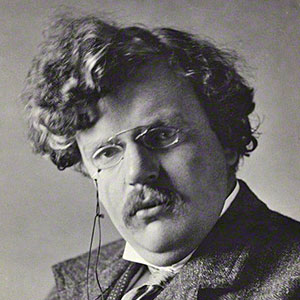
Born: May 29, 1874 in Campden Hill in Kensington, London
Died: June 14, 1936 at his home in Beaconsfield, Buckinghamshire
Chesterton’s parents were Marie Louise, née Grosjean, and Edward Chesterton.
At the age of one month, he was baptized into the Church of England, even though his parents were irregularly practising Unitarians (-> „Unitarians are so called because they insist on the oneness of God and because they affirm the essential unity of humankind and of creation“ BBC). As a young man he became fascinated with the occult.
He was educated at St Paul’s School and then attended Slade School of Art in order to become an illustrator. While attending University College London, he also took classes in literature. At the end he did not complete a degree in either, though.
- 1896-1902: Employed by London publisher Redway, and T. Fisher Unwin.
Here, he started his journalistic work as a freelance art and literary critic. - 1901: Married Frances Blogg, their marriage lasted the rest of his life.
- 1902: The Daily News gave him a weekly opinion column.
- 1905: Got a weekly column in The Illustrated London News where he’d work for the next 30 years.
- The character he’s best known for is priest-detective Father Brown, who appeared only in short stories. His best-known novel is The Man Who Was Thursday.
- He loved to debate and engaged in friendly public disputes with men like George Bernard Shaw, H. G. Wells, Bertrand Russell and Clarence Darrow.
- 1922: Entered full communion with the Catholic Church.
- 1931: Invitation by the BBC to give a series of radio talks.
From 1932 until his death, he made 40 appearences per year. - 14 June, 1936: Chesterton died of congestive heart failure in the morning.
During his life, he published 80 books, several hundred poems, some 200 short stories, 4000 essays, and several plays. He also wrote articles for the Encyclopædia Britannica (which I often use, the online version that is) and wrote the entry for Charles Dickens and part of the entry on Humour in the 14th edition (1929).
There’s also a dark chapter to him, as Chesterton also had an anti-semitic side to him.
While he openly expressed his opposition to Hitler’s rule from day one, he „believed that there was a „Jewish Problem“ in Europe, in the sense that he believed that Jewish culture (though not Jewish ethnicity) separated itself from the nationalities of Europe […] He suggested the formation of a Jewish homeland as a solution, and was later invited to Palestine by Jewish Zionists who saw him as an ally in their cause. Later he grew out of the notion of Palestine as a Jewish homeland, and suggested somewhere in Africa instead.“ (Textarchive)
There’s more about his antisemitism in his biography. Eugenics, on the other hand, is an idea he completely rejected writing in response to the Mental Deficiency Act of 1913 „as if one had a right to dragoon and enslave one’s fellow citizens as a kind of chemical experiment“
(the bill proposed sterilizing people deemed „mentally defective“).
Note: I didn’t read the biography of any of these poets until I decided to make a blog post about it. Since I already featured their poem, I feel it is also my duty to include things like that if I come across it.
Source
G. K. Chesterton
https://www.textarchiv.com/g-k-chesterton
Unitarianism at a glance
https://www.bbc.co.uk/religion/religions/unitarianism/ataglance/glance.shtml
Little Door Nr. 20
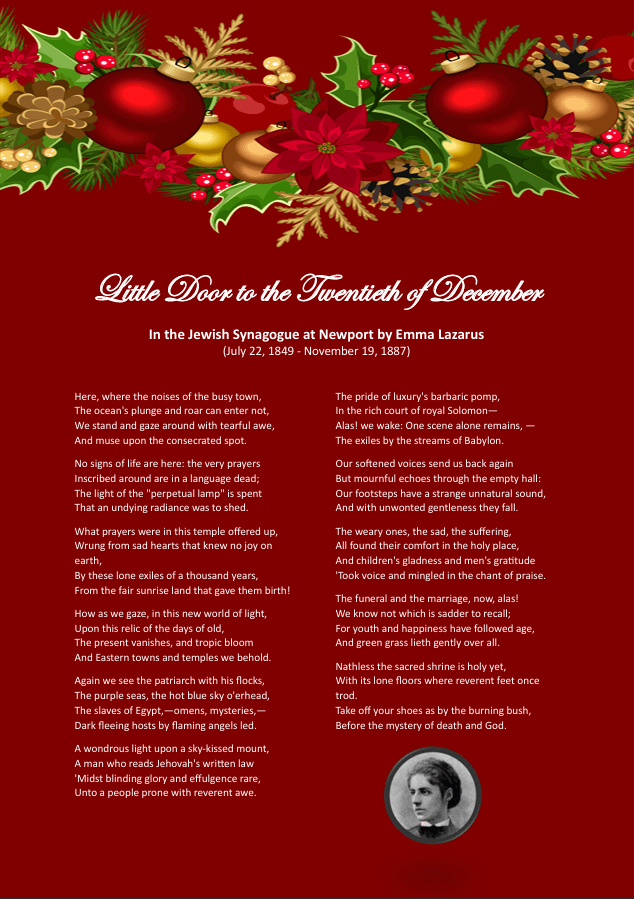
In the Jewish Synagogue at Newport by Emma Lazarus
Here, where the noises of the busy town,
The ocean’s plunge and roar can enter not,
We stand and gaze around with tearful awe,
And muse upon the consecrated spot.
No signs of life are here: the very prayers
Inscribed around are in a language dead;
The light of the „perpetual lamp“ is spent
That an undying radiance was to shed.
What prayers were in this temple offered up,
Wrung from sad hearts that knew no joy on earth,
By these lone exiles of a thousand years,
From the fair sunrise land that gave them birth!
How as we gaze, in this new world of light,
Upon this relic of the days of old,
The present vanishes, and tropic bloom
And Eastern towns and temples we behold.
Again we see the patriarch with his flocks,
The purple seas, the hot blue sky o’erhead,
The slaves of Egypt,—omens, mysteries,—
Dark fleeing hosts by flaming angels led.
A wondrous light upon a sky-kissed mount,
A man who reads Jehovah’s written law,
‚Midst blinding glory and effulgence rare,
Unto a people prone with reverent awe.
The pride of luxury’s barbaric pomp,
In the rich court of royal Solomon—
Alas! we wake: One scene alone remains, —
The exiles by the streams of Babylon.
Our softened voices send us back again
But mournful echoes through the empty hall:
Our footsteps have a strange unnatural sound,
And with unwonted gentleness they fall.
The weary ones, the sad, the suffering,
All found their comfort in the holy place,
And children’s gladness and men’s gratitude
‚Took voice and mingled in the chant of praise.
The funeral and the marriage, now, alas!
We know not which is sadder to recall;
For youth and happiness have followed age,
And green grass lieth gently over all.
Nathless the sacred shrine is holy yet,
With its lone floors where reverent feet once trod.
Take off your shoes as by the burning bush,
Before the mystery of death and God.
Short Biography
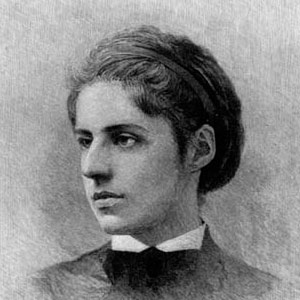
Born: July 22, 1849 in New York City
Died: November 19, 1887 in New York City
She was the fourth of seven children and born to a Sephardic Jewish family of Portuguese descent. Her father, Moses Lazarus, was a successful sugar merchant and her mother was called Esther. Moses wanted to ensure his children received the best education and they were taught multiple languages including German, French, and Italian by a private tutor.
At the age of 17, she had already written a book of poems called Poems and Translations: Written Between the Ages of Fourteen and Sixteen. Her father supporter her and published the book for private circulation. When Lazarus decided to sent one copy to Ralph Waldo Emerson (1803-1882). He quickly became her mentor and when she published her next book of poetry in 1871, her main poem was dedicated “To My Friend, Ralph Waldo Emerson.”
The book was titled Admetus and Other Poems.
- 1874: Published her first novel called Alide: An Episode in Goethe’s Life based on the autobiography of the German writer Goethe.
- 1878: Published her second and last work of fiction with the title The Eleventh Hour in Scribner’s Monthly. For the next decade, her poems were published in American magazines.
- 1881: Her poem Progress and Poverty was published in the New York Times.
The same year she published a translation of the well-known German-Jewish poet Heinrich Heine (1797-1856). It was entitled Poems and Ballads of Heinrich Heine. - 1882: Published another translation of Heinrich Heine with the title Songs of a Semite: The Dance to Death and Other Poems.
„As Lazarus continued to write, she used her poems and essays to speak out against the persecution of Jews in Europe and growing anti-Semitism in the United States. She publicly proclaimed her identity as a Jewish poet and advocated for Jewish issues internationally. Lazarus wrote in various publications promoting Zionism and a Jewish homeland in Palestine. In addition to her writing, she also met with immigrants and refugees, volunteered at the Hebrew Immigrant Aid Society, and helped establish the Hebrew Technical Institute in New York to provide Jewish immigrants with vocational training.“ (National Women’s Museum)
- 1883: Founded the Society for the Improvement and Colonization of East European Jews. The same year she wrote her poem The New Colossus which was to be auctioned to raise money for the pedestal of the Statue of Liberty. In order to inspire continued work on the statue, the organizers published it the Catalogue of the Pedestal Fund Art Loan Exhibition at the National Academy of Design.
- May 1885 – September 1887: Second trip to Europe to participate in social reform.
She met with Robert Browning, William Morris, and Jewish leaders on her first trip.
Documented in her essay “A Day in Surrey with William Morris”. - November 19, 1887: Died in New York City after she returned home sick from her trip through Europe.
You may know the poem which is engraved at the base of the Statue of Liberty:
„Give me your tired, your poor, your huddled masses yearning to breathe free.“
The full poem goes as follows:
Not like the brazen giant of Greek fame,
With conquering limbs astride from land to land;
Here at our sea-washed, sunset gates shall stand
A mighty woman with a torch, whose flame
Is the imprisoned lightning, and her name
Mother of Exiles. From her beacon-hand
Glows world-wide welcome; her mild eyes command
The air-bridged harbor that twin cities frame.
“Keep, ancient lands, your storied pomp!” cries she
With silent lips. “Give me your tired, your poor,
Your huddled masses yearning to breathe free,
The wretched refuse of your teeming shore.
Send these, the homeless, tempest-tost to me,
I lift my lamp beside the golden door!”
Source: https://www.poetryfoundation.org/poems/46550/the-new-colossus
Source
Biography: Emma Lazarus
https://www.womenshistory.org/education-resources/biographies/emma-lazarus
Ralph Waldo Emerson
https://www.britannica.com/biography/Ralph-Waldo-Emerson
Heinrich Heine
https://www.britannica.com/biography/Heinrich-Heine-German-author
Little Door Nr. 21
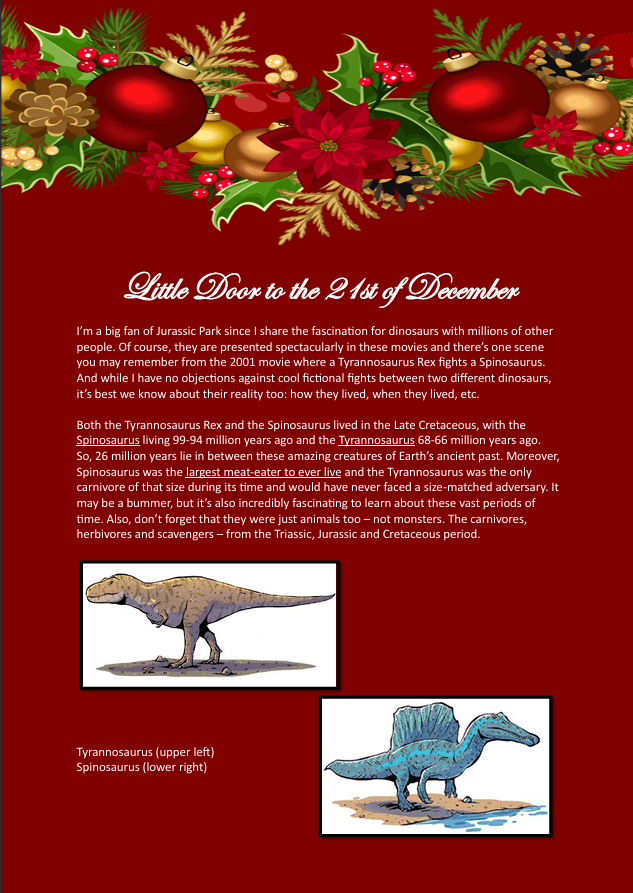
I’m a big fan of Jurassic Park since I share the fascination for dinosaurs with millions of other people. Of course, they are presented spectacularly in these movies and there’s one scene you may remember from the 2001 movie where a Tyrannosaurus Rex fights a Spinosaurus.
And while I have no objections against cool fictional fights between two different dinosaurs, it’s best we know about their reality too: how they lived, when they lived, etc.
Both the Tyrannosaurus Rex and the Spinosaurus lived in the Late Cretaceous, with the Spinosaurus living 99-94 million years ago and the Tyrannosaurus 68-66 million years ago.
So, 26 million years lie in between these amazing creatures of Earth’s ancient past. Moreover, Spinosaurus was the largest meat-eater to ever live and the Tyrannosaurus was the only carnivore of that size during its time and would have never faced a size-matched adversary. It may be a bummer, but it’s also incredibly fascinating to learn about these vast periods of time. Also, don’t forget that they were just animals too – not monsters. The carnivores, herbivores and scavengers – from the Triassic, Jurassic and Cretaceous period.
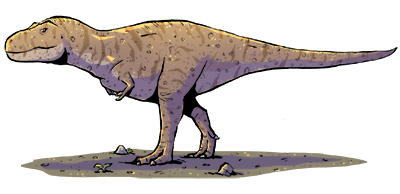
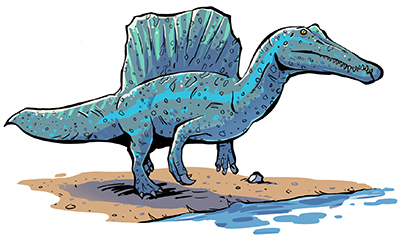
Length: 12 m
Weight: 7,000 Kg
Diet: carnivorus
Length: 14 m
Weight: 7,400 Kg
Diet: carnivorus
Comment: In the future, I’ll talk about many other prehistoric creatures – from the Ichthyostega (which lived in the Late-Devonian) to the Gigantopithecus (which lived from the Pliocene epoch of the late Tertiary to the mid-Pleistocene epoch of the Quaternary).
My current English vocabulary probably wouldn’t do justice to describe my fascination with these ancient creatures, and plant life is not any less interesting to me.
I very much recommend the book „The Complete Illustrated Encyclopedia of Dinosaurs & Prehistoric Creatures“ (language: English).
ISBN: 978-1-846-81209-5 | Price: UK £11.99 / US $18.99
Source
Debunking dinosaur myths and movie misconceptions
https://www.nhm.ac.uk/discover/debunking-dinosaur-myths-and-movie-misconceptions.html
Tyrannosaurus
https://www.nhm.ac.uk/discover/dino-directory/tyrannosaurus.html
Spinosaurus
https://www.nhm.ac.uk/discover/dino-directory/spinosaurus.html
Little Door Nr. 22
For over 3,000 years – from around 3100 B.C to 30 B.C. –, Ancient Egypt with its pharaohs existed. It was neither a monolithic nor static society, as there were many dynasties during this long time period. This can also be seen by the different burial sites such as the Valley of the Kings (18th, 19th and 20th dynasty – 1539–1075 B.C.) and the Great Pyramid of Giza
(c. 2543–c. 2436 B.C.) built by Cheops, the second King of the 4th dynasty.
Throughout much of its history, Ancient Egypt followed a polytheistic religion where many different gods and goddesses were venerated. So, here’s a few of them you may have already heard about:
- Osiris – The God of the Underworld
Abydos, in Upper Egypt, was an important cult centre for him - Amun-Ra – God associated with the Sun
Luxor, ancient Thebes, particularly important during the New Kingdom - Maat – God associated with truth, justice and order
He was the god who would weigh a person’s deeds against a feather.
“If the person had committed a great deal of wrong, the person’s heart would be heavier than the feather and the person’s soul would be obliterated. On the other hand, if their deeds were generally good, they passed forward and had the opportunity to successfully navigate the underworld.” (LiveScience)
Lastly, let’s move on to the Egyptian writing.
As you may be aware, their hieroglyphic script is unlike our modern alphabet. The earliest inscriptions date back about 5,200 years. Barry Kemp, a professor of Egyptology, described it as a living oral language where most hieroglyphs represent the sounds of consonants and certain emphatically expressed vowels.
After Alexander the Great conquered Egypt, the Greek language became widely used.
Coptic, an Egyptian language that used the Greek alphabet, was used after Christianity spread throughout Egypt. During the 5th century the hieroglyphic writing style became extinct. Arabic spread in 641 A.D. and is widely used in the country to this day.
Comment: Ancient civilizations, such as Egypt, fascinate people to this day. Sadly, there are many conspiracy theorists out there who either seek to downplay their accomplishments (rambling about aliens *cough* The History Channel *cough*) or deceive their audience by implying it was a monolithic and static society (like a certain TikToker who’s been debunked by Miniminuteman aka Milo Rossi). Archeology is about finding facts, not truths.
There may not have been visits of extraterrestials at any point during Earth’s existence, but what we can be certain of: there were many amazing civilizations over the last several thousand years. Their history, accomplishments, society and culture are worth researching.
As everyone else, archeologists depend on funding from institutions in order to do their work in the first place. A better understanding of the past also gives us insight into the challenges these people faced, and perhaps we even learn the one or other thing – from their failures and successes.
Source
Ancient Egypt: History, dynasties, religion and writing
https://www.livescience.com/55578-egyptian-civilization.html
Valley of the Kings
https://www.britannica.com/place/Valley-of-the-Kings
Great Pyramid of Giza
https://www.britannica.com/place/Great-Pyramid-of-Giza
Milo Rossi (Miniminuteman)
https://www.youtube.com/@miniminuteman773
Little Door Nr. 23
Today’s the last day before Christmas, at least here in Germany. I might consider doing one for the 25th too. However, today we will focus on a place my grandma and grand-grandma once called their home: East Prussia, or Königsberg to be precise.
Due to the limitation here, we will stick to a short summary of the history; to me it is still important as it is my historic identity (part of my national identity: German). Historic because it was once part of Germany, and in history this region will remain in order to rest for good.
Linguistically, the name Prussia is of Baltic origin. The Teutonic Order, however, exterminated the ancient inhabitants called Prusi (who lived in an area between Vistula and Neman River).
- 1308: The Knights conquer the Polish province of Pomorze.
- 1466: Poland recovers Pomorze
- 1525: Royal Prussia becomes a secular duchy.
- 1657: Treaty of Wehlau, freed Royal Prussia from Polish suzerainty
- 1701: The Elector of Brandenburg, Friedrich III. (1657-1713) becomes king in Prussia.
- 1815: The name ‘East Prussia’ was given to the easternmost province of Prussia, the boundaries remained unchanged until the First World War (36,995 km² / 14,284 miles²).
- 1919: Treaty of Versailles – the Memel (Klaipėda) territory was taken from Germany and incorporated into Lithuania in 1924, the district of Soldau (Dzialdowo) given to Poland and the regency of Marienwerder (Kwidzyn) joined East Prussia. The Polish corridor and Danzig separated it territorially from Germany.
- 1945: Partition of East Prussia – southern part was given to Poland, the northern part to the Soviet Union and the Klaipėda territory reincorporated into Lithuania.
Assimilation of the Old Prussians (Prusi) also occurred:
“During the 13th century, the Old Prussians were conquered by the Teutonic Knights, and gradually assimilated over the following centuries. The former German state of Prussia took its name from the Baltic Prussians, although it was led by Germans who had assimilated the Old Prussians; the old Prussian language was extinct by the 17th or early 18th century.”
(Academic Dictionaries and Encyclopaedias)
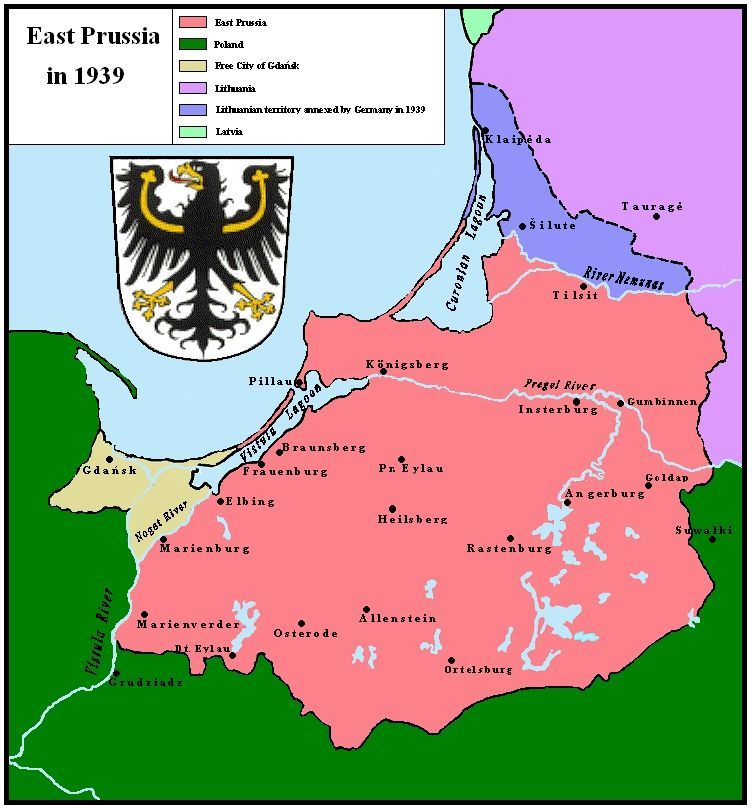
Comment: As I explained it in the little door, I wrote about East Prussia and a very short summary of its history because my grandma (1942-2023) and grand grandma (1920-2016) were born in Königsberg. I figured the one or other might be interested in it too.
In one of my blog posts, in German though, I talked about the historic identity that is different to the national identity (in the here and now). The historic identity is exclusive to former German territory where the focus is on preserving the memory, culture and realities of the people back then – the bright, dark and grey chapters alike. However, as some associations of expellees already do, this can also include reaching out to the people who currently live there and connect by doing projects and festivals together or working on educational material (for instance: after the Second World War, Soviet Russia annexed eastern Poland and Stalin displaced the Polish citizens forcing them to move westwards).
Generally speaking, anyone who is interested in the history and culture is welcome. As long as the person isn’t an imperialist who wants to retake the territory. The Putins of the world can go to hell and burn forever.
„With the acquiescence of the western allies, the Soviets re-annexed eastern Poland, Bessarabia, and northern Bukovina. Though the Soviet Union also annexed the Baltic states, those annexations were never recognized by Britain or the United States. Poland annexed Pomerania, Silesia, and southern East Prussia; the new German-Polish border lay along the line of the Oder and Neisse Rivers.“ (The Soviet Union and Europe after 1945 – USHMM)
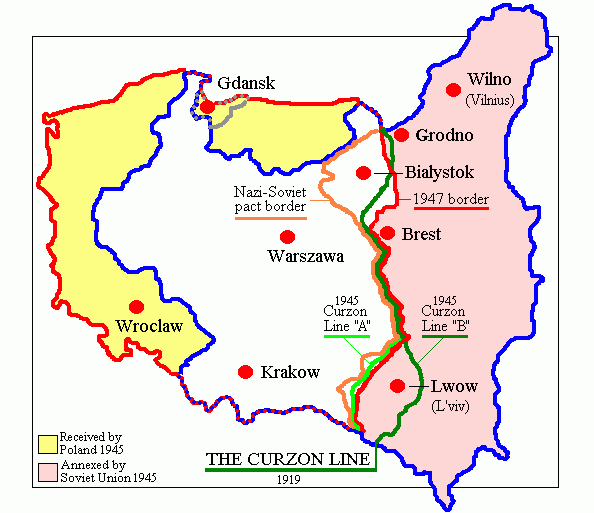
483,000 Ukrainians were moved from Poland to Ukraine and 790,000 Poles were transported from Ukraine to Poland – thus being one of the largest transfers undertaken in postwar Europe.
Source
East Prussia
https://www.britannica.com/place/East-Prussia
Treaty of Wehlau
https://www.britannica.com/event/Treaty-of-Wehlau
January 18, 1701 ~ Elector Friedrich III of Brandenburg, Crowns himself King Friedrich I in Prussia in Königsberg.
https://europeanroyalhistory.wordpress.com/2022/01/18/january-18-1701-elector-friedrich-iii-of-brandenburg-i-crowns-himself-king-friedrich-i-in-prussia-in-konigsberg/
Old Prussians
https://en-academic.com/dic.nsf/enwiki/301575
Ukrainian-Polish Population Transfers, 1944–46: Moving in Opposite Directions
https://link.springer.com/chapter/10.1057/9780230246935_8
The Soviet Union and Europe after 1945
https://encyclopedia.ushmm.org/content/en/article/the-soviet-union-and-europe-after-1945
Little Door Nr. 24
Today’s the last day of the Advent calendar, at least in Europe. So, naturally, we will talk about Santa Claus and his origins.
Santa Claus is based on traditions associated with Saint Nicholaus (which is celebrated on December 6). It was the Dutch who transported the legend of Saint Nicholas (Sinterklaas) to New Amsterdam (now New York, the English conquered it in 1664) with the customs of giving children gifts and sweets.
The current depiction of Santa with an impressive white beard, dressed in a red suit with a black belt and white fur trim, black boots, and a soft red cap was the creation of Haddon Sunblum (1899-1976) in 1931 who worked as an illustrator for the Coca-Cola company.
An earlier depiction was created by the cartoonist Thomas Nast (1840-1902) which was published in Harper’s Weekly beginning in 1863. His version was heavily influenced by the description given in the poem ‘A Visit from St. Nicholaus’ (aka Twas the Night Before Christmas) first published in 1823. You’ll find the poem on the next page.
| New Amsterdam, and thus New York as a trading hub, was the result of the Dutch Golden Age. “The Dutch Golden Age emerged during the Netherlands’ long struggle against Spanish rule. The Dutch revolution against Habsburg Spain began in 1566. The Seven Provinces joined together under the Union of Utrecht (1579) and formally declared their independence with the Act of Abjuration in 1581. The new, united Dutch republic fought the Eighty Years War to secure its independence which was finally achieved and recognized by Spain with the Treaty of Westphalia in 1648.” (New Amsterdam History Center) England was another emerging power at the time and the competition between both countries eventually led to war: between 1652 and 1674, three separate Ango-Dutch wars were fought. Pressure from France and England, as well as Orangists within the Netherlands, led to the collapse of the Dutch government and WIC bankruptcy. |
A Visit from St. Nicholas by Clement Clarke Moore
‚Twas the night before Christmas, when all through the house
Not a creature was stirring, not even a mouse;
The stockings were hung by the chimney with care,
In hopes that St. Nicholas soon would be there;
The children were nestled all snug in their beds;
While visions of sugar-plums danced in their heads;
And mamma in her ‚kerchief, and I in my cap,
Had just settled our brains for a long winter’s nap,
When out on the lawn there arose such a clatter,
I sprang from my bed to see what was the matter.
Away to the window I flew like a flash,
Tore open the shutters and threw up the sash.
The moon on the breast of the new-fallen snow,
Gave a lustre of midday to objects below,
When what to my wondering eyes did appear,
But a miniature sleigh and eight tiny rein-deer,
With a little old driver so lively and quick,
I knew in a moment he must be St. Nick.
More rapid than eagles his coursers they came,
And he whistled, and shouted, and called them by name:
„Now, Dasher! now, Dancer! now Prancer and Vixen!
On, Comet! on, Cupid! on, Donder and Blitzen!
To the top of the porch! to the top of the wall!
Now dash away! dash away! dash away all!“
As leaves that before the wild hurricane fly,
When they meet with an obstacle, mount to the sky;
So up to the housetop the coursers they flew
With the sleigh full of toys, and St. Nicholas too—
And then, in a twinkling, I heard on the roof
The prancing and pawing of each little hoof.
As I drew in my head, and was turning around,
Down the chimney St. Nicholas came with a bound.
He was dressed all in fur, from his head to his foot,
And his clothes were all tarnished with ashes and soot;
A bundle of toys he had flung on his back,
And he looked like a pedler just opening his pack.
His eyes—how they twinkled! his dimples, how merry!
His cheeks were like roses, his nose like a cherry!
His droll little mouth was drawn up like a bow,
And the beard on his chin was as white as the snow;
The stump of a pipe he held tight in his teeth,
And the smoke, it encircled his head like a wreath;
He had a broad face and a little round belly
That shook when he laughed, like a bowl full of jelly.
He was chubby and plump, a right jolly old elf,
And I laughed when I saw him, in spite of myself;
A wink of his eye and a twist of his head
Soon gave me to know I had nothing to dread;
He spoke not a word, but went straight to his work,
And filled all the stockings; then turned with a jerk,
And laying his finger aside of his nose,
And giving a nod, up the chimney he rose;
He sprang to his sleigh, to his team gave a whistle,
And away they all flew like the down of a thistle.
But I heard him exclaim, ere he drove out of sight—
“Happy Christmas to all, and to all a good night!”
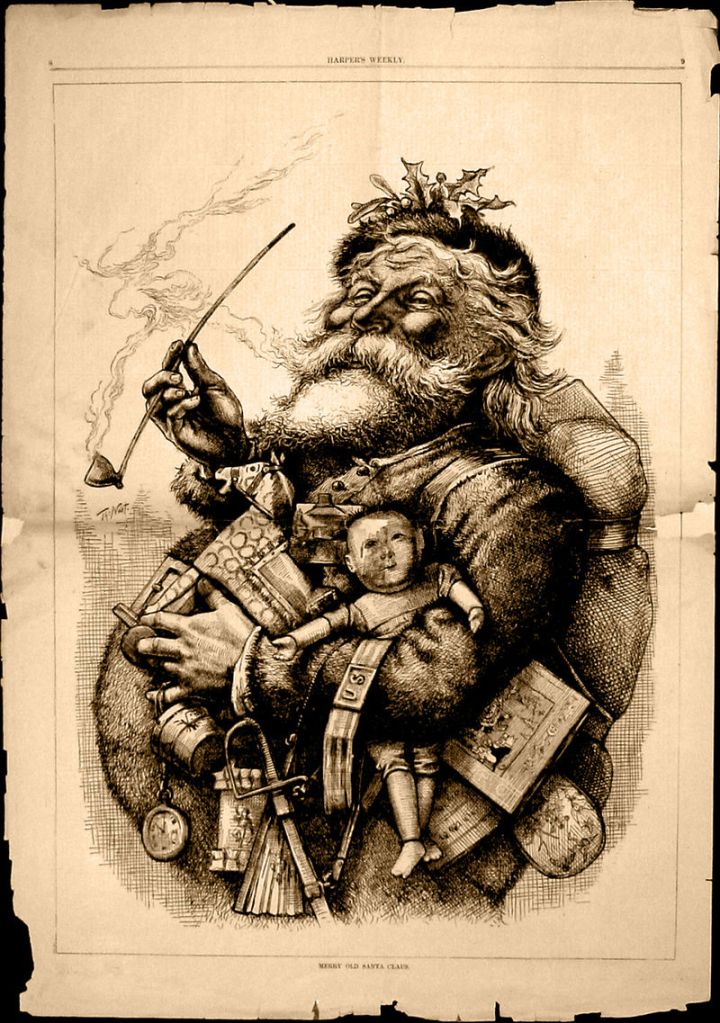
Short Biography
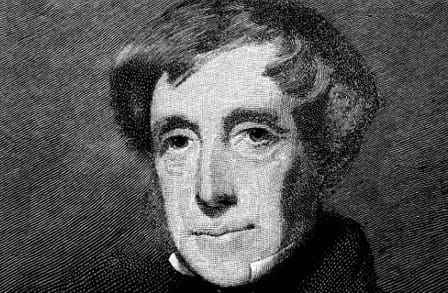
Born: 1779 in New York City
Died: July 10, 1863 in Newport, Rhode Island
Clement’s parents were Reverend Benjamin Moore and Charity Clarke Moore and was born an only child. Until he entered Columbia College, he was tutored by his father.
- 1798: Graduation from Columbia College.
- 1801: MA from Columbia University.
- 1809: Published the book A Compendious Lexicon of the Hebrew Language.
- 1811: Published a translation from a French book, called A Complete Treatise on Merinos and Other Sheep.
- 1813: Married 19-year old Catharine Elizabeth Taylor. Together they had 9 children.
- 1823: Began to work as a professor for oriental and Greek literature at the General Theological Seminary. During this year, the poem he wrote for his children (A Visit from St. Nicholaus) was published anonymously and got increasingly popular since.
- 1829: Awarded an LLD by the Columbia University.
- 1837: The poem ‚A Visit from St. Nicholaus‘ was published in The New-York Book of Poetry.
- 1844: Moore’s collection Poems was published when it was acknowledged is was written by him. Due to the popularity, however, several people claimed authorship.
- 1850: Retires from his work as a professor at the General Theological Seminary.
Purchased a house in Newport, Rhode Island. - July 10, 1863: Died in his house in Newport, Rhode Island.
Clement Clarke Moore was a very religious man, so when he inherited land he gave a large portion to of the land – then called Chelsea estate and now called Chelsea Square – to the General Theological Seminary.
The poem, however, is nowadays attributed to Major Henry Livingston, Jr. (1748-1828).
I’m not sure what exactly the position of the Poetry Foundation is – the source of this poem -, since they wrote „Livingston had also written verses for his children, but he made no written mention of „A Visit from St. Nicholas“ during his lifetime, nor had his friends heard of his connection with the verses. They were said to have been published in a Poughkeepsie newspaper long before they appeared in the Troy Sentinel, but no copies of the paper containing the poem have ever turned up“, but according to a scholar they also quote on Livingston’s biography it was apparently proven otherwise: „In Author Unknown: On the Trail of Anonymous (2000), scholar Don Foster, a Vassar College professor, gathered evidence to support Livingston as the author of the well-known poem.“
I personally am confused. So, I’ll leave it as it is and hope you liked this blog entry of mine.
Learning about the poets and their lives was something I enjoyed throughout this entry.
Source
The Story of New Amsterdam
https://www.newamsterdamhistorycenter.org/bios/origins.html
Clement Clarke Moore
https://www.poetryfoundation.org/poets/clement-clarke-moore
A Visit from St. Nicholas
https://www.poetryfoundation.org/poems/43171/a-visit-from-st-nicholas
Major Henry Livingston, Jr.
https://www.poetryfoundation.org/poets/henry-livingston
In case I don’t write anything else in the next three days,
I wish you a Happy New Year!
 Baroque

Ein Kommentar zu “History of the Advent Calendar and More”