
On February 24, 2022, Russia started the war of aggression against Ukraine. From the beginning, it was Putin’s plan to wipe out the Ukrainian identity and to absorb all of her territory into Russia. The Russian military commits war crimes systematically – from targeting civilian infrastructure to mass murder and sexual violence.
This blog entry is, therefore, a call to continue the support of Ukraine against imperialism and authoritarianism. A Ukrainian victory is vital for a democratic future.
The Frontlines of the War
On February 24, 2022 the Russian War of Aggression started at 04:00 am in the morning, first they managed to conquer vast swathes of Ukrainian territory from February to March 2022, from April to August the Russian forces were forced back from Kyiv and from September to November of the same year, the Ukrainian counter offensive reconquered further territory. Since then, progress has been very slow especiall due to the lack of ammunition where Ukraine relies on supplies of Europe and the US especially.
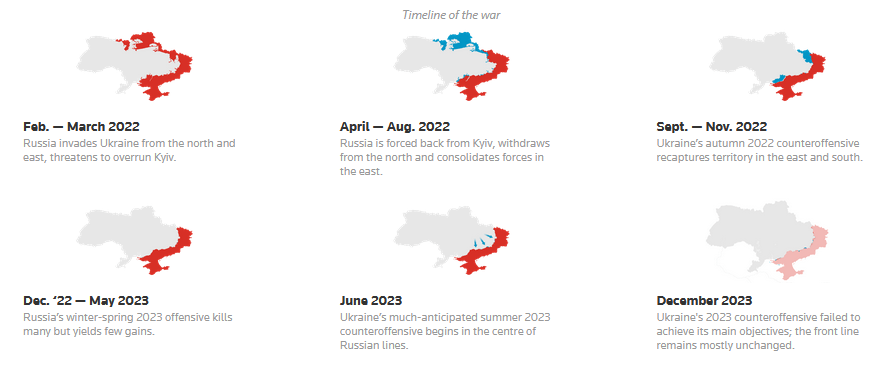
The grey writing from Reuters may be difficult to see or tedious to read, so here’s my revision:
February – March 2022
Russia invades Ukraine from the north and east, threatens to overrun Kyiv.
April – August 2022
Russia is forced back from Kyiv, withdraws from the north and consolidates forces in the east.
September – November 2022
Ukraine’s autumn 2022 counteroffensive recaptures territory in the east and south.
December ’22 – May 2023
Russia’s winter-spring 2023 offensive kills many but yields few gains.
June 2023
Ukraine’s much-anticipated summer 2023 counteroffensive begins in the centre of Russian lines.
December 2023
Ukraine’s 2023 counteroffensive failed to achieve its main objectives; the front line remains mostly unchanged. While the main objective wasn’t achieved, there still was some success: „Despite few breakthroughs along the front, Ukraine’s counteroffensive can claim some modest success.
The counteroffensive in Crimea, employing sea drones and targeted long-range missile strikes, forced Russia’s navy on the backfoot in the Black Sea, and a declassified U.S. intelligence report pointed to a cost for Russia’s armed forces of nearly 315,000 dead and wounded troops, or nearly 90% of the personnel it had when the conflict began.“ (Reuters)
The main objective of said counteroffensive, with preparations made from January to July 2023, was to severe the connection between Crimea and Russian mainland. It is a very important target as Russia relies on this route for supplies. However, the 7 months that were needed to prepare for this counteroffensive also gave Russia the time to fortify their positions with trenches, obstacles and land mines. We’ve also seen how drones became increasingly important for both sides: both for reconnaissance (surveillance drones) and attacks (bomber drones like the Iranian kamikaze drones). This combination of conventional warfare and new technology make it also very difficult to clear minefields:
„Ukraine employed Western mine-clearance vehicles and armoured columns of tanks and vehicles to traverse the hazardous terrain. But the army’s movements to clear paths through the mines unfolded under the watchful eye of surveillance drones operated by Russia’s new specialised drone units.
These drones meticulously observed the mine-clearance vehicles, feeding targeting information to artillery and attack helicopters. Evolving optical capabilities on the drones also meant they could see through traditional camouflage techniques such as smoke screens that would foil human observers.“ (Reuters)
Given the asymmetry of the war, where Russia bombards Ukraine from East to West while Ukraine’s allies do not want to or only very hesitantly give long-distance weapons which could reach Russian soil, it creates a strategic imbalance. For instance, if Ukraine were to be sent long-range weaponry they’d be able to hit military targets and weapon factories within Russia – thus crippling the Russian war machinery and saving human lives in the process. Additionally, it’d put the Putin dictatorship even further under pressure with frequent targeting of military targets and the war industry.
Civilians Under Enemy Fire
The Russian military has repeatedly targeted civilian infrastructure, so much so that Ukrainian authorities had to announce in October 2022 that there will be power outages across the country after 40% of Ukraine’s energy facilities were seriously damaged.
The morale of a population is not a lawful target, it is a war crime.
„The strategy behind Russia’s latest warfare tactics is unmistakable. In bombing Ukraine’s critical civilian infrastructure, including energy facilities, the Russian army clearly intends to undermine industrial production, disrupt transportation, sow fear and despair and deprive civilians in Ukraine of heat, electricity and water as the cold grip of winter approaches.“
– Marie Struthers, Amnesty International’s Director for Eastern Europe and Central Asia
On March 4, 2022, the UN established the Independent International Commission of Inquiry on Ukraine to „to investigate all alleged violations and abuses of human rights, violations of international humanitarian law and related crimes in the context of the aggression against Ukraine by Russia“. The three members are Chair Erik Møse, Pablo de Greiff and Vrinda Grover who are neither UN staff nor receive a salary for their work (UN).
In their press release from October 20, 2023, they wrote that more evidence emerged that Russian authorities carried out indiscriminated attacks and have committed war crimes of torture, rape and other sexual violence, and deportation of children to the Russian Federation. In the Cherkasy region, for instance, a mulitstory residential apartment in Uman came under attack which caused the death of 24 civilians, mostly women and children, and part of the building becoming inhabitable. Russian authorities „have used torture in a widespread and systematic way in various types of detention facilities“, the new evidence was collected in the Kherson and Zaporizhzhia regions: „Witnesses reported situations in which torture had been committed with such brutality that the victim died. In a detention facility in a school in Biliayivka village, Kherson region, co-detainees requested medical care when a victim showed signs of respiratory distress immediately after being tortured. However, Russian armed forces refused, and the victim died within an hour.“
The investigations into these regions also showed the extent of rape and other sexual violence which were often committed together: „A 75-year-old woman who stayed alone to protect her property, was attacked by a Russian soldier who hit her on her face, chest, and ribs, strangled her, as he was interrogating her. He ordered her to undress and when she refused, he ripped off her clothes, cut her abdomen with a small sharp object and raped her several times. In addition to the consequences of the rapes, the victim suffered several broken ribs and teeth. The Commission found that, in addition to rape, the war crime of torture was also committed against the victim.“ The age from sexual assault victims ranged from 19 to 83 (ABC News).
In May 2022, it was documented that 31 Ukrainian children had been transferred to Russia.
The commission concluded that it was an unlawful deportation and, therefore, a war crime.
According to Ukrainian officials, at least 19,000 children are still gone with the actual number believed to be much higher.
„They’re sent to Russian foster families, technical schools, military training and so-called summer camps with the intention of turning them into Russian citizens. Ukraine’s prosecutor general, Andriy Kostin, testified via video recording to that same group of bipartisan lawmakers.“ (NPR)
Lastly to the casualties of the war and other key facts, as summarized by the reliefweb:
- As of 22 February 2024 (the latest data available), 30,457 civilians were killed and wounded, including 10,582 civilians killed in the conflict, including 587 children. A total of 9,241 people have been killed by explosive weapons with wide area effects, and mines and explosive remnants of war.
(Source: UN Human Rights Monitoring Mission in Ukraine) - 14.6 million people, including more than 3 million children, are in need in Ukraine this year. 80% of those in need of aid also require mental health support. Approximately
4 million people are displaced within Ukraine. Women make up 58% of the internally displaced, and are more likely than men to experience unemployment and dependency on humanitarian aid. (Source: Humanitarian Needs and Response Plan 2024) - Poverty level in Ukraine increased from 5.5% to 24% in 2022 alone.
(Source: World Bank) - 5.9 million Ukrainian people are refugees. (Source: UNHCR)
- 67% of internally displaced people say they want to return home one day.
(Source: UNHCR)
(source: Ukraine: 42 civilian casualties every day in two years of war, reliefweb)
The sources provided in the bullet point summary were added by the authors, I added the brackets because that’s how I’m used to do it when I directly cite a source.
Broken Agreements
On December 4, 1994, the Budapest Memorandum on Security Assurances were signed by Belarus, Ukraine, Kazakhstan, Russia, the United States and the United Kingdom and prohibited the latter three from using military force or economic coercing against Ukraine, Belarus or Kazakhstan. In turn, Ukraine had to eliminate all nuclear weapons from its territory. Here’s the content of the treaty in its entirety:
„Welcoming the accession of Ukraine to the Treaty on the Non-Proliferation of Nuclear Weapons as a non-nuclear-weapon State,
Taking into account the commitment of Ukraine to eliminate all nuclear weapons from its territory within a specified period of time,
Noting the changes in the world-wide security situation, including the end of the cold war, which have brought about conditions for deep reductions in nuclear forces,
Confirm the following:
1. The Russian Federation, the United Kingdom of Great Britain and Northern Ireland and the United States of America reaffirm their commitment to Ukraine, in accordance with the principles of the Final Act of the Conference on Security and Cooperation in Europe, to respect the independence and sovereignty and the existing borders of Ukraine;
2. The Russian Federation, the United Kingdom of Great Britain and Northern Ireland and the United States of America reaffirm their obligation to refrain from the threat or use of force against the territorial integrity or
political independence of Ukraine, and that none of their weapons will ever be used against Ukraine except in self-defence or otherwise in accordance with the Charter of the United Nations;
3. The Russian Federation, the United Kingdom of Great Britain and Northern Ireland and the United States of America reaffirm their commitment to Ukraine, in accordance with the principles of the Final Act of the Conference on Security and Cooperation in Europe, to refrain from economic coercion designed to subordinate to their own interest the exercise by Ukraine of the rights inherent in its sovereignty and thus to secure advantages of any kind;
4. The Russian Federation, the United Kingdom of Great Britain and Northern Ireland and the United States of America reaffirm their commitment to seek immediate United Nations Security Council action to provide assistance to Ukraine, as a non-nuclear-weapon State party to the Treaty on the Non-Proliferation of Nuclear Weapons, if Ukraine should become a victim of an act of aggression or an object of a threat of aggression in which nuclear weapons are used;
5. The Russian Federation, the United Kingdom of Great Britain and Northern Ireland and the United States of America reaffirm, in the case of Ukraine, their commitment not to use nuclear weapons against any non-nuclearweapon State party to the Treaty on the Non-Proliferation of Nuclear Weapons,
except in the case of an attack on themselves, their territories or dependent territories, their armed forces, or their allies, by such a State in association or alliance with a nuclear-weapon State;
6. Ukraine, the Russian Federation, the United Kingdom of Great Britain and Northern Ireland and the United States of America will consult in the event a situation arises that raises a question concerning these commitments.
This Memorandum will become applicable upon signature.
Signed in four copies having equal validity in the Ukrainian, English and Russian languages.
For Ukraine:
(Signed) Leonid D. KUCHMA
For the Russian Federation:
(Signed) Boris N. YELTSIN
For the United Kingdom of Great Britain and Northern Ireland:
(Signed) John MAJOR
For the United States of America:
(Signed) William J. CLINTON“
(source: Internet Archive -> Council on Foreign Relations)
With the occupation of Crimea in 2014, the Russian Federation already broke the treaty.
8 years later, on February 24, 2022, the Russian Federation has shown the world – once and for all – that they couldn’t care less about binding treaties. Minsk II was broken too when Vladimir Putin recognized the „People’s Republics“ of Donetsk and Luhansk.
In other words: if Putin somehow emerges victorious from this war, it will be pretty much impossible to provide legal certainty internationally when „might makes right“ becomes the norm again.
What Needs to be Done
Some of the points I list here are already in the process of being done or continued, like the humanitarian and military aid provided by the EU and the USA.
- As stated above, it is of utmost importance to continue to support Ukraine by providing military and humanitarian aid – ammunition and weaponry has to arrive on time, delays help the enemy to prepare and recover; humanitarian aid is self-explanatory, from medicine to equipment to repairing damaged or destroyed infrastructure.
- Developing with Ukraine plans for psychological assistance for soldiers and civilians, for instance by planning on how to expand services that already exist like pastoral counseling.
- Continuing the investigation into war crimes and their documentation, naturally it includes the identification of perpetrators.
- Increasing the production capacity of military equipment and ammunition, this also includes illusionary equipment as it is already produced in Ukraine – meaning fake mortars, for example, that are attacked by kamikaze drones instead of the real ones. Thus saving human lives and forcing the enemy to waste resources.
- In order to not fall into the trap as Russia’s economy did, where the major reason for economic growth – if the data can even be trusted, which I’m extremely skeptical of – is the military industrial complex combined with the logistics, a post-war plan needs to be developed on how to use the ramped up military industry for nonmilitary purposes (perhaps a way to turn into military production in emergency, if needed again).
- In the long-term, the United Nations must undergo reforms as Zelenskiy proposed them: „The Ukrainian president argued that the war had demonstrated the need to limit veto power, give the UN general assembly the power to override vetoes, and expand the council’s permanent members beyond the current five powers, who acquired their privileged position in the wake of the second world war. […]
He laid out proposals for UN reform as part of his 10-point peace plan. He supported a suggestion, which has been championed by France in the past, that in case of “mass atrocities against human rights” the veto powers of the permanent members – Russia, the US, UK, China and France – should be voluntarily suspended.“ (The Guardian) - The International Criminal Court must be strengthened, it is unacceptable that the US hasn’t joined it either – if the Nuremberg Principles mean anything to the international community, even big powers must be pressured (domestically and by partners) into signing and adhering to it. Without a doubt, it will be the legal project of the century.
- With the death of Alexei Navalny, which was more likely a political assassination, Putin eliminated a major Russian opposition leader – at this point in time probably the last major one for a long time. In case Russia collapses in itself entirely, as the Wagner coup has shown could be done rather easily with the barely to non-existing resistance, the international community should ensure that neighbouring countries aren’t destabilized by it – a contingency plan is necessary for this scenario, even if that sounds unlikely.
How to Support Ukraine
In case you want to know how you can support Ukraine, visit this official website of the European Union. You can directly donate to Ukraine using the following organizations (also listed on the website, of course):
- Caritas Ukraine
- Razom
- Voices of Children
- Vostok SOS
- Warehouse Centre for Humanitarian and Medical Aid to Ukraine
End
According to Zelenskiy, 31,000 Ukrainian soldiers have died during the two years of war.
They were normal men and women, like you and me, who died defending their country.
My high regard also goes to all those men and women who have been injured and now recover in hospitals and sick bays. Ukrainians fight not only for their democracy and sovereignty, but also for the democracies in Europe and the US. In spirit, for all the democratic ideals shared by democracies around the world.
Sources
Mapping Ukraine’s counteroffensive
https://www.reuters.com/graphics/UKRAINE-CRISIS/MAPS/klvygwawavg/
Ukraine: Russian attacks on critical energy infrastructure amount to war crimes
https://www.amnesty.org/en/latest/news/2022/10/ukraine-russian-attacks-on-critical-energy-infrastructure-amount-to-war-crimes/
Ukraine: Rape and torture by Russian forces continuing, rights experts report
https://news.un.org/en/story/2023/09/1141417
UN Commission of Inquiry on Ukraine finds continued war crimes and human rights violations gravely impacting civilians
https://www.ohchr.org/en/press-releases/2023/10/un-commission-inquiry-ukraine-finds-continued-war-crimes-and-human-rights
Russians committing rape, ‚widespread‘ torture against Ukrainians, UN report finds
https://abcnews.go.com/International/russians-committing-rape-widespread-torture-ukrainians-report-finds/story?id=103465772
Ukrainian children, abducted by Russia and then returned, are speaking out
https://www.npr.org/2024/02/05/1229117422/ukrainian-children-abducted-by-russia-and-then-returned-are-speaking-out
Ukraine: 42 civilian casualties every day in two years of war [EN/UK]
https://reliefweb.int/report/ukraine/ukraine-42-civilian-casualties-every-day-two-years-war-enuk
Budapest Memorandums on Security Assurances, 1994
https://web.archive.org/web/20170312052208/http://www.cfr.org/nonproliferation-arms-control-and-disarmament/budapest-memorandums-security-assurances-1994/p32484
Full text of the Minks agreement
https://peacemaker.un.org/UA-ceasefire-2014
https://www.unian.info/politics/1043394-minsk-agreement-full-text-in-english.html
Zelenskiy says only way to ensure peace is fundamental UN reform
https://www.theguardian.com/world/2023/sep/20/volodymyr-zelenskiy-russia-veto-un-security-council
The International Nuremberg Principles Academy
https://www.nurembergacademy.org/about-us/history/
Zelenskiy says 31,000 Ukrainian soldiers killed since Russia invaded
https://www.reuters.com/world/zelenskiy-says-31000-ukrainian-soldiers-killed-during-russias-invasion-2024-02-25/
 Baroque