
In this blog entry I present to you Kant’s definition of enlightenment. However, before we do that, I’ll talk about some of the most important events of the 18th century until 1784 to get a better understanding. Then it is followed up by the structure of domination.

Historical Context
In order to better understand a historical figure, it is always worthwhile to look at the historic events that took place (meaning: getting to know the period they grew up in).
Consequently, we begin with the important events that took place before we discuss Kant’s definition. Since it is based on the work that someone else did (who compiled it), I’ll keep the subdivision into decades. However, I did reexamine it to verify it did in fact happen – not to downplay the work of the author, merely a precaution in case errors snuck in (and to go into greater detail in some cases).
- 1700-1709
The Great Northern War begins with the assault of Saxon groups on Riga.
One year later, the War of the Spanish Succession begins and ends in 1912.
Between 1706 and 1707, the Acts of Union were passed which leads to the formation of the United Kingdom. - 1710-1719
Germany, Sweden and Russia suffer from a plague epidemic at the beginning of the decade – more than over half a million Europeans lose their lives. However, at the same time it was the last plague epidemic to haunt Europe.
The Prussian King Frederick I. founds the Berliner Charité in response to the plague which took the lives of 1/3rd of East Prussia’s population.
The Third Ottoman-Russian War: from 1710 until 1711, it ends in a defeat for Russia.
August II. the Strong (1694-1733), Elector of Saxony and King of Poland, contributes in Meißen to the foundation of the first porcelain factory in Europe.
(Frederick II. was born on January 24, 1712) - 1720-1729
The Great Northern War ends after 20 years with a peace agreement between Sweden and Prussia. Prussia was on its way to become a major power, however, it first had to pay two million Thaler for the territories of Stettin, Usedom, Wollin and Vorpommern.
The Dano-Swedish war ended as well.
Meanwhile, the paper currency experienced failure in France. France returned to the coin standard and John Law, who was responsible for the paper currency, had to leave France for security reasons. Great Britian still suffered from the consequences of a recession. The Chinese Empire absorbs Tibet, officially it claims that the autonomy of Tibet will remain. Effectively, it was the exterior rule through the Manchu minority.
(Immanuel Kant was born on April 22, 1724 – 30 years after Voltaire was born) - 1730-1739
Frederick II. (later known as Frederick the Great), crown prince of Prussia, attempts to abscond from his father with his friend due to his known homosexuality. The attempted escape fails and Frederick II. was sentenced to fortress detention. His friend was executed in front of his eyes.
After the death of Frederick II. King of Denmark and Norway, Christian IV. succeeds. - 1740-1749
The Austrian Emperor Karl IV. dies, thus ending the Habsburger male line.
The heir to the throne went to his daughter instead: Maria Theresia.
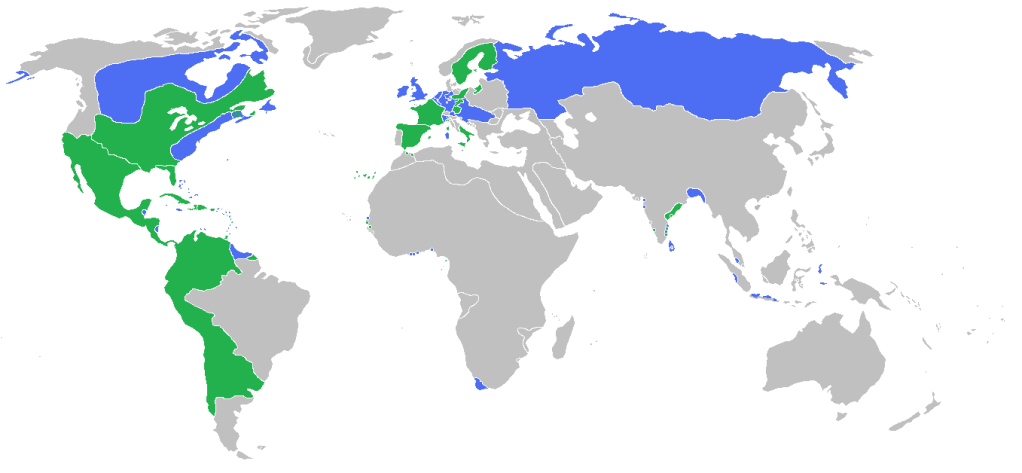
As a consequence, European monarchs laid claim to the Habsburg Hereditary Lands which led to the War of the Austrian Succession (1740-1748). The war encompassed the two Silesian Wars too and grew to a global conflict. Frederick the Great opposed the appointment of a female monarch and joined the war by occupying Silesia.
Russia also experienced a succession to the throne. Ivan VI., a minor, succeeds the Tsar Anna Ioannovna (1693-1740) and while here unrest emerges as well Europe remains largely unaffected by it. Ivan VI. was proclaimed Tsar when he was just at the age of two months, his mother received the title of regent. One year later, the new Tsar and his mother were disposed of in a coup. The young Tsar, his mother and his siblings were jailed for the rest of their life.
- 1750-1759
In January 1750, Portugal and Spain agree to the course of the borders of their colonies in South America. The Treaty of Madrid also included a binding border for Brazil.
The Italian-Austrian composer, Kapellmeister and music pedagogue Antonio Salieri (1750-1825) was born in Legnago (Republic of Venice).
On July 28, 1750, the German composer Johann Sebastian Bach died in Leipzig. To his most well-known works belong Das wohltemperierte Klavier, die Matthäus-Passion and die Kunst der Fuge.
The French philosopher and writer Voltaire (François-Marie Arouet, 1694-1778), who was one of the most read and influential authors of the Enlightenment, accepted the invitation of the Prussian King Frederick II. to his court. He remained there for three years until they parted in a dispute. - 1760-1769
The French and Indian War in North America (begin: 1754) between the French and British colonial powers ends in a victory for Britain in 1763. As a result, Louisana only formally belongs to France.
Meanwhile, the 7-years war in Europe continues (begin: 1756). While Frederick II. was able to emerge victorious from some battles, the Austrians and Russians drove him further into a corner. This all changed when Tsar Elisabeth died. She was succeeded by Peter III. – who was an admirer of Frederick II. – who left the anti-Prussian coalition.
In 1763, the war came to an end.
The improved steam engine created by James Watt was patented in 1769 (Nr. 913). - 1770-1779
On April 20, 1770, Captain James Cook discovered Australia and claimed the eastern coast for the British Crown in August of the same year.
Due to a severe famine in Germany in 1771, potatoes were strongly promoted to prevent another crop failure with a subsequent famine.
In 1772, Prussia, Austria and Russia agreed on the partition of Poland in the Treaties of Petersburg. It took place in the same year. The fith Turkish-Russian war ended in a victory for Russia under Tsar Chatherine II. of Russia.
The American Declaration of Independence was signed on July 4, 1776.
Another war of succession, this time the War of the Bavarian Succession which was the result of Austria’s refusal to accept Maximillian III. as heir. Due to the war, the Bavarian lineage had been completely wiped out. - 1780-1789
In a collaborative declaration (First League of Armed Neutrality), Russia, Prussia, Sweden, Denmark and Austria protest against British naval warfare.
On November 29, 1780, Empress Maria-Theresia of Austria died.
The capitulation of the British General Lord Charles Cornwallis in 1781 turns the tide of the War of Independence in favour of the Americans.
Austrian Emperor Josef III. implements reforms which abolish serfdom (not entirely) as well as significantly eased official censorship of books and the press.
In 1782, the first performance of Schiller’s drama „Der Räuber“ takes place in the Mannheimer national theater. Overnight, Schiller becomes famous and it is seen as the height of the Sturm und Drang period.
In 1783, the War of Independence ends with the Treaty of Paris. England’s reputation and influence suffered as a result of the lost war. The Canadian ship „Empress of China“ enters chinese harbor.
Europe in the 18th Century – System of Governments
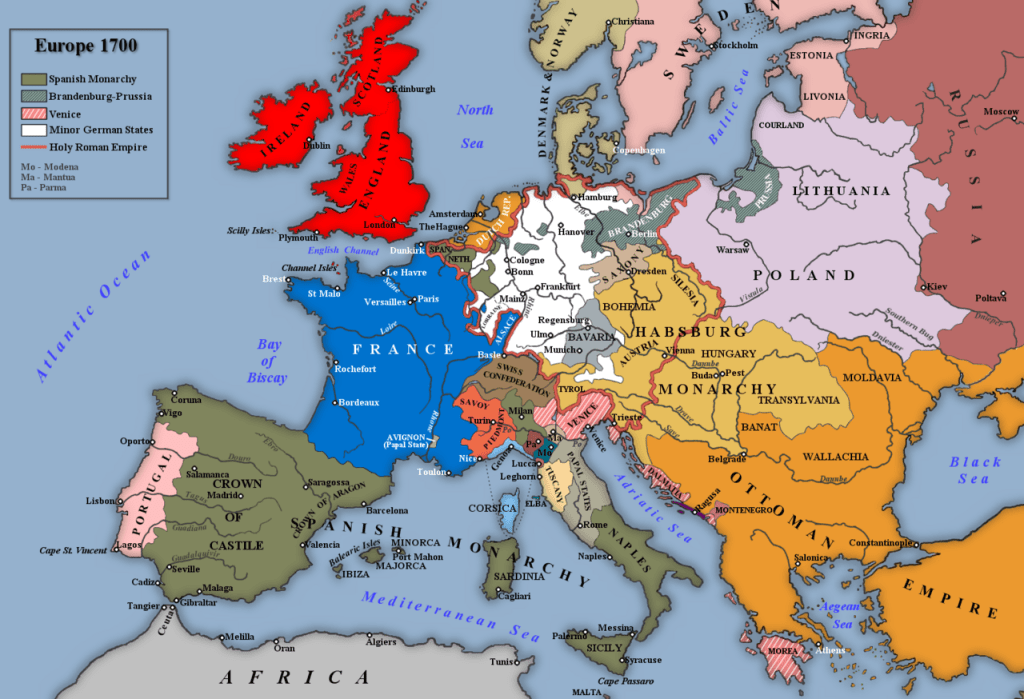
The 17th and 18th century is regarded as the transitionary phase from the Renaissance to Modernity. It was the age of the Baroque, Absolutism and the Enlightenment.
At the beginning of the 18th century, Absolutism still played a central role; in countries like France, for instance, the royal family and the aristocratic elite lived a luxurious lifestyle while the people suffered from extreme poverty and dependency.
These horrid conditions were increasingly criticized by philosophers, writers and politicians who advocated for liberty, equality and overcoming the social deficiencies.
The ascension of the bourgeoisie (Bürgertum) was a result of the closer examination of the current social structure, religion and absolutism which led, in turn, to the decline of the aristocracy. Through education and capital, the bourgeoisie was no longer dependent on the aristocratic class and could carry on commerce themselves. The height of this development was the French Revolution with its call for „liberté, égalité, fraternité“ (= liberty, equality, fraternity).
Abolutism understood itself as a god-given system of governance, demanding serfdom and subordination from the people. By contrast, the thought of the Enlightenment questioned this basis of legitimacy. Thus, the Enlightenment is strongly interwoven with the French Revolution, but not solely responsible for it.
The Revolution itself happened over a time span of 10 years divided into 3 phases:
1. 1789-1791
The struggle for civic rights and the reform into a constitutional monarchy.
2. 1792-1794
Foundation of the Republic.
3. 1795-1799
Rule of the Directory (political leadership guided by the interests of the bourgeoisie), the interests of the property-owning bourgeoisie (social justice) clash with monarchist ambitions of restoration.
The Reign of Terror („La Terreur„) which lasted from September 5, 1793 to July 27, 1794, was therefore part of the second phase. It ended with the execution of Maximillien de Robespierre (May 6, 1758 – July 28, 1794).
| Kant on the French Revolution |
| When it comes to the French Revolution, the political side of Immanuel Kant was an ardent supporter of it: „The >>political<< – one could also say: the historico-philosophical – Kant remains an admirer of the new France. No Robespierre or Guillotine led him astray from his opinion that this is where the future dawned. Contemporary witnesses gave account to his blue-white-red passion. When the French Republic was proclaimed in 1792 he is said to have quoted the protestant Lukas, we learn from Karl August Varnhagen von Ense: „Herr! Nun lasse Deinen Diener in Frieden dahinfahren, denn ich habe das Heil der Welt gesehen!“ (= „Lord! Now let your servant pass away in peace, for I have seen the salvation of this world!“). […] „The ministry official Georg Heinrich Nicolovious quotes Kants view in 1794: „All of the atrocities occuring in France right now are insignificant compared to the ongoing wickedness of despotism which had previously been institutionalized in France.“ Internally, he wrestled with the jurisprudential Kant and was torn. In his writings, he’s less clear about it – possibly restraining himself due to censorship. Especially since the death of Frederick the Great in 1786 he suffered from censorship apparatus, because the new king Frederick Wilhelm II. fancied himself as the ‚oppressor of dissident opinions‘. |
| (source: ZeitGeschichte, 300 Jahre Kant, Nr 1/2024, p. 79) |
Kant’s Definition
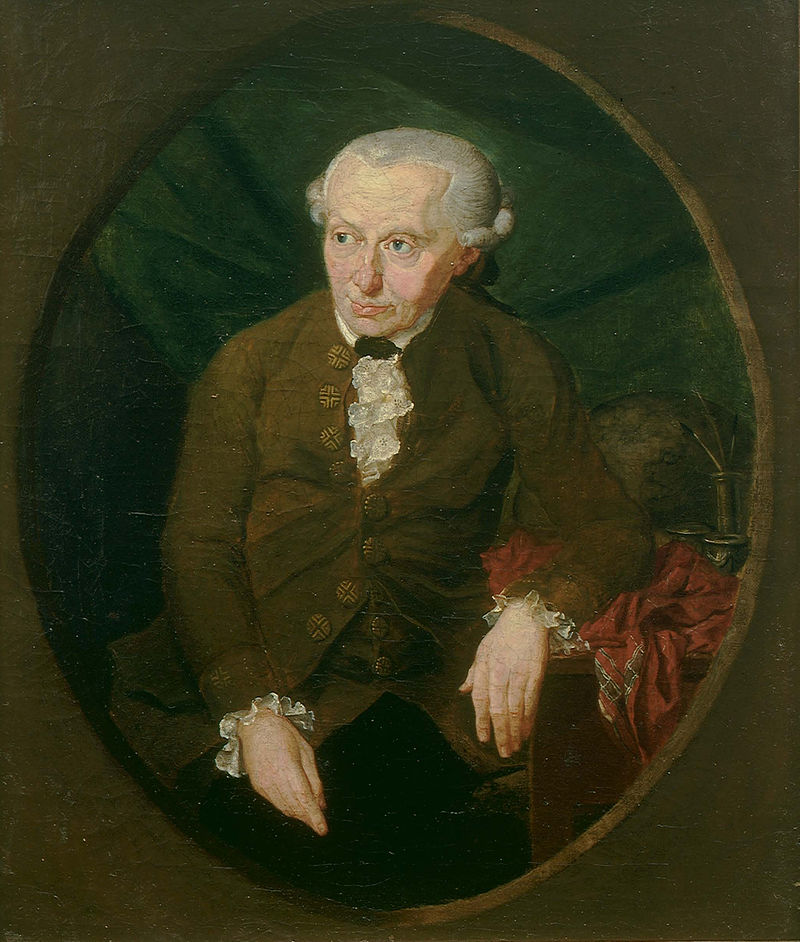
Born on April 22, 1724, Immanuel Kant was the fourth of ten children. He grew up in Königsberg, East Prussia (present day Kalinigard).
He died on February 12, 1804 in Königsberg at the age of 79 years.
He’s one of the most influential philosophers and his writing „Critique of Pure Reason“ (published in 1781) marked the beginning of modern philosophy.
His writings extend beyond epistemology as he also wrote foundational work in ethics called „Critique of Practical Reason“ (published in 1788) and in aesthetics the „Critique of Judgment“ (published in 1790). Next to these important writings he also wrote about religion, legal philosophy and philosophy of history.
In this blog entry, we’ll discuss his writing „An Answer to the Question: What is Enlightenment?“ (1784). It is an excerpt from a book called „Texte zur Freiheit“ which was published in the Reclam publishing company in 2014 (editor: Jonas Pfister).
I don’t know if there’s an English version available, though.
What is Enlightenment?
Kant begins his explanation by stating that the Enlightenment is humanity’s emergence from its self-imposed immaturity. Immaturity is described as the inability to „use one’s mind without the guidance of another’s“. It becomes self-imposed when the reason for immaturity is not the lack of reason, but rather the „resolution and courage to use one’s reason without the guidance of another“.
„Sapere aude!“ (Dare to know) is therefore, to him, the slogan of the Enlightenment.
He further criticizes that this immaturity is still widespread by giving an example: „If I have a book for my intellect, a pastor for my conscience, a doctor who assesses my diet, etc., I myself have no need to put in any effort. I do not need to think if I can simply pay; there are others who will do this irksome business for me instead.“
Thus, it also evolves into a critique of the current status – which, as we know, is the absolutist system which demands serfdom and subordination . This „supervision“ let the people become ignorant on purpose and were raised to „never make a step outside of the baby walker“. They were then shown the dangers they’d find themselves in if they dared to walk alone.
Kant believed that humanity would learn to walk after falling several times.
The dangers they are made to believe to exist, prevents them from even trying. Consequently, it would be difficult for an individual to free themselves from the „near inherently grown into immaturity“. They may even have grown fond of their immaturity and are incapable – for the time being – of using their own mind, because nobody let them try it before.
On the contrary, „an audience“ (all people at a location) could enlighten themselves.
It’d even be inevitable, if they were given the freedom to do so. In the end there’d always be independent-minded individuals, even among the former custodians, who spread this thought. The audience could only slowly reach Enlightenment: „A revolution may get rid off personal despotism and profit- or power-seeking oppression, but a true reform of the mindset would never occur; instead, new prejudices will guide the thoughtless masses just as the old prejudices did.“
Furthermore, Immanuel Kant makes a distinction between two different limitations – one that is beneficial to the enlightenment, and the other that is not.
| Usage | Limitiation |
| Public Usage | This one must always be unobstructed and it alone can lead to enlightenment. Kant understands this public use as one’s own reason, the scholar who puts it to use in front of the reading public. |
| Private Usage | This one is allowed to be more limited, without preventing the progress of enlightenment. Here, one can use one’s own reason within the boundaries of a occupation or official position with which one has been entrusted. |
An example given by Kant explains the difference between „Öffentlicher Gebrauch“ (public usage) and „Privater Gebrauch“ (private usage) better: „For an officer it would be ruinous if he, in the line of duty, was loudly reasoning about the purposefulness or usefulness of an order; he has to follow orders. However, as a scholar he cannot be denied to make remarks about errors made during the military service and reveal it to the reading public so that they can issue their own judgement.“ (the other two examples were about a citizen and a cleric, same structure)
As a scholar, you should therefore be able to enjoy unrestricted freedom to use your own mind and speak for yourself.
Sources
Where I could find an English equivalent, I added it beneath the German source. Some sources were already in English, so it wasn’t necessary to do so. However, there are a few exceptions when no equivalent was found.
Here the main sources I have used:
Ereignisse im 18. Jahrhundert
https://www.was-war-wann.de/1700/index.html
Politische und wirtschaftliche Ursachen der Französischen Revolution
https://www.lernhelfer.de/schuelerlexikon/geschichte/artikel/politische-und-wirtschaftliche-ursachen-der-franzoesischen
French Revolution (economic and political reasons)
https://www.britannica.com/event/French-Revolution/Counterrevolution-regicide-and-the-Reign-of-Terror
Aufklärung: Epoche der Vernunft (1720–1800)
https://abi.unicum.de/abitur/abitur-lernen/aufklaerung-epoche
Enlightenment (Stanford Encyclopedia)
https://plato.stanford.edu/entries/enlightenment/
Immanuel Kant Biographie
https://whoswho.de/bio/immanuel-kant.html
Biography of Immanuel Kant
https://www.britannica.com/biography/Immanuel-Kant
Texte zur Freiheit (Reclam Verlag)
ISBN 978-3-15-018997-9
ZeitGeschichte (Nr 1/2024)
Kant – Wie der große Philosophy der Aufklärung unsere Welt bis heute prägt
Individual Sources
Acts of Union 1707
https://www.parliament.uk/about/living-heritage/evolutionofparliament/legislativescrutiny/act-of-union-1707/
Großer Nordischer Krieg (1701-1721)
https://www.wikiwand.com/de/Gro%C3%9Fer_Nordischer_Krieg
Second Northern War (1700-1721)
https://www.britannica.com/event/Second-Northern-War
Spanischer Erbfolgekrieg
https://www.br.de/themen/bayern/sendlinger-mordweihnacht-hintergrund100.html
The War of the Spanish Succession
https://www.royalhampshireregiment.org/about-the-museum/timeline/war-spanish-succession/
Die Pestepidemie und Gründung der Berliner Charité
https://www.aerzteblatt.de/archiv/67859/300-Jahre-Berliner-Charite-Die-Pest-die-Weisse-Frau-und-eine-weitgreifende-Kabinettsorder
Founding the Beliner Charité
https://www.charite.de/en/charite/campuses/campus_charite_mitte/history_of_campus_charite_mitte/
Russisch-Türkische Kriege
https://de.wikipedia.org/wiki/Russisch-T%C3%BCrkische_Kriege
History of the Russo-Turkish Wars
https://en.wikipedia.org/wiki/History_of_the_Russo-Turkish_wars
Älteste Porzellan-Manufaktur in Europa
https://www.mz.de/leben/manufakturen-in-deutschland-in-meissen-steht-europas-alteste-porzellanmanufaktur-2890951
Europe’s Porcelain Factory
https://www.erlebniswelt-meissen.com/en/manufactory
Papiergeld in Frankreich 1720
https://www.faz.net/aktuell/finanzen/fonds-mehr/historische-finanzkrisen-frankreich-1720-aufstieg-und-fall-von-john-laws-finanzsystem-1283673.html
< The Murderer, The Boy King, And The Invention Of Modern Finance
https://www.npr.org/transcripts/909876702
Tibet Einverleibung im 18. Jahrhundert durch das Manchu-Dynastie
https://www.tagesschau.de/ausland/tibet372.html
Tibet under Manchu overlordship
https://www.britannica.com/place/Tibet/Tibet-14th-to-19th-century
Britische Rezession im Jahre 1720 – Südseeblase
https://www.tagesschau.de/wirtschaft/boerse/finanzmaerkte-suedseeblase-101.html
The South Sea Bubble
https://www.historic-uk.com/HistoryUK/HistoryofEngland/South-Sea-Bubble/
Friedrich II. (Flucht als Jugendlicher mit seinem Freund, Schlesische Kriege, usw.)
https://www.lernhelfer.de/schuelerlexikon/geschichte/artikel/friedrich-ii#
Österreichischer Erbfolgekrieg (1740-1748)
https://www.wikiwand.com/de/%C3%96sterreichischer_Erbfolgekrieg
War of the Austrian Succession (1740-1748)
https://www.britannica.com/event/War-of-the-Austrian-Succession
Christian VI. (1730-1746)
https://en.wikipedia.org/wiki/List_of_Danish_monarchs
Christian VI. of Denmark
https://en.wikipedia.org/wiki/Christian_VI_of_Denmark
Ivan VI.
https://www.britannica.com/biography/Ivan-VI
Ivan VI of Russia
https://en.wikipedia.org/wiki/Ivan_VI_of_Russia
Vertrag von Madrid (1750)
https://de-academic.com/dic.nsf/dewiki/1459023
Madrid, Treaty of (1750)
https://www.encyclopedia.com/humanities/encyclopedias-almanacs-transcripts-and-maps/madrid-treaty-1750
Antonio Salieri (1750-1825)
https://de.wikipedia.org/wiki/Antonio_Salieri
Antonio Salieri
https://en.wikipedia.org/wiki/Antonio_Salieri
Johann Sebastian Bach (1685-1750)
https://de.wikipedia.org/wiki/Johann_Sebastian_Bach
Johann Sebastian Bach
https://en.wikipedia.org/wiki/Johann_Sebastian_Bach
Voltaire (1694-1778)
https://de.wikipedia.org/wiki/Voltaire
François-Marie Arouet
https://en.wikipedia.org/wiki/Voltaire
Franzosen- und Indianerkrieg (1754-1763)
https://www.deinlexikon.de/wiki/Franzosen-_und_Indianerkriege
Der Siebenjährige Krieg (1756-1763)
https://www.deinlexikon.de/wiki/Siebenj%C3%A4hriger_Krieg
Seven Years‘ War (1756-1763)
https://www.britannica.com/event/Seven-Years-War
James Watt Dampfmaschine (Patent Nr. 913)
https://www.deutschlandfunk.de/vor-250-jahren-als-james-watt-das-patent-auf-seine.871.de.html?dram:article_id=437216
James Watt (1736-1819)
https://digital.nls.uk/scientists/biographies/james-watt/index.html
Captain James Cook (1728-1779)
https://www.britannica.com/biography/James-Cook
Hungersnot 1770-1772
https://www.wissenschaft.de/magazin/weitere-themen/hungern-und-handeln/
Partition von Polen (1772, 1793, 1795)
https://www.britannica.com/event/Partitions-of-Poland
USA Unabhängigkeitserklärung 1776
https://www.bpb.de/internationales/amerika/usa/10590/eine-nation-entsteht
Declaration of Independence: A Transcription
https://www.archives.gov/founding-docs/declaration-transcript
Bayrischer Erbfolgekrieg 1779
https://www.hdbg.de/polges/pages/kap5b.htm
War of the Bavarian Succession
https://www.britannica.com/event/War-of-the-Bavarian-Succession
Bewaffnete Seeneutralität
https://archivdatenbank.gsta.spk-berlin.de/midosasearch-gsta/MidosaSEARCH/i_ha_gr_rep_69/index.htm?kid=274acc7a-8975-48d6-a6a7-3414b17d82a7
League of Armed Neutrality
https://www.oxfordreference.com/display/10.1093/oi/authority.20110803100056830
Maria Theresia (1717-1780)
https://de.wikipedia.org/wiki/Maria_Theresia
Maria Theresa
https://en.wikipedia.org/wiki/Maria_Theresa
Schlacht in Yorktown (Kapitulation von Lord Charles Cornwallis)
https://www.wissenschaft.de/zeitpunkte/schlacht-in-yorktown/
Siege of Yorktown
https://www.britannica.com/event/Siege-of-Yorktown
Joseph II. (Reformen)
https://www.geschichtewiki.wien.gv.at/Joseph_II.
Early reign of Joseph II, 1780–85
https://www.britannica.com/place/Austria/Reforms-1763-80
Friedrich Schiller („Die Räuber“, 1781)
https://www.friedrich-schiller-archiv.de/inhaltsangaben/zusammenfassung-die-raeuber/
Friede von Paris (3. September 1783)
https://www.wissenschaft.de/zeitpunkte/friede-von-paris/
Treaty of Paris (1783)
https://www.archives.gov/milestone-documents/treaty-of-paris
Empress of China (1890-1911)
https://en.wikipedia.org/wiki/RMS_Empress_of_China_(1890)
 Baroque