
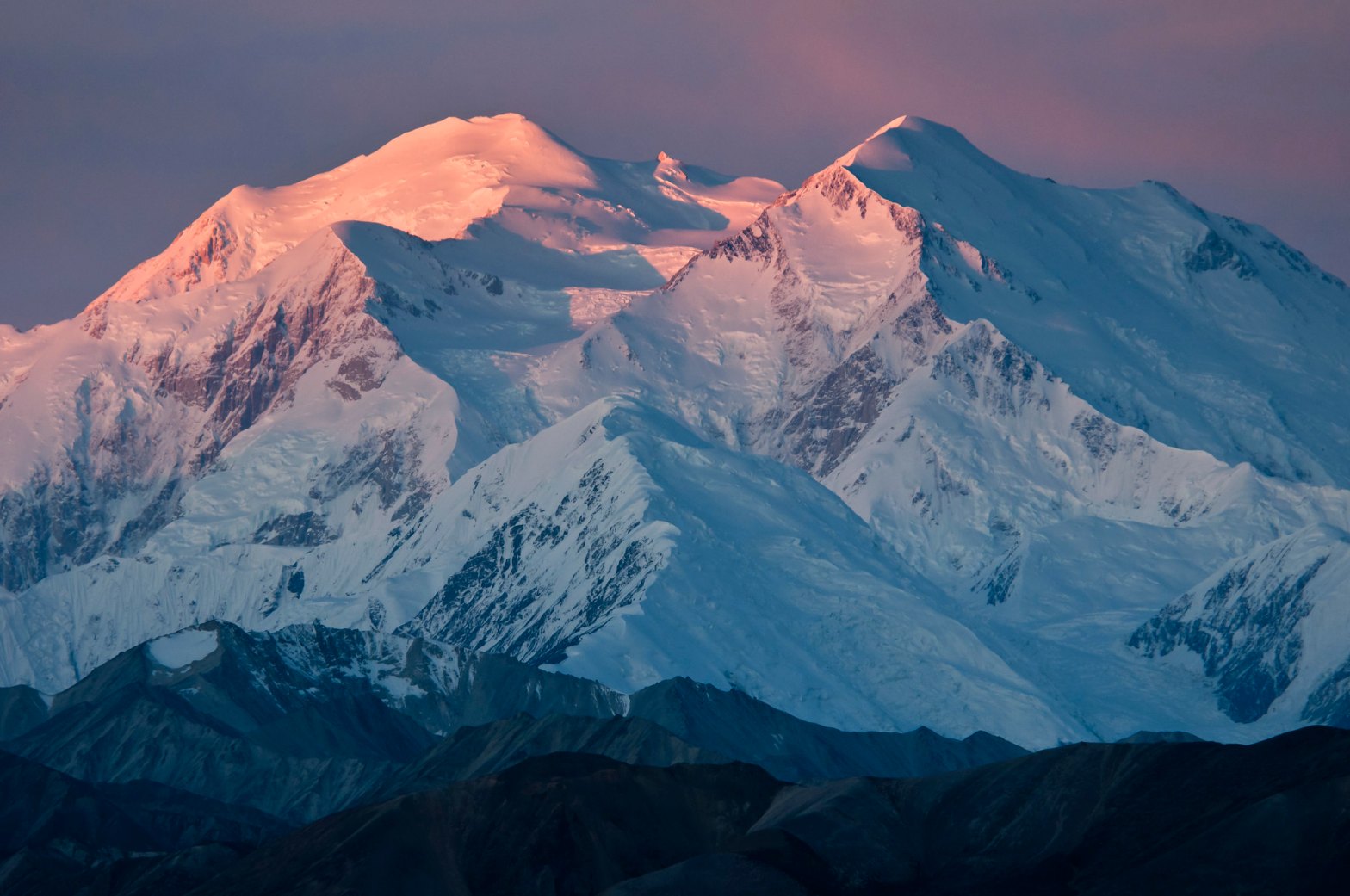
Denali is the highest mountain in North America, measuring 6,190 m (20,310 feet) at its peak. In this blog entry, however, we do not only talk about the mountain but also the native people who named this mountain „the tall one“.
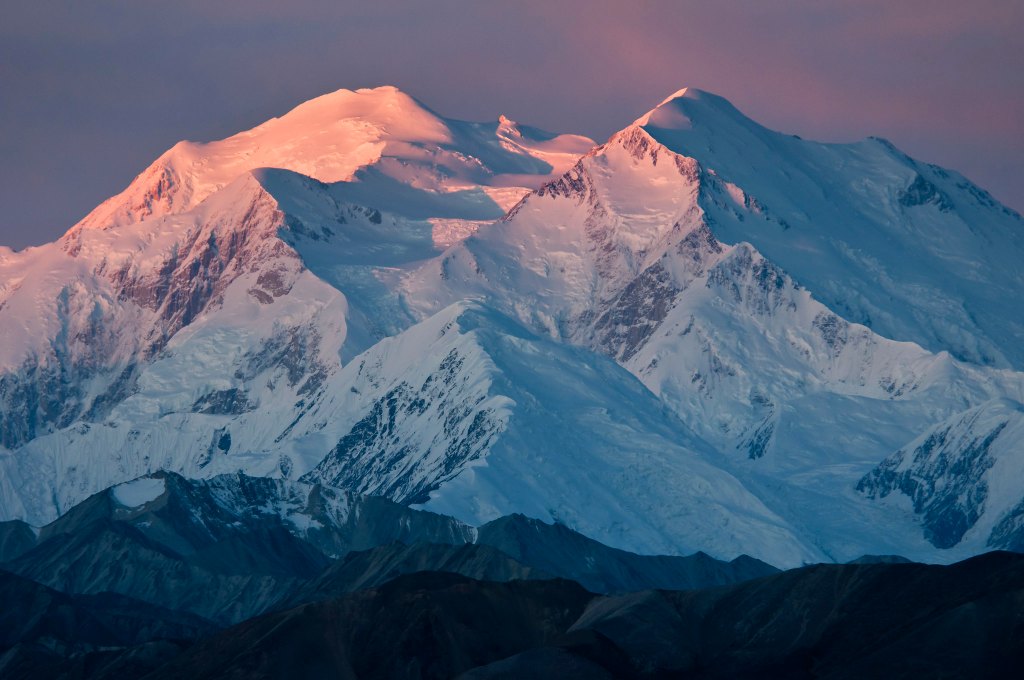
(source: Flickr)
The Mountain
Mount Denali and the other mountains of the Alaska Range were formed about 60 million years ago through tectonic uplift, it is a direct result of the still ongoing collision between the the Pacific Plate and the North American Plate. While it is not a volcano, there’s still considerable seismic activity and earthquakes are frequent but low in intensity (around 600 seismic events occur within the Denali National Park and the magnitude measuring between 1.5 and 2.0). Moreover, the mountain also continues to grow and increases in height by approximately 1 millimeter each year.
This brings us to the type of rocks Denali consists of.
Denali is primarily composed of granite (an igneous rock type) and metamorphic rocks (such as slate and marble). Igneous rocks form when magma or lava solidify; they are further distinguished between intrusive igneous rocks when they solidify beneath the Earth’s surface and extrusive igneous rocks when magma reaches the Earth’s surface (becoming lava) solidifying there (examples would be basalt and andesite).
Metamorphic rocks are rocks that are modified by heat, pressure and chemical processes.
Here, we also distinguish between two types: foliated metamorphic rocks, which appearance is layered or banded and formed through exposure to heat and directed pressure (examples: slate and gneiss); non-foliated metamorphic rocks, which are neither layered nor banded in appaerance as they often lack minerals that form plates (examples: marble and quartzite).
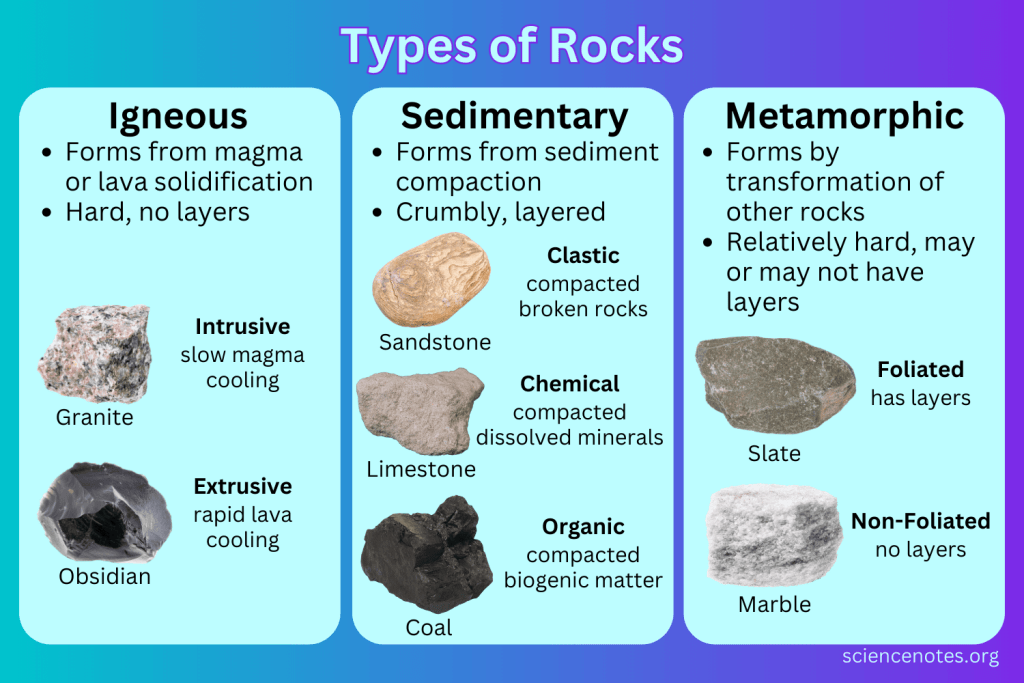
(Link: https://sciencenotes.org/types-of-rocks-igneous-sedimentary-metamorphic/)
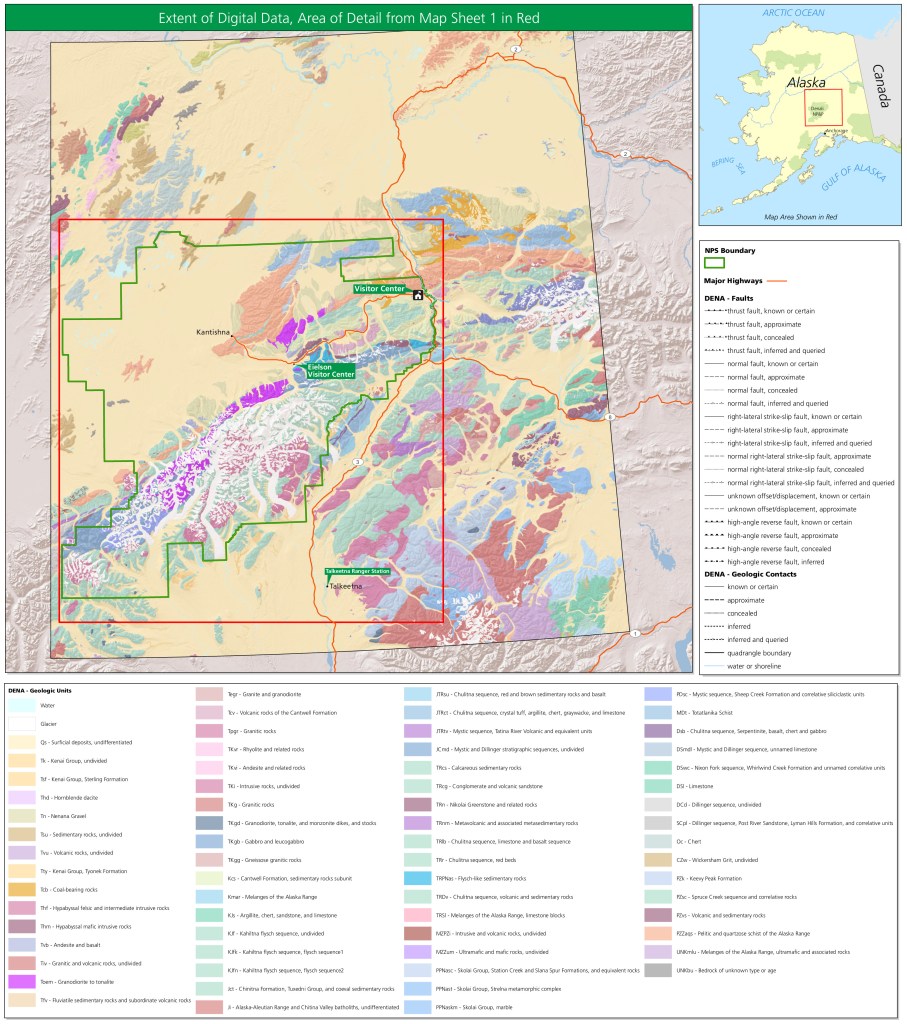
The following maps shows the geology of all rock layers within the Dali National Park.
As the name already implies, the Mount Denali is the centerpiece of the National Park and Preserve which spans 2.4 million hectares (6 million acres) of land.
(source: National Park Maps https://npmaps.com/denali/)
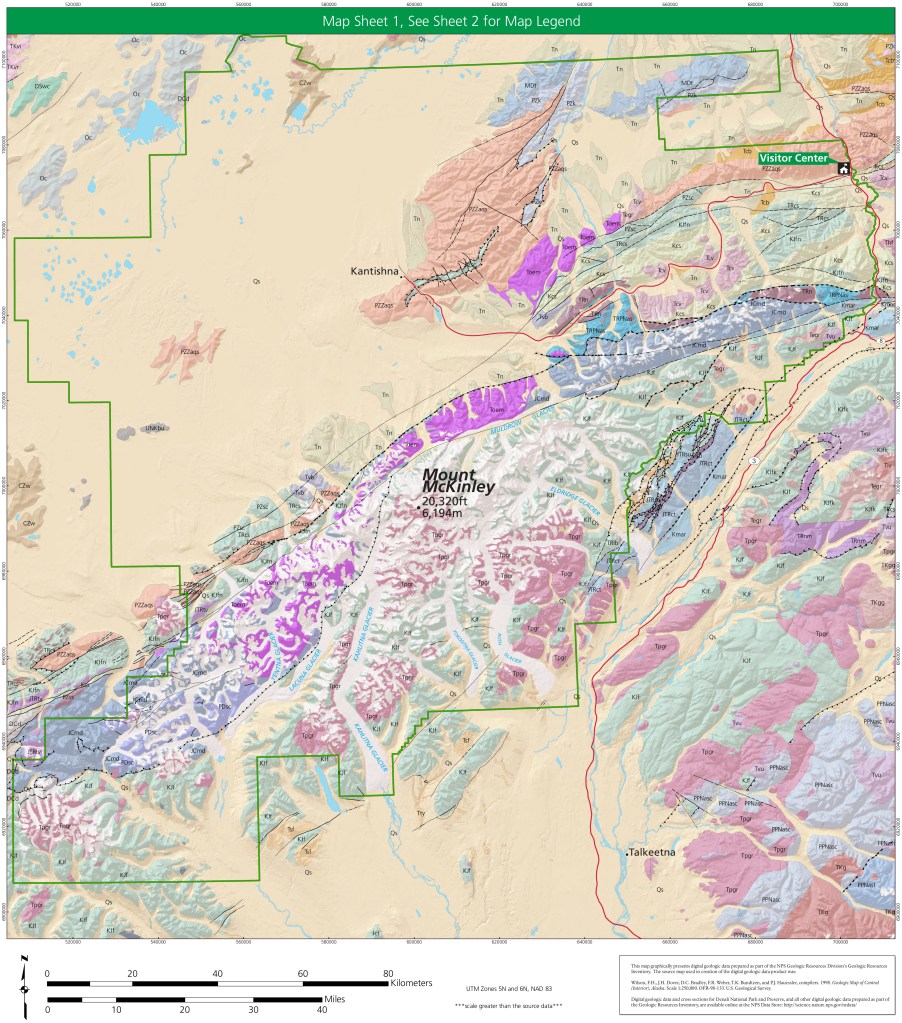
Additionally, here’s the map including what each colour represents:
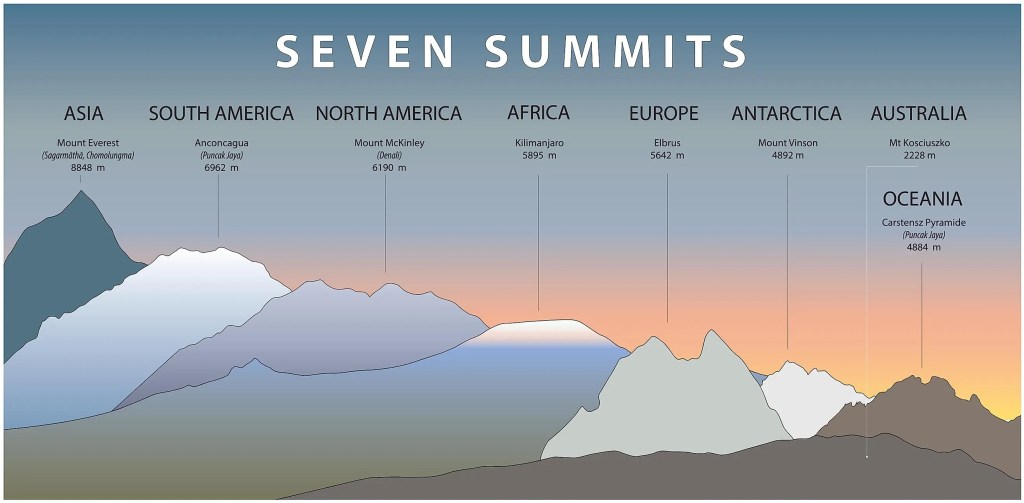
Denali itself also belongs to The Seven Summits. The highest mountain per continent.
The tallest mountain is Mount Everest in Asia while Mount Kosciuszko in Australia is the shortest. Only 350 people managed to climb all seven mountains so far.
However, there are two different lists for the Seven Summits.
1) The Bass List created by American climber Dick Bass (1929-2015).
„The high-mountain expeditions were mounted in partnership with Frank Wells and a number of professional guides, beginning in 1981 and culminating with a successful Everest ascent in 1984.“ (International Skiing History Association)
The Bass Seven Summits are Asia’s Everest (8,848 m), South America’s Aconcagua
(6,961 m), North America’s Denali (6,194 m), Africa’s Kilimanjaro (5,895 m), Europe’s Elbrus (5,642 m), Antarctica’s Vinson (4,892 m), and Australia’s Kosciuszko (2,228 m)
2) The Messner List created by South Tyrolean mountaineer Reinhold Messner (1944).
„In 1978 he and Austrian Peter Habeler were the first to climb Mount Everest (29,035 feet [8,850 metres]), the highest mountain in the world, without the use of contained oxygen for breathing, and two years later he completed the first solo ascent of Everest, also without supplemental oxygen. He was the first person to climb all 14 of the world’s mountains that exceed an elevation of 26,250 feet (8,000 metres).“ (Encyclopedia Britannica)
Messner’s List only has a slight modification of Bass‘ list by replacing Australia’s Kosciuszko with the mountain Puncak Jaya in Indonesia (4,884 m). He wanted to shift the focus from Australia to the region of Oceania more broadly. Puncak Jaya is Indonesian for „glorious peak“.
(source: World Atlas)
The Native People and Mount Denali’s Significance
To the indigenous people of the region, the mountain is a sacred entity.
The name comes from the Koyukon Athabascan language and means „the high one“ or „the tall one“ and has been used for millennia and by early non-native researchers and naturalists. This changed in 1896 when William A. Dickey, a prospector, began calling it after William McKinley (1843-1901) who only was a presidential candidate at the time and held the presidency from 1897 until his assassination in 1901. 16 years later, Congress decided to officially name it after McKinley. In 1975, a movement began to rename it to Denali but it was blocked by politicians in Ohio, McKinley’s home state. In 2015, the efforts seemed to finally pay off when then-President Barack Obama (1961) and Secretary of the Interior Sally Jewell (1956) took action to recognize it’s true name: „The renaming in 2015 symbolized recognition of indigenous history and culture and reflected a shift in appreciation towards acknowledging the heritage of the land.“ (NCESC)
Unfortunately, 10 years later, the far-right tyranny of the Second Trump Administration came into full force and next to aggressive imperialistic demands to annex Canada, Greenland and the Panama Canal the old imperialistic side of the US returned too by renaming Denali to McKinley again. Hence, I seek to spread the word why even very small and seemingly insignificant acts such as using the original name (unfortunately I do not have the skill to alter maps like the one about its geology) have a meaning to some.
Denaakk’e
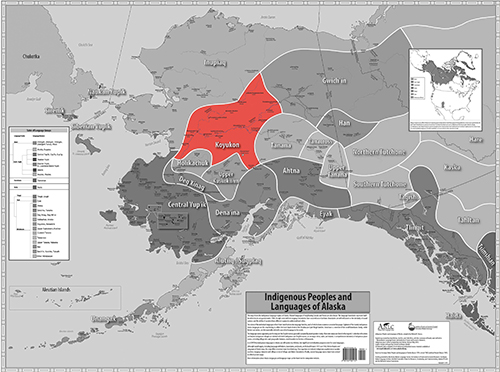
Koyukon is one of many Athabascan languages, but it occupies the largest territory.
The name is derived from the word denaa ‚people‘ and the suffix -kk’e ‚like, similar‘, thus literally meaning ‚like us‘. Denaakk’e is spoken in three dialects (Upper, Central, and Lower) in 11 villages „along the Koyukuk and middle Yukon rivers“. About 2,300 people in total live there of whom 300 speak the language.
(source: Alaska Native Language Center)
From 1899 through 1927, the Jesuit Catholic missionary Jules Jette (1864-1927) did extensive work on the language: „The submission of a paper to the 15th International Congress of Americanists, held at Quebec in 1906, marked the beginning of Jetté’s career as an ethnographer. He later published a number of articles on the social organization and religious traditions of the Koyukons in such periodicals as the Journal (London) of the Royal Anthropological Institute of Great Britain and Ireland in 1907, 1908, and 1909, Man (London) in the same years, and Anthropos (Vienna) in 1911 and 1913. He was also the author of a huge dictionary of some 30,000 words, which remained unpublished until 2000. Jetté made a considerable contribution to ethnography that was of excellent quality, to judge by the praise of anthropologists such as Frederica De Laguna and linguists such as Michael E. Krauss.“
(Source: Dictionary of Canadian Biography)
Several decades after his death, native-Denaakk’e speaker Eliza Jones (1938) sought to preserve her people’s language and co-authored the Koyukon Athabascan Dictionary (J. Jette and E. Jones, 2000, Alaska Native Language Center, University of Alaska Fairbanks).
Before, she worked at the Alaska Native Language Center at the University of Alaska Fairbanks from 1973 to 1990. In 1990, she received a honorary doctorate.
„When accepting the Hall of Fame award in 2016, Jones said she was grateful of the recognition given her achievements, then joked about one of her regrets.
“I know it wasn’t perfect. I made a lot of mistakes. I mean, the dictionary is called Koyukon Athabaskan Dictionary. Where the heck is the Native word in there? Now I think about it and I think, ‘Why didn’t I call it Denaakk’e?’” she said. “But you do what you do, best you can.”“
(University of Alaska Fairbanks)
In case you make the decision to buy the book, the ISBN is 1-55500-117-3.
Disclaimer: I recommend checking out your local bookshop, usually all you need is the ISBN (as I have shown above) and then it may arrive between 1-2 or 2-4 weeks (depending on where you live). Furthermore, I do not know whether the Alaska Native Language Center (which is part of the University of Alaska System) ships outside of the US.
So, if you live outside of the US (and want to avoid Amazon too), you know what to do.
It seems like you can buy it at the University of Alaska (Mall Site) website for $86 (€75.62):
https://epay.alaska.edu/C21563_ustores/web/product_detail.jsp?PRODUCTID=5692
However, you can also save money as they elaborate: „A PDF version of the dictionary is available on USB for $10 [€8,79].“
Common Expressions
| dzaanh nezoonh | hello |
| baasee‘ | thank you |
| enaa neenyo | welcome |
| gganaa‘ | good luck, friend |
History of the Koyukuk Native Village
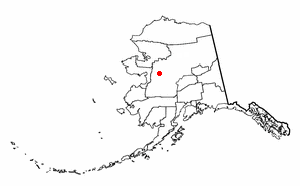
Since there are different villages each having their own history, I’ll present here the history of the Koyukuk Native Village – or well, at least the rather limited information I found.
(Source: Wikipedia)
Traditionally, the Koyukon Athabascans had spring, summer, fall and winter camps and moved as the wild animals migrated. Overall, there were 12 camps located on the Yukon River between the Koyukuk River and the Nowitna River. They had intergenerational friendships and trade relations with Inupiat Eskimos of the Kobuk area.
- 1838
Russians establish a trading post at nearby Nulato. - 1839
The first smallpox epidemic – one of several major epidemics. - 1867
Along the northside of Yukon, construction of a military telegraph line.
Koyukon became the site of a telegraph station.
Alaska was purchased by the US on March 30 for $7.2 million (equivalent to
$129 million in 2023). - 1880
Trade post opened. - 1884-1885
The Organic Act of 1884 was passed by Congress, it provided a civil government for Alaska. Gold rush of 1884-1885.
Population at the time: 150 - 1887
Missionary activity was intensified along the Yukon.
Roman Catholic mission and school opened in Nulato. - 1898-1900
Post office operated in the area for two years. - 1900
With 46 boats in operation, steamboats on the Yukon peaked.
During the 1900s, food shortages and a measles epidemic reduced the native population by a third. - 1906
Gold seekers left Yukon. - 1919
Galena lead mines began operating. - 1939
Construction of the first school. Families now began to live at Koyukon all year. - 1973
Koyukuk was incorporated as a second-class municipality city under the Alaska statute (source: 2018 Koyukuk Community Plan, p. 11). - 1992
The Koyukuk Tribal Council operates from now under the Tribal Constitution of the Native Tribe of Koyukuk (source: 2018 Koyukuk Community Plan, p. 11). - 2012
As of this date, the population was 95.
In the village live primarily Koyukon Athabascans.
The community also experienced severe flooding from both the Yukon and Koyukuk Rivers.
During my research, I also came across community plans for the village Koyukuk.
The first one was published in November 2008 (10-year plan):
https://www.tananachiefs.org/wp-content/uploads/2020/03/Koyukuk-CP-2008.pdf
The second one was published 2018, a 5-year plan (2018-2023):
https://www.tananachiefs.org/wp-content/uploads/2022/07/2018-Koyukuk-Community-Plan.pdf
Here’s their Vision Statement from the most recent plan (2018-2023):
Mineelghaadze T’oh Bet’oh K’edeezoone
(Proud to be from the mountain, where beautiful people come
from)
We are happy, healthy, and hardworking Denaakk’e people who
teach and sustain strong cultural values and traditional lifestyle.
Together, we work with integrity, with full participation and
involvement to be successful and self-sufficient.
With deep respect for all and with great responsibility, we protect
the environment for mother earth and all the resources that she
has to offer; our land is clean and bountiful.
We set a high standard to live by to improve the quality of life for
all.
We gather together, we learn together, we sing and dance
together. We are unified, together we are one; together we are
strong.
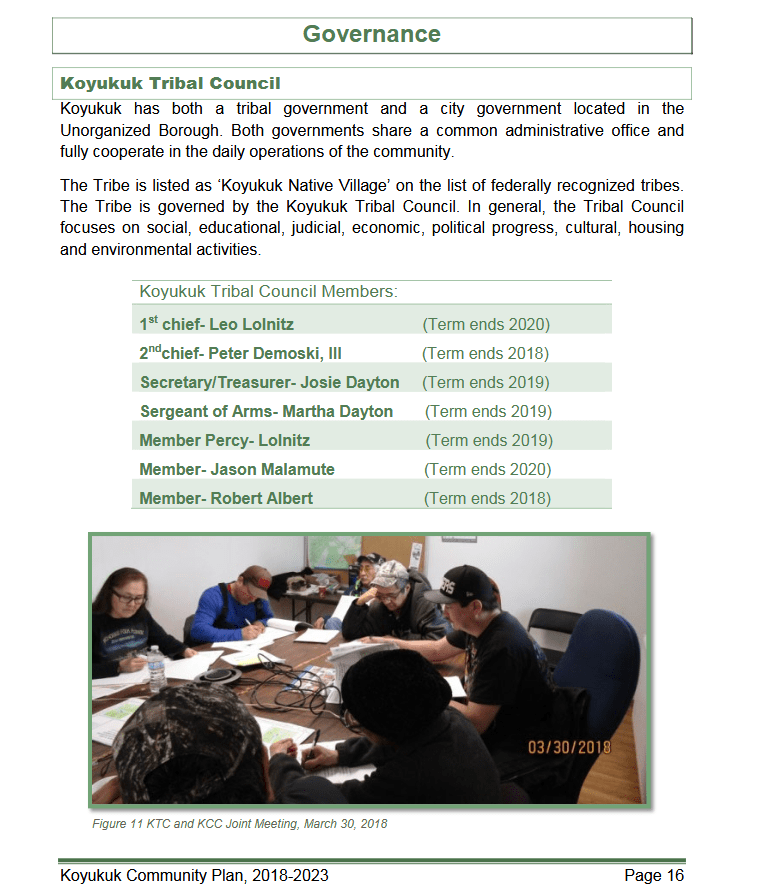
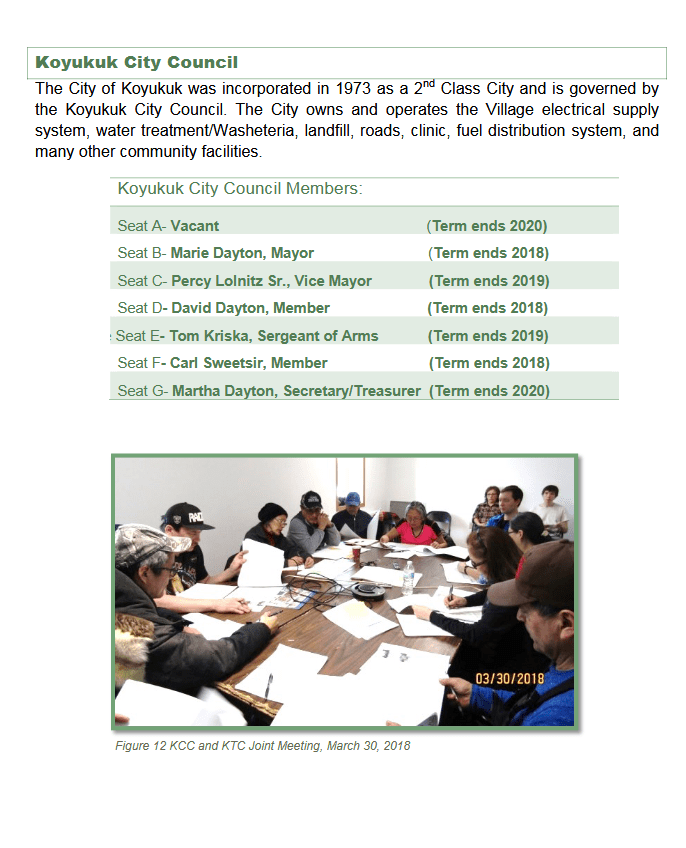
Finally, I’ll introduce you to the Koyukuk Tribal Council and Koyukuk City Council.
I figured that way the native people don’t remain an anonymous group.
Athabascan Woman Blog
At the end of this blog I would like to post an excerpt from an Athabascan woman who has her very own blog and posted long before I graduated from secondary school (Hauptschule, now a Werkreakschule). It’s about the Athabascan spiritual beliefs about hunting, fishing and gathering. Her name is Angela Gonzalez and her sister Tanya Yatlin is the editor.
„Girls in my family were not allowed to step over clothes, hunting tools and other items belonging to men and boys. Girls are not allowed to look at bears, talk about them or eat bear meat. If we did need to talk about it, we referred to them as ‘big animals’. The only women who were able to say the name or eat bear meat are older women. If you did any of the taboo things, you would be wishing them bad luck in hunting and other activities.
I remember thinking it was so unfair that the boys got all of the respect. I had chores of dishes, cooking and cleaning. I challenged my mom several times about the belief over the years. Her response was that it was hutla’nee (taboo). The boys had to do some chores inside the house, but most of them were outside, like chopping wood, feeding the dogs, picking up dog poop, and cleaning the yard.
[…]
Times are changing. We still hunt, fish and gather, but we can get store-bought food in between harvests. Some beliefs are not as strictly held as before. Girls are participating in more hunting activities, and are providing for families in different ways too. I am finally beginning to understand some of the beliefs, but I realize I still have a lot to learn. I see many Alaska Native people have similar cultural beliefs about respecting the land and animals.“
(Published: April 24, 2012)
I very much love the logo of their blog! It was designed by Cindy Shake Design.
For more, check out her blog:
Note: I also found out about the positive reaction the Athabascan people had to Obama’s decision to officially recognize the century-old name Denali in a post called „Alaska Native culture – Denali Name Restored“ from September 2, 2015.
Saddening and infuriating me even more that an old and senile imperialist, convicted felon and failed businessman insults the native population and history in such a way.
(see: Executive Order 14172 signed on January 20, 2025)
Sources
Encyclopedia Entry: Denali
https://education.nationalgeographic.org/resource/denali/
What is Denali in Geography? A Comprehensive Guide
(for a little information on climate, weather patterns and the ecosystems)
https://www.ncesc.com/geographic-faq/what-is-denali-in-geography/
Types of Rocks – Igneous, Sedimentary, Metamorphic
https://sciencenotes.org/types-of-rocks-igneous-sedimentary-metamorphic/
Denali Maps
https://npmaps.com/denali/
The Seven Summits
https://www.worldatlas.com/articles/the-seven-summits.html
Dick Bass – Mountaineer, Snowbird co-founder
https://www.skiinghistory.org/lives/dick-bass
Reinhold Messner – Italian Explorer
https://www.britannica.com/biography/Reinhold-Messner
William McKinley (1897-1901): The Dawn of an American Empire
https://enotrans.org/article/william-mckinley-1897-1901-the-dawn-of-an-american-empire/
Languages: Koyukon
https://www.uaf.edu/anlc/languages-move/koyukon.php
Julius Jetté
https://en.wikipedia.org/wiki/Julius_Jett%C3%A9
JETTÉ, JULES, professor, Jesuit missionary, ethnographer, and specialist in the Koyukon language
https://www.biographi.ca/en/bio/jette_jules_15E.html
Eliza Jones
https://jukebox.uaf.edu/p/3596
Eliza Jones
https://www.uaf.edu/centennial/uaf100/jones.php
Koyukuk Native Village
https://www.alaskan-natives.com/637/koyukuk-native-village/
Community of Koyukuk – Comprehensive Community Development Plan
(PDF-file: 66 pages)
https://www.tananachiefs.org/wp-content/uploads/2020/03/Koyukuk-CP-2008.pdf
2018-2023 Koyukuk Community Plan
(PDF-file: 77 pages)
https://www.tananachiefs.org/wp-content/uploads/2022/07/2018-Koyukuk-Community-Plan.pdf
Athabascan Spiritual Beliefs About Hunting, Fishing and Gathering
https://athabascanwoman.com/?p=433
 Baroque