
Last year, I published my Discord advent calendar on here. This years advent calendar focused more on spreading knowledge (the previous had a greater focus on poets and peoms) from the history of the Christstollen to the creation of humans in Sumerian myth, but we also have two paintings featured and four poems from Heinrich Heine! The history of the advent calendar (AC) remains unchanged, included for the sake of completeness. There’ll also be elaborations added to some little doors (Türchen, as they are called in German), since one DIN A4 page forces me to condense information to the best possible degree. Without further ado, let’s begin!
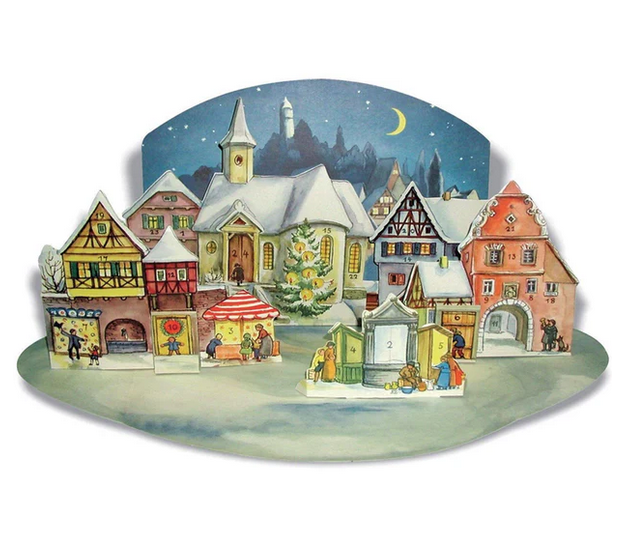
The classical advent calendar above (and many more) is available on the website of the Richard Sellmer Verlag. However, I don’t know if they ship outside of Germany. You can’t place any order right now either, because they have closed for holidays from December 15, 2025 to January 11, 2026.
-> Link: https://sellmer-adventskalender.com/collections/antique-advent-calendars/products/advent-calendar-moonlit-village?variant=39334116360357
History of the Advent Calendar
Before we move on to the actual advent calendar, let’s see how we’ve got here in the first place. Advent is latin and means „coming“, it originates from Christian customs to prepare spiritually for Christmas. It’s both for the celebration of the birth of Jesus Christ and the in preparation of the Second Coming of Christ (-> „Early Christians believed the Advent to be imminent, and most Christian theologians since then have believed that the visible appearance of Jesus may occur at any moment and that Christians should be ever ready for it“).
It is uncertain, however, when Advent was observed for the first time. The Encyclopedia Britannica mentions sources which dates it to the 4th century CE „when it was a period of preparation for the baptism of new Christians during Epiphany in January“. It was associated with Christmas by the time of Middle Ages (5th to 15th century).
Note: Most commercial advent calendars do not cover the entirety of the Advent season, because they usually begin on December 1. In Western churches, however, the Advent season begins on the Sunday nearest to November 30 (St. Andrew’s Day).
As for the origin of the analogous Advent calendar: German Protestants were known for counting down the days until Christmas. In this case not a calendar with little doors, but through activities like lighting a candle, placing a straw in a Nativity crib, ticking walls or doors with chalk, or hanging a devotional image on the wall.
There’s another story as well where a Munich housewife created the analogue calendar, because she was tired of „having to answer endlessly when Christmas would come“.
But to keep it short, here a timeline:
- Early 20th century: Appearance of first commercially printed calendars.
- 1920s: German publisher Gerhard Lang (1881-1974) added small doors with pictures behind it; other publishers included Bibel verses.
- 1939-1945: The Nazi-party banned the printing of calendars with images due to paper rationing. Only a few publishers began printing traditional calendars again after the war, like the Richard Sellmer Verlag which produces them to this day.
- 1950s: Introduction of chocolate behind the little doors.
- 21st century: Children are no longer the main target demographic, as companies began to start first small sample sizes of their products in festive packaging.
Adults can now count down to Christmas too with specialized Advent calendars that contain everything from gourmet foods to beauty products and fitness gear.
Excerpt from the 2024 blog entry „History of the Advent Calendar and More„, published on my blog on December 28, 2024.
Baroque’s Advent Calendar Nr. II
Little Door Nr. 1
„Advent, Advent, ein Lichtlein brennt…“
– One little light is shining during Advent time
It’s the beginning of the most known German poem which refers to the time until Christmas. “Advent” is derived from the Latin word “Adventus” which means “coming”, it refers to the four Sundays before Christmas until the Nativity of Christ is celebrated in Western churches.
The first Advent always falls between November 27 and December 3.
Then, each Sunday, a candle is lit on an Advent wreath with green twigs which serves as a protection against evil during the winter months. The twigs symbolize life and fertility.
Traditionally, the time is spent singing traditional songs, eating holiday cookies (Plätzchen) or reading the Bible story of Christmas. The advent I remember the most was the one where I got little Pokémon finger figures in my Advent calendar (they have a hole beneath so you can stick them on your fingers, pretty good quality and I still like to collect them from time to time), not every day but I think every 4th day I got one behind a little door (Türchen). (-> Kaiserslautern American)
Did you know that the first time Advent was celebrated was in the 4th century?
Back then it was just three weeks long and characterized by prayers and fasting.
The role model was the Passiontide, the time of fasting before Eastern.
In Rome it was first celebrated in the 6th century, but instead of four it was six Sundays.
Pope Gregory I., also called the Great (born ca. 540 – March 12, 604), reduced it to four Sundays. The Second Council of Trent (1545-1563) set the Advent time to four weeks for the entirety of the church. Miland being the sole exception to the rule (still six weeks).
(-> Wie und warum feiern wir Advent?)
Sources
Schools – Advent, Advent, ein Lichtlein brennt
https://www.kaiserslauternamerican.com/advent-advent-ein-lichtlein-brennt/
Gregor, „der Große“ (= Gregor, „the Great“)
https://www.heiligenlexikon.de/BiographienG/Gregor_I_der_Grosse.htm
Ursprung & Bräuche: Wie und warum feiern wir Advent?
https://www.mdr.de/religion/religion/advent-wann-wir-feiern-ursprung-legenden-brauchtum-symbole-104.html
PDF-File:
Little Door Nr. 2

In Deep Winter – Painting by Richard von Drasche-Wartinberg
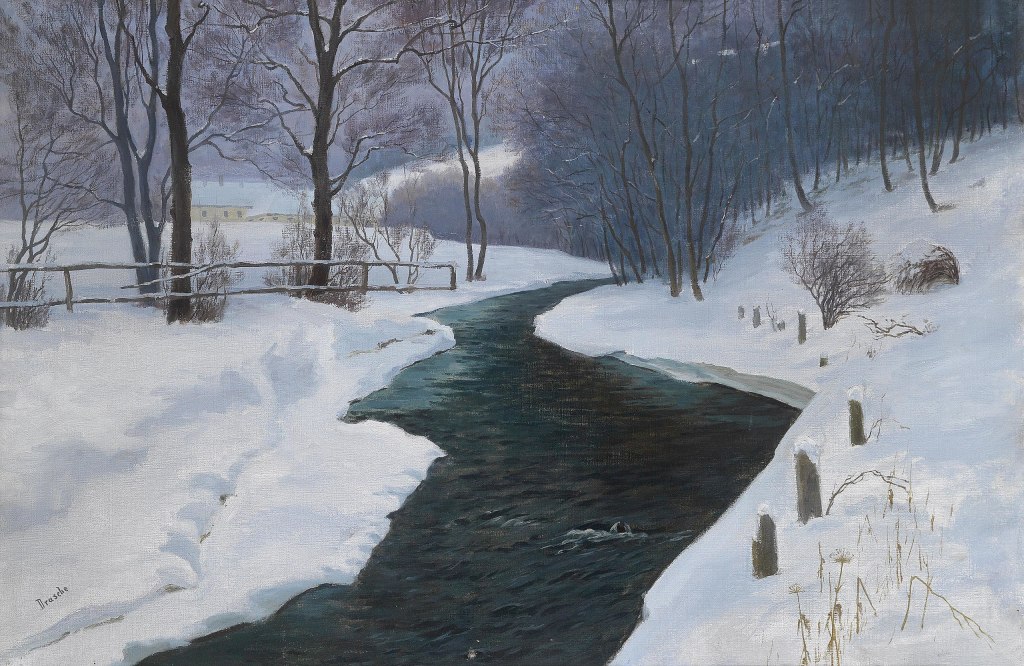
Richard Drasche lived from March 18, 1850 to July 3, 1923. He was an Austrian industrial magnate who was also an Asian explorer and painter. His painting career would start quite late though. Before 1900, he received private lessons from Eduard Ameseder (an Austrian painter). In 1902 he introduced himself as a guest to the Hagebund (1900 to 1938) and was member of it from 1903 to 1905. He preferred to paint alpine Winter landscapes.
In 1905 he became an ordinary member of the artist association Künstlerhaus Wien, from 1914 onwards he was an honourable member and regularly presented his art in exhibitions.
| In 1884, Drasche was even promoted to baronage by the Austrian Emperor Franz Joseph I. (1830-1916) and received a Wappenbesserung (coat of arms uplift). The baronage (Freiherr) was a title of nobility that originated in the Holy Roman Empire, but it remained in use in Austria and Germany until 1919. You likely already know what was meant by ‚coat of arms uplift‘ in this context: the coat of arms was changed to signify this promotion by the Emperor himself. Changes to coat of arms also occur over time. |
Source
Richard von Drasche-Wartinberg
https://de.wikipedia.org/wiki/Richard_von_Drasche-Wartinberg
PDF-File:
Little Door Nr. 3
Did you know…
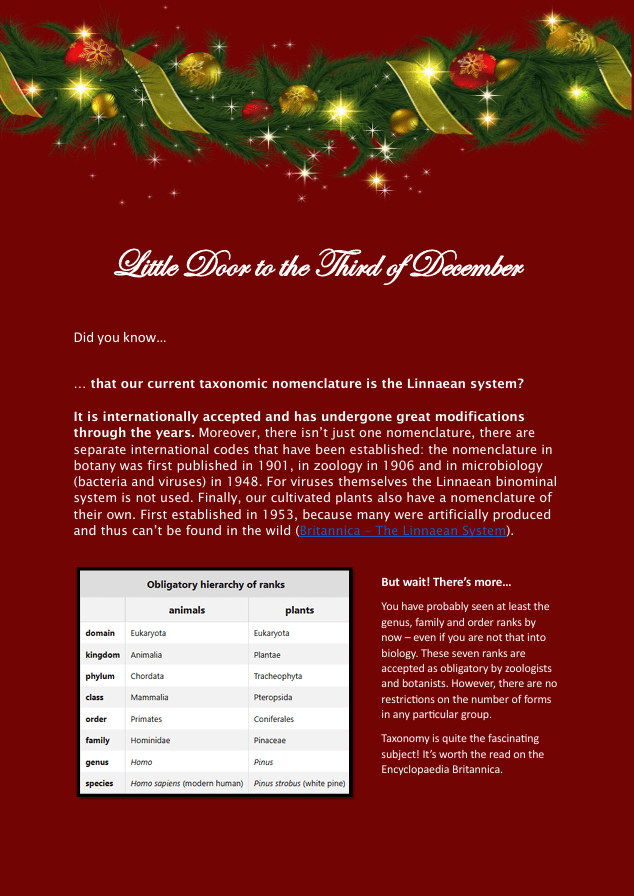
… that our current taxonomic nomenclature is the Linnaean system?
It is internationally accepted and has undergone great modifications through the years. Moreover, there isn’t just one nomenclature, there are separate international codes that have been established: the nomenclature in botany was first published in 1901, in zoology in 1906 and in microbiology (bacteria and viruses) in 1948. For viruses themselves the Linnaean binominal system is not used. Finally, our cultivated plants also have a nomenclature of their own. First established in 1953, because many were artificially produced and thus can’t be found in the wild (Britannica – The Linnaean System).
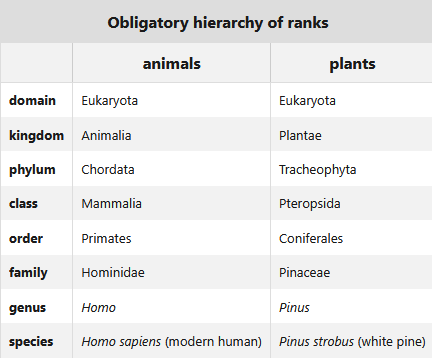
But wait! There’s more…
You have probably seen at least the genus, family and order ranks by now – even if you are not that into biology. These seven ranks are accepted as obligatory by zoologists and botanists. However, there are no restrictions on the number of forms in any particular group.
Taxonomy is quite the fascinating subject! It’s worth the read on the Encyclopaedia Britannica.
Source
The objectives of biological classification
https://www.britannica.com/science/taxonomy/The-objectives-of-biological-classification
PDF-File:
Little Door Nr. 4
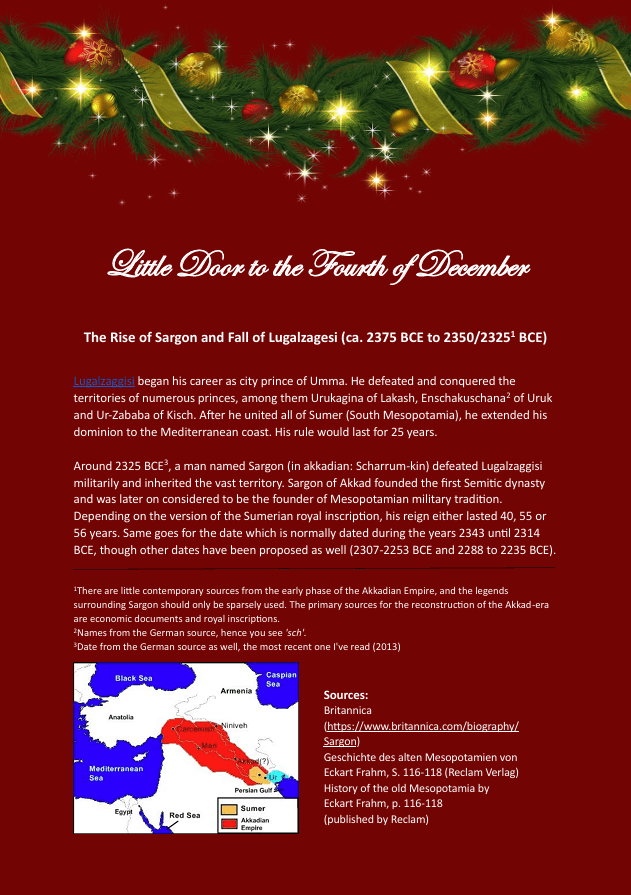
The Rise of Sargon and the Fall of Lugalzagesi (ca. 2375 BCE to 2350/23251 BCE)
Lugalzaggisi began his career as city prince of Umma. He defeated and conquered the territories of numerous princes, among them Urukagina of Lakash, Enschakuschana2 of Uruk and Ur-Zababa of Kisch. After he united all of Sumer (South Mesopotamia), he extended his dominion to the Mediterranean coast. His rule would last for 25 years.
Around 2325 BCE3, a man named Sargon (in akkadian: Scharrum-kin) defeated Lugalzaggisi militarily and inherited the vast territory. Sargon of Akkad founded the first Semitic dynasty and was later on considered to be the founder of Mesopotamian military tradition.
Depending on the version of the Sumerian royal inscription, his reign either lasted 40, 55 or 56 years. Same goes for the date which is normally dated during the years 2343 until 2314 BCE, though other dates have been proposed as well (2307-2253 BCE and 2288 to 2235 BCE).
1There are little contemporary sources from the early phase of the Akkadian Empire, and the legends surrounding Sargon should only be sparsely used. The primary sources for the reconstruction of the Akkad-era are economic documents and royal inscriptions.
2Names from the German source, hence you see ’sch‘.
3Date from the German source as well, the most recent one I’ve read (2013)

Sources
Britannica (https://www.britannica.com/biography/Sargon)
Geschichte des alten Mesopotamien von Eckart Frahm, S. 116-118 (Reclam Verlag)
History of the old Mesopotamia by Eckart Frahm, p. 116-118
(published by Reclam)
ISBN: 978-3-15-019108
PDF-File:
Little Door Nr. 5
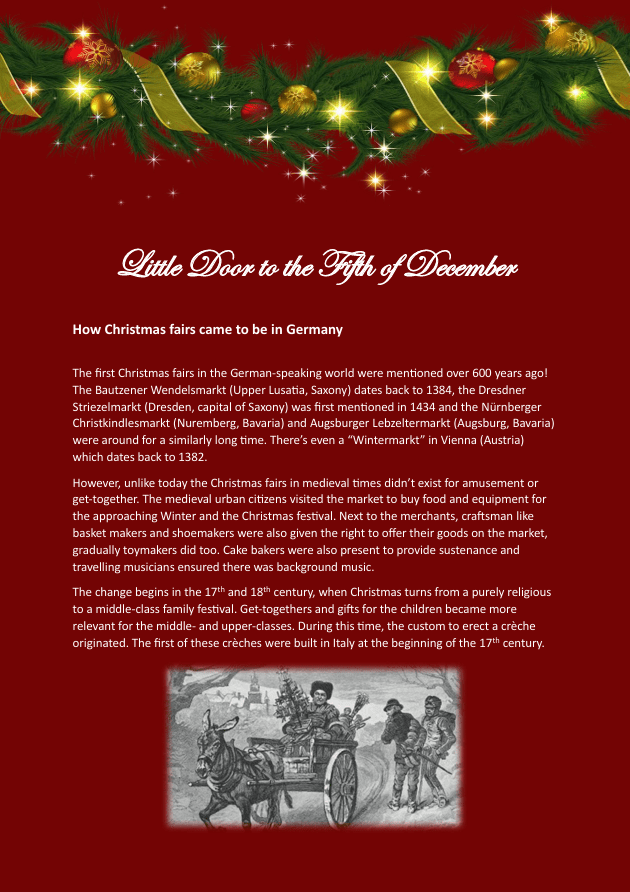
How Christmas fairs came to be in Germany
The first Christmas fairs in the German-speaking world were mentioned over 600 years ago! The Bautzener Wendelsmarkt (Upper Lusatia, Saxony) dates back to 1384, the Dresdner Striezelmarkt (Dresden, capital of Saxony) was first mentioned in 1434 and the Nürnberger Christkindlesmarkt (Nuremberg, Bavaria) and Augsburger Lebzeltermarkt (Augsburg, Bavaria) were around for a similarly long time. There’s even a “Wintermarkt” in Vienna (Austria) which dates back to 1382.
However, unlike today the Christmas fairs in medieval times didn’t exist for amusement or get-together. The medieval urban citizens visited the market to buy food and equipment for the approaching Winter and the Christmas festival. Next to the merchants, craftsman like basket makers and shoemakers were also given the right to offer their goods on the market, gradually toymakers did too. Cake bakers were also present to provide sustenance and travelling musicians ensured there was background music.
The change begins in the 17th and 18th century, when Christmas turns from a purely religious to a middle-class family festival. Get-togethers and gifts for the children became more relevant for the middle- and upper-classes. During this time, the custom to erect a crèche originated. The first of these crèches were built in Italy at the beginning of the 17th century.

Two wanderers look at him as he passes by.
Source
Weihnachtsmarkt-Geschichte: Einst Versorgung, heute Vergnügen
https://www.ndr.de/geschichte/chronologie/Weihnachtsmarkt-Geschichte-Von-der-Versorgung-zum-Vergnuegen,weihnachtsmarkt1370.html
PDF-File:
Little Door Nr. 6
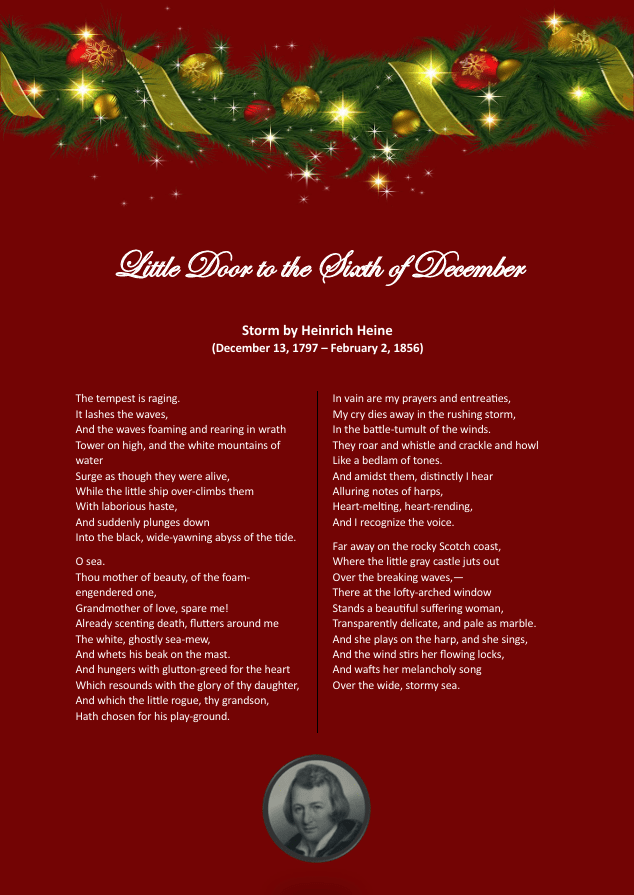
Storm by Heinrich Heine
(December 13, 1797 – February 2, 1856)
The tempest is raging.
It lashes the waves,
And the waves foaming and rearing in wrath
Tower on high, and the white mountains of water
Surge as though they were alive,
While the little ship over-climbs them
With laborious haste,
And suddenly plunges down
Into the black, wide-yawning abyss of the tide.
O sea.
Thou mother of beauty, of the foam-engendered one,
Grandmother of love, spare me!
Already scenting death, flutters around me
The white, ghostly sea-mew,
And whets his beak on the mast.
And hungers with glutton-greed for the heart
Which resounds with the glory of thy daughter,
And which the little rogue, thy grandson,
Hath chosen for his play-ground.
In vain are my prayers and entreaties,
My cry dies away in the rushing storm,
In the battle-tumult of the winds.
They roar and whistle and crackle and howl
Like a bedlam of tones.
And amidst them, distinctly I hear
Alluring notes of harps,
Heart-melting, heart-rending,
And I recognize the voice.
Far away on the rocky Scotch coast,
Where the little gray castle juts out
Over the breaking waves,—
There at the lofty-arched window
Stands a beautiful suffering woman,
Transparently delicate, and pale as marble.
And she plays on the harp, and she sings,
And the wind stirs her flowing locks,
And wafts her melancholy song
Over the wide, stormy sea.
Short Biography
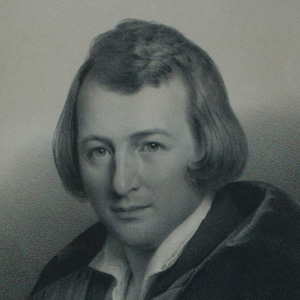
Born: December 13, 1797 as Harry Heine in Düsseldorf, Duchy of Berg
Died: February 17, 1856 in Paris, France
Heine is considered to be ‚the last poet of the romantic era‘ as well as the conqueror of it.
He made everyday language lyricable (lyrikfähig), elevated the Feuilleton (the lyrical, cultural or entertanining part of a newspaper) and travel reports to an artform and ‚bestowed German literature with an unprecedented elegant lightness‘. He is the most translated poet, which also explains why I was able to find English poems from him so easily. Next to poetry, he was also a journalist, essayist, satirist and polemicist.
He was both admired and feared. Unfortunately, he was treated with hostility by antisemites and nationalists because of his Jewish origin and political positions – even after his death. Heine was shaped by his life long role as an outsider.
13 December, 1797
In the Heine scholarship, this date is considered to be the most likely birth date.
Unfortunately, all contemporary files about him were lost over the last 200 years.
His father was Samson Heine (August 19, 1764 in Hannover; † Dezember 2, 1829 in Hamburg) and had a job as a cloth merchant; his mother Betty Heine (November 27, 1770 in Düsseldorf; † September 3, 1859 in Hamburg) born van Geldern, was the great-grandchild of the electoral court chamber agent Joseph Jacob van Geldern in whose home the first synagogue of Düsseldorf was established. Heine had three siblings.
1803
Harry Heine attends the israelite private school of Hein Hertz Rintelsohn.
1804
After the Electoral-Palatine-Bavarian government, the Duchy of Berg and its capital Düsseldorf were subordinated to it, allowed Jewish children to visit Christian schools Heine changed to the urban elementary school.
1807-1810
Preparatory class of the Lyceum of Düsseldorf (today the Görres-Gymnasium/-Highschool) which orientated itself on the late Enlightenment.
1810-1814
Attended the Lyceum, but left it without the leaving-certificate.
He followed the family tradition of going to a commercial school instead to prepare for a mercantile job.
1806-1815
Heine grew up in political turbulent times, as his childhood and juvenile years fell between the French Revolution and the Napoleonic Wars. In 1811, as a 13-years old, he witnessed the invasion of the French of Napoleon I. in Düsseldorf. Five years earlier, Maximilian Joseph von Bayern (1756-1825) transferred the sovereignty of the Duchy of Berg to the French Emperor. Contrary to what Heinrich von Treitschkes (1834-1896) claimed, the German version of Karl Lueger (1844-1910), Heine never requested to have French citizenship during the French occupation. Heine did admire the French Emperor for introducing the Code civil which put Jews on equal footing with non-Jews.
1815-1816
Heine works as a volunteer for the Frankfurter banker Rindskopff.
While working in Frankfurt, he learned about the oppressive and till then alien Ghetto-existence. In 1816, he got a different job at the bank company of his wealthy uncle Salomon Heine in Hamburg. While he supported him until his death in 1844, he showed little understanding for Heine’s literary interests.
1817
For the first time, the newspaper Hamburgs Wächer published Heine’s poems.
He wrote regularly since 1815.
1819
Since Heine had neither talent nor an inclination for financial transactions, his uncle organized a cloth business for him called Harry Heine & Comp. It quickly went bankrupt, because Heine devoted his time to the art of poetry. In the same year, after some intra-familial conflicts, he was allowed to go studying at the Rhenish Friedrich-Wilhelms-Universität where he studied jurisprudence and cameral sciences. However, he only attended one juridicial lecture. During the Winter Semester 1819/1820, Heine attended the lectures about the history of the German language and poetry from August Wilhelm Schlegel (1767-1845). The co-founder of romanticism had a large literary impact on the young Heine, in his later works Heine wrote about him mockingly.
1820-1823
Winter Semester at the Georg-August-Universität, but after a duel scandal he had to the leave the university. From 1821-1823, he attended the Berliner Universität and was present at lectures from Georg Wilhelm Friedrich Hegel (1770-1831) and others.
He’d soon make friends in the literary circle of the town and became a regular Saloon Elise and the Second Saloon Rahel Varnhagens. Rahel and her husband Karl August Varnhagen befriended Heine and supported him career-wise.
1824-1827
In 1824, he published the Collection of Thirty-Three Poems, among them the most well-known poem in Germany: „Die Loreley“. In the same year, during his trip to Harz region, he was able to visit Johann Wolfgang von Goethe (1749-1832) whom Heine greatly admired.
In 1826, he published his travel account of his trip to the Harz region which became his first major publishing success. Business relations to the publishing company Hoffmann und Campe were established in the same year. Julius Campe (1792-1867) would remain the head of the publishing company until Heine’s death.
In October 1827, he published the volume of poems ‚Book of Songs‘ which made him famous and remains popular to this day. Later, he included political contents in his verses and called himself a ‚romanticist gone astray‘.
1831-1856
Due to the censorship and hostilities towards him due to his political positions (e.g. he welcomed the July Revolution of 1830), Heine decided to move to Paris.
In 1832, he became the correspondent of Paris for the German Augsburger Allgemeine Zeitung (a German newspaper) which was founded by Johann Friedrich Cotta (1764-1832), the most significant publisher of the Weimar Classics. It was the most-read newspaper at the time. Until 1833 in Prussia, and 1835 in every member state of the German Confederation (1815-1866), Heine wrote a series of articles which his publisher Julius Campe published in December 1832 under the title ‚Französische Zustände‘ (= Conditions in France). This article series is considered to be a cornerstone of German literary and press history, because Heine established with it formally and substantially modern political journalism and the historiography of the present that characterizes the German Feuilleton to this day. After the censorship of 1835, Paris became his permanent exile where he met important figures of European cultural life such as Hector Berlioz (1803-1869), Ludwig Börne (1786-1837), Frédéric Chopin (1810-1849), George Sand (1804-1876), Alexandre Dumas (1802-1870) and Alexander von Humboldt (1769-1859).
This is where have to make a shortcut, as there’s much more to his life. And if I wrote more this would probably be no short biography anymore. I’m not that good at summarizing yet.
On February 17, 1856, Heinrich Heine died. His last words were, when Mathilde prayed next to him that god may forgive him, the following (after interrupting her): „N’en doute pas, ma chère, il me pardonnera; c’est son métier!“ – „Zweifle nicht daran, meine Liebe, er wird mir verzeihen. Das ist sein Geschäft!“ (= „Have no doubts, my dear, he will forgive me. That’s his bread and butter!“). Three days after his death, Heinrich Heine was buried on the graveyard Montmartre. 27 years later, Mathilde – who he announc her as the sole heir – was buried next to him as he wanted in his last will. The tomb created in 1901 is adorned by a marble bust of Heine and his poem „Wo?“ (Where?) which was crafted by the Danish sculptor Louis Hasselriis (1844-1912).

(Image source: Wikipedia)
Sources
Storm – textarchive
https://www.textarchiv.com/heinrich-heine/storm/index.html
Heinrich Heine – Deutscher Dichter und Publizist
https://www.textarchiv.com/heinrich-heine/index.html
Dr.jur. Heinrich Harry (Chaim) (Christian Johann) Heine
https://www.hohenemsgenealogie.at/getperson.php?personID=I30477&tree=Hohenems
PDF-File:
Little Door Nr. 7
The Stockton & Darlington Railway
While the Stockton & Darlington Railway was neither the first railway to transport passengers (the horse-hauled Swansea and Oystermouth Railway which opened in 1807 already existed) nor the first public railway in Britain (predated by Lake Lock Railroad near Wakefield, which opened in 1798; and the Surrey Iron Railway, authorised in 1801), it still has a place in history. Originally, the main purpose of their railway was to exploit a rich vein of coal on the coast of Darlington (County Durham, England). Edward Pease first wanted to use horses to transport the coal, but George Stephenson (who built several steam engines for the Killingworth colliery) told Pease that the steam engine could pull 50 times the load a horse could draw in 1821. Pease was impressed by this and on September 27, 1825, the first engine ran from Darlington to Stockton. 450 people were carried at a speed of 24 km/h.
But here’s the important part of what Stockton & Darlington Railway contributed to history: “What marks the S&DR out as being so significant was that in the 1820s it was the most complex railway that the world had seen to date: it was improving steam locomotives and developing operating principles via trial and error; it was growing and returning a healthy profit; and most importantly, it was very open to sharing data and experience with visiting engineers and the promoters of other railways. It was a pioneering railway bringing earlier ideas together, adapting them, and sharing the results, influencing the development of other pioneering railways, many of which it learned from in turn from 1830 onwards.”
Even if you can’t be the first at doing something, you can be the first to improve something!

(source: pickpik)
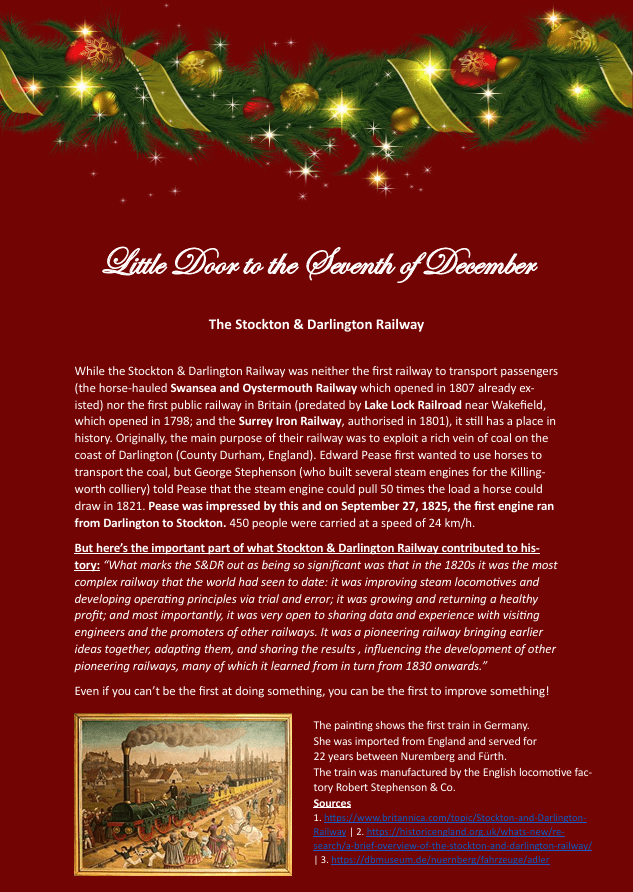
The painting shows the first train in Germany. She was imported from England and served for 22 years between Nuremberg and Fürth. The train was manufactured by the English locomotive factory Robert Stephenson & Co.
Sources
Stockton and Darlington Railway
1. https://www.britannica.com/topic/Stockton-and-Darlington-Railway
A Brief Overview of the Stockton and Darlington Railway
2. https://historicengland.org.uk/whats-new/research/a-brief-overview-of-the-stockton-and-darlington-railway/
DB Museum Nürnberg – Adler
Note:
3. https://dbmuseum.de/nuernberg/fahrzeuge/adler
PDF-File:
Little Door Nr. 8
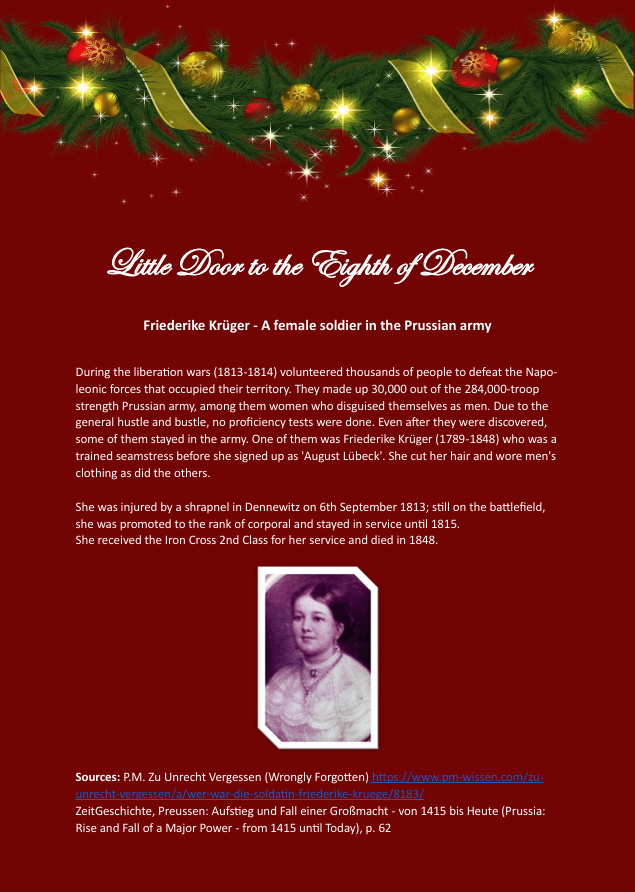
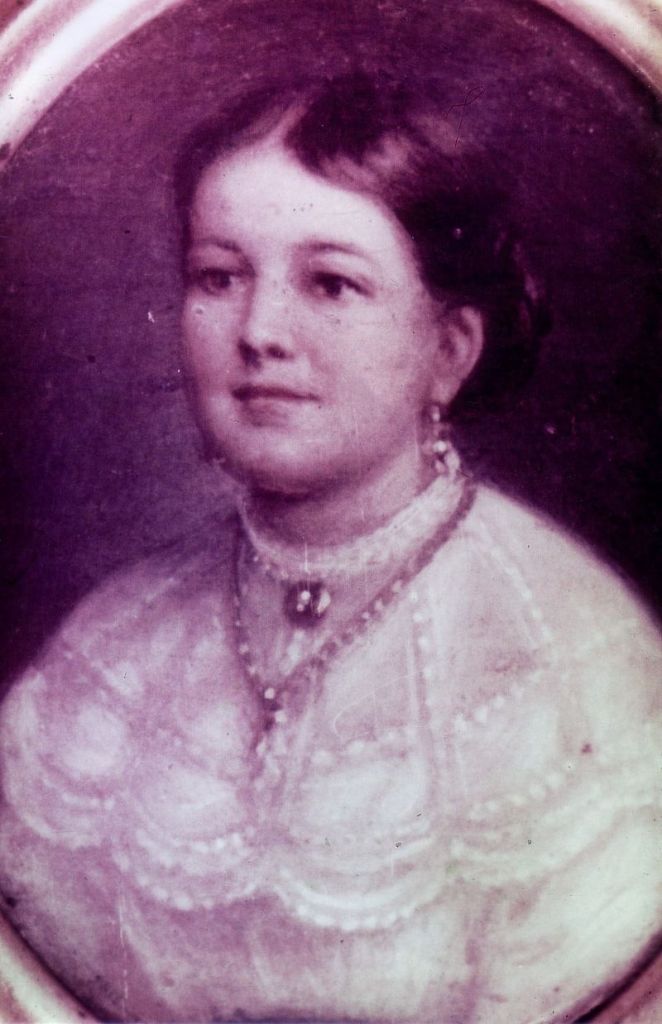
Friederike Krüger – A female Soldier in the Prussian army
During the liberation wars (1813-1814) volunteered thousands of people to defeat the Napoleonic forces that occupied their territory. They made up 30,000 out of the 284,000-troop strength Prussian army, among them women who disguised themselves as men. Due to the general hustle and bustle, no proficiency tests were done. Even after they were discovered, some of them stayed in the army. One of them was Friederike Krüger (1789-1848) who was a trained seamstress before she signed up as ‚August Lübeck‘. She cut her hair and wore men’s clothing as did the others.
She was injured by a shrapnel in Dennewitz on 6th September 1813; still on the battlefield, she was promoted to the rank of corporal and stayed in service until 1815.
She received the Iron Cross 2nd Class for her service and died in 1848.
Sources
P.M. Zu Unrecht Vergessen (Wrongly Forgotten)
https://www.pm-wissen.com/zu-unrecht-vergessen/a/wer-war-die-soldatin-friederike-kruege/8183/
ZeitGeschichte, Preussen: Aufstieg und Fall einer Großmacht – von 1415 bis Heute (Prussia: Rise and Fall of a Major Power – from 1415 until Today), p. 62
PDF-File:
Little Door Nr. 9
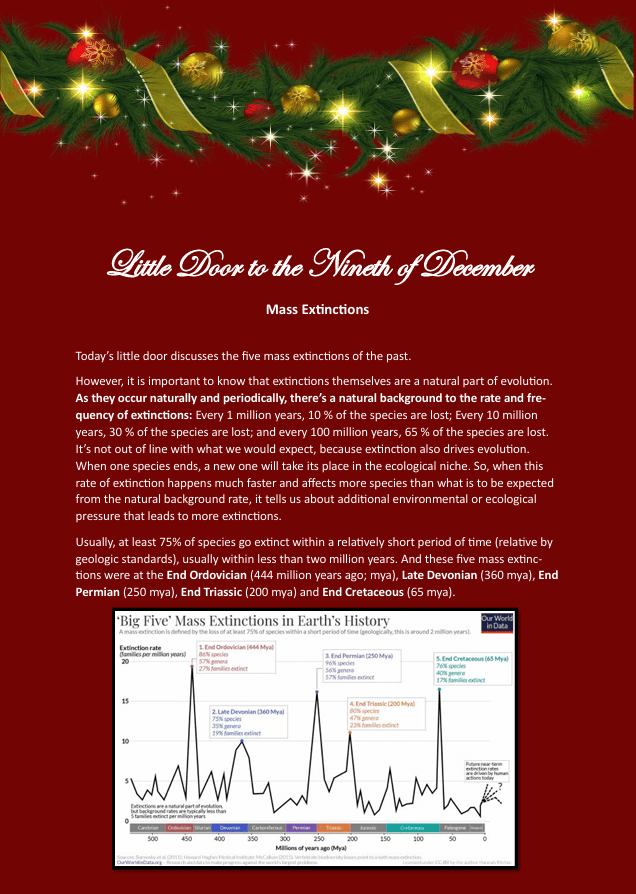
Mass Extinctions
Today’s little door discusses the five mass extinctions of the past.
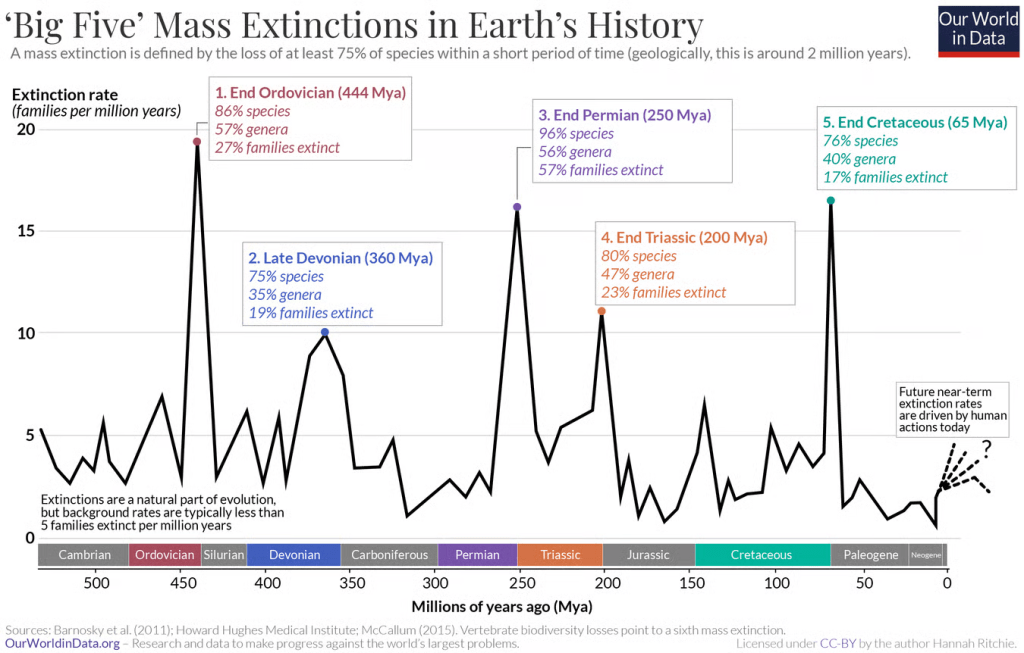
However, it is important to know that extinctions themselves are a natural part of evolution. As they occur naturally and periodically, there’s a natural background to the rate and frequency of extinctions: Every 1 million years, 10 % of the species are lost; Every 10 million years, 30 % of the species are lost; and every 100 million years, 65 % of the species are lost. It’s not out of line with what we would expect, because extinction also drives evolution. When one species ends, a new one will take its place in the ecological niche. So, when this rate of extinction happens much faster and affects more species than what is to be expected from the natural background rate, it tells us about additional environmental or ecological pressure that leads to more extinctions.
Usually, at least 75% of species go extinct within a relatively short period of time (relative by geologic standards), usually within less than two million years. And these five mass extinctions were at the End Ordovician (444 million years ago; mya), Late Devonian (360 mya), End Permian (250 mya), End Triassic (200 mya) and End Cretaceous (65 mya).
Source
Mass Extinctions – Our World in Data
https://ourworldindata.org/mass-extinctions
PDF-File:
Little Door Nr. 10
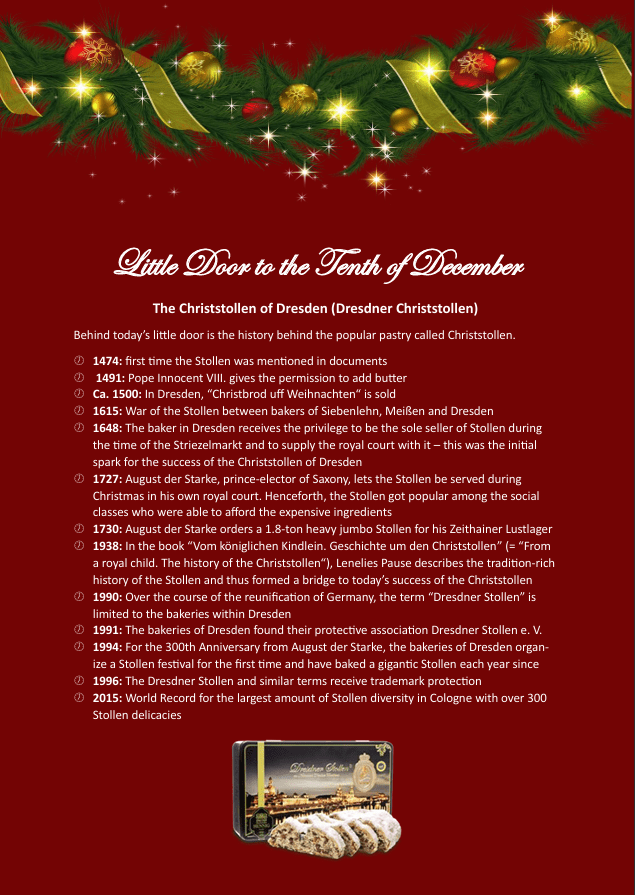
The Christstollen of Dresden (Dresnder Christstollen)
Behind today’s little door is the history behind the popular pastry called Christstollen.
- 1474: first time the Stollen was mentioned in documents
- 1491: Pope Innocent VIII. gives the permission to add butter
- Ca. 1500: In Dresden, “Christbrod uff Weihnachten“ is sold
- 1615: War of the Stollen between bakers of Siebenlehn, Meißen and Dresden
- 1648: The baker in Dresden receives the privilege to be the sole seller of Stollen during the time of the Striezelmarkt and to supply the royal court with it – this was the initial spark for the success of the Christstollen of Dresden
- 1727: August der Starke, prince-elector of Saxony, lets the Stollen be served during Christmas in his own royal court. Henceforth, the Stollen got popular among the social classes who were able to afford the expensive ingredients
- 1730: August der Starke orders a 1.8-ton heavy jumbo Stollen for his Zeithainer Lustlager
- 1938: In the book “Vom königlichen Kindlein. Geschichte um den Christstollen” (= “From a royal child. The history of the Christstollen“), Lenelies Pause describes the tradition-rich history of the Stollen and thus formed a bridge to today’s success of the Christstollen
- 1990: Over the course of the reunification of Germany, the term “Dresdner Stollen” is limited to the bakeries within Dresden
- 1991: The bakeries of Dresden found their protective association Dresdner Stollen e. V.
- 1994: For the 300th Anniversary from August der Starke, the bakeries of Dresden organize a Stollen festival for the first time and have baked a gigantic Stollen each year since
- 1996: The Dresdner Stollen and similar terms receive trademark protection
- 2015: World Record for the largest amount of Stollen diversity in Cologne with over 300 Stollen delicacies
Source
Die Geschichte des Christstollens
(there’s much more to the history of the Dresdner Stollen, if you understand German I recommend checking it out, my timeline also starts later with the first documentation)
https://www.brotexperte.de/brothistorie/die-geschichte-des-christstollens/
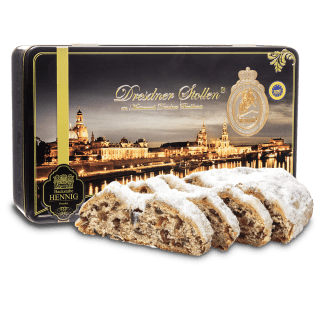
1000g Dresdner Christstollen in Geschenkdose Premium (source of the image)
https://www.stollen-aus-dresden.de/1000g-dresdner-christstollen-in-geschenkdose-premium
PDF-File:
Little Door Nr. 11
Time Travel: What Happened between October – December 1925?
It’s always interesting to look back at the past to find out what were some of the important news or developments back then. Much more preferable than the past returning to us.
- October 17: On this day, the first German Imperial Warriors Day (Deutscher Reichskriegertag) took place in Leipzig, Germany. It ended on October 19.
- October 30: World premiere of the operetta „Paganini“ by Franz Lehár (1870-1948) in the Johann-Strauß-Theatre in Vienna.
- November 1: In a public declaration, the German government defense its Locarno-policies against attacks from the right-wing parties.
- November 2: The vast majority of the National Council of the French socialist party expressed their disagreement with the policies of Minister President Paul Painleve (1863-1933).
- November 3: In a speech broadcasted through the radio, the Minister of Foreign Affairs Gustav Stresemann (1878-1929) explains the results of the Conference of Locarno that took place in October.
- December 1: Concluding the negotiations from October 5 to October 16, the Treaties of Locarno were signed. Hans Luther (1879-1962) signed for Germany.
- December 2: The companies BASF, Bayer Hoechst, Agfa and others merge to form the chemical group I. G. Farben.
- December 3: After consultations with King Alfons XIII. (1886-1941), the Spanish dictator Miguel Primo de Rivera (1870-1930) changed his military directorate with the addition of some civilians into a cabinet. However, the constitution remained suspended.
(source: https://timemachine.fandom.com/wiki/The_Time_Machine)
| The Pact of Locarno Initialed in Locarno, Switzerland on October 16 and signed in London on December 1, this series of treaties between Germany, France, Belgium, Great Britain and Italy meant to mutually guarantee peace in western Europe. Meaning any conflicts have to be solved diplomatically and that none of the contracting parties attacks each other unless in legitimate self-defense or in consequence of a League of Nations (1920-1946) obligation. „The agreements consisted of (1) a treaty of mutual guarantee between Germany, Belgium, France, Great Britain, and Italy; (2) arbitration treaties between Germany and Belgium and between Germany and France; (3) a note from the former Allies to Germany explaining the use of sanctions against a covenant-breaking state as outlined in article 16 of the League of Nations Covenant; (4) arbitration treaties between Germany and Czechoslovakia and between Germany and Poland; and (5) treaties of guarantee between France and Poland and between France and Czechoslovakia.“ (source: https://www.britannica.com/event/Pact-of-Locarno) In 1936, Germany defended its deployment of troops into the Rhineland – which was demilitarized under the Treaty of Versailles – by claiming that the Franco-Soviet alliance of 1935 changed the situation envisaged at Locarno. While France viewed it as a ‚flag violation‘ of the Locarno Pact, Great Britain did not and no action was taken. Both times in 1938 with Czechoslovakia and in 1939 with Poland, Nazi Germany made no effort to arbitrate its disputes with its neighbours. |
Source
Was war 1925? Das war 1925
https://www.was-war-wann.de/1900/1920/1925.html
Little Door Nr. 12
Question by Heinrich Heine
(Heinrich Heine will accompany us today, and two times more, throughout December!)
By the sea, by the desolate nocturnal sea,
Stands a youthful man,
His breast full of sadness, his head full of doubt.
And with bitter lips he questions the waves:
„Oh solve me the riddle of life!
The cruel, world-old riddle,
Concerning which, already many a head hath been racked.
Heads in hieroglyphic-hats,
Heads in turbans and in black caps,
Periwigged heads, and a thousand other
Poor, sweating human heads.
Tell me, what signifies man?
Whence does he come? whither does he go?
Who dwells yonder above the golden stars?“
The waves murmur their eternal murmur,
The winds blow, the clouds flow past.
Cold and indifferent twinkle the stars,
And a fool awaits an answer.

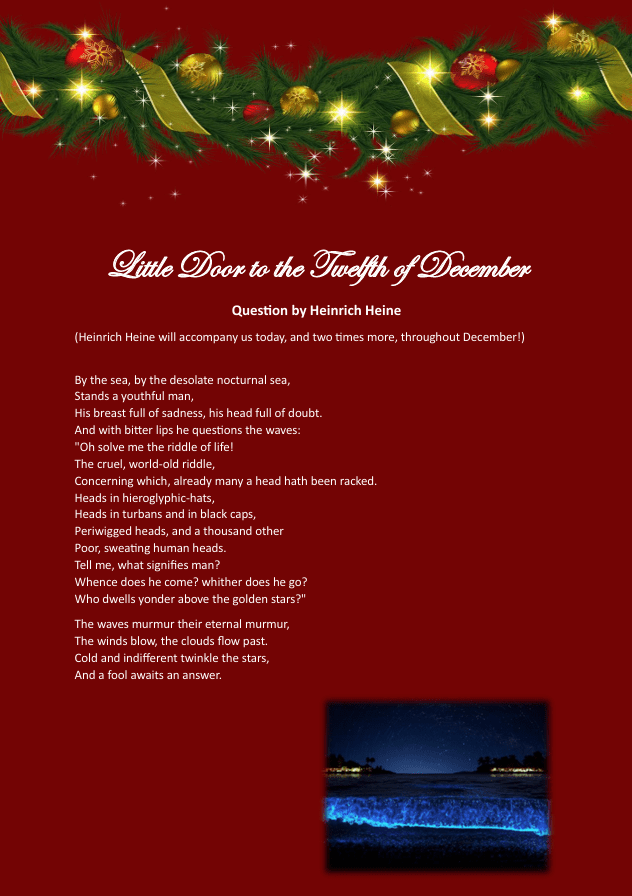
Addendum: I actually looked it up, here’s the explanation: „One of the microscopic organisms called bioluminescent plankton that give Japan’s beaches their glowing appearance is Noctiluca scintillans, mostly referred to as “sea sparkle.” These plankton release a chemical reaction that generates light when they are disturbed by movement, such as crashing waves, swimming fish, or even a human touch. The end effect is an eerie neon-blue glow that appears to be pulsing with energy beneath the water’s surface.“ (source: https://japandaily.jp/glowing-beaches-in-japan-where-waves-sparkle/) I just couldn’t let it slide, so I added this during the examination of my blog post.
Source
Question – textarchive
https://www.textarchiv.com/heinrich-heine/question/index.html
PDF-File
Little Door Nr. 13
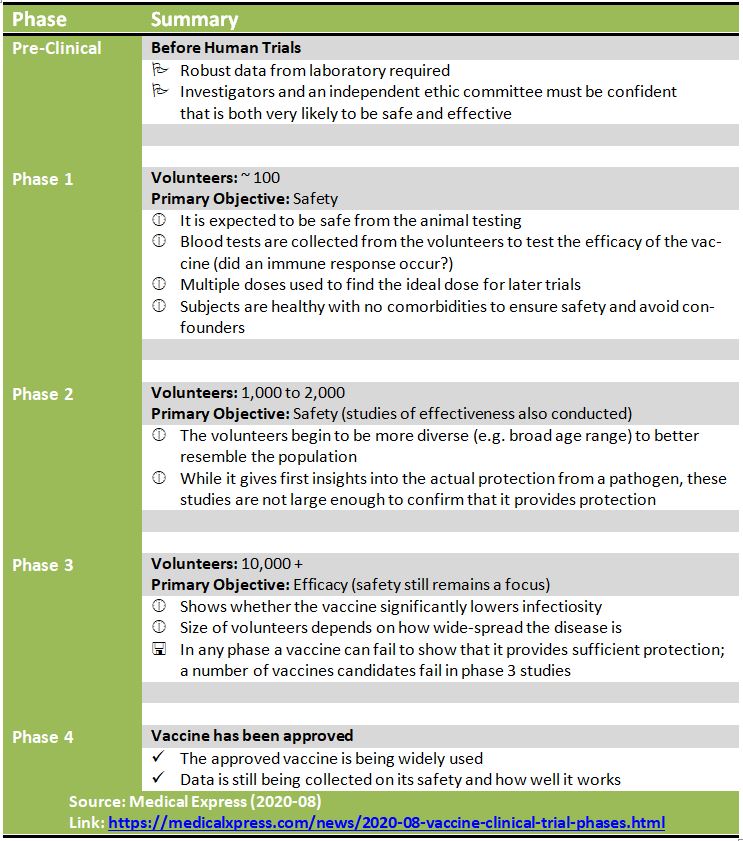
Vaccination Facts: The different Phases!
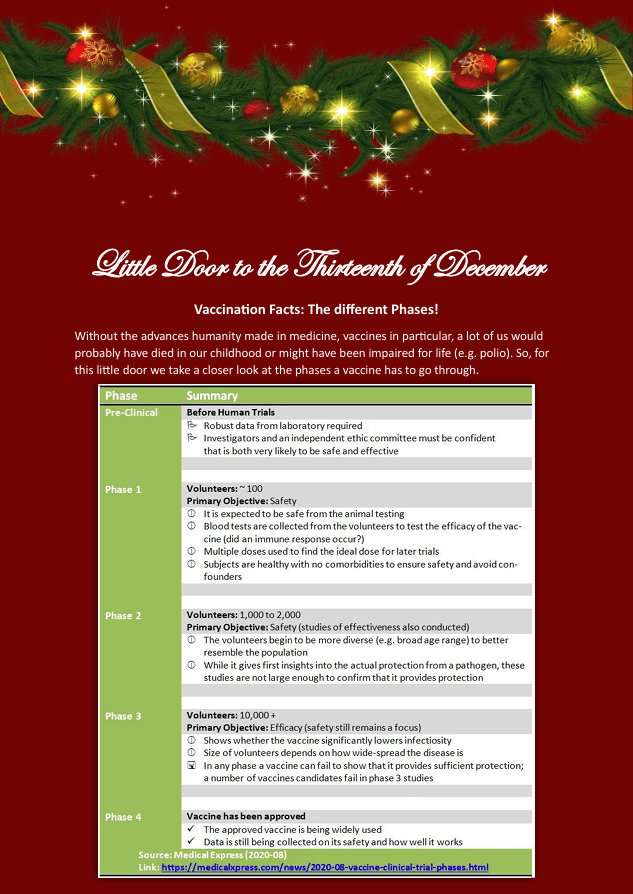
Without the advances humanity made in medicine, vaccines in particular, a lot of us would probably have died in our childhood or might have been impaired for life (e.g. polio). So, for this little door we take a closer look at the phases a vaccine has to go through.
Source
Medical Express (2020-08)
https://medicalxpress.com/news/2020-08-vaccine-clinical-trial-phases.html
PDF-File:
Little Door Nr. 14
The Invention of the Christmas Tree Ball
Christmas trees have been around for 500 years, but until the 18th century they were only erected and displayed in public spaces. In the 19th century the Christmas tree at home was popularized and even back then the Christmas tree was decorated.
Before Christmas tree balls were a thing, our ancestors decorated it primarily with things you can eat. First apples and nuts; then, at some point, people started to gild the nuts. Pastries, such as cookies, were stringed up too. The children would then eat the cookies.
Home-made Christmas decoration, like stars made out of paper, were hung as well.
This changed when in the 19th century in Lauscha, Thuringia, the technological progress made it possible for glassblowers to create Christmas tree balls. Back then they were not as big as the spheres we have on our Christmas trees nowadays. The oldest Christmas tree ball, which was exhibited in the exhibition „Eine runde Sache? Wie Lauscha die Weihnachtskugel erfand“ (= A spherical thing? How Lauscha invented the Christmas tree ball) in the Historisches Museum Bamberg (Upper Franconia, Bavaria), dates back to the year 1850.
At the beginning of the 20th century, these Christmas tree balls got particularly popular in the United States thus becoming an export hit! They were produced between May and December by glassblowers. The women and children helped too by adorning and wrapping the Christmas tree balls up. However, the production where the glassblowers were involved in wasn’t hazard-free: since they worked with gas, they had a wild bird in a cage to signal when the concentrations were too high (the bird didn’t sing anymore). Similar to mineworkers.
As they were essential for survival, they’d later be immortalized as birds made out of glass.
The glassblowers didn’t limit themselves to Christian symbols: one cabinet in the exhibition shows sparkling Bretzels, beer cans and unicorns as Christmas tree decoration.

Source
Die Erfindung der Christbaumkugel – Eine runde Sache | BR
https://www.br.de/nachrichten/kultur/die-erfindung-der-christbaumkugel-eine-runde-sache,TzAlr42
PDF-File:
Little Door Nr. 15
The Coldest Stellar Object (Yet)
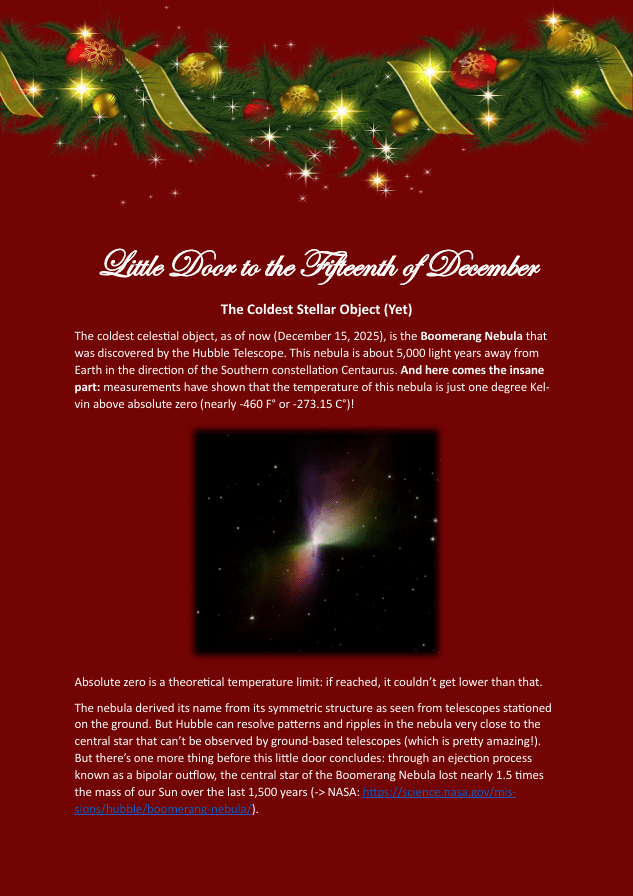
The coldest celestial object, as of now (December 15, 2025), is the Boomerang Nebula that was discovered by the Hubble Telescope. This nebula is about 5,000 light years away from Earth in the direction of the Southern constellation Centaurus. And here comes the insane part: measurements have shown that the temperature of this nebula is just one degree Kelvin above absolute zero (nearly -460 F° or -273.15 C°)!

For comparison: the coldest place on Earth, at least where people live, is the Sakha republic in Russia: „The climate of Sakha, which is the most severe of the inhabited world, is the extreme of continental, with an average January temperature of −46 °F (−43.5 °C) and an average July temperature of 66 °F (19 °C). Only exceptionally dry air and calm weather conditions make the lower temperatures bearable. Precipitation everywhere is low, amounting to 8–16 inches (200–400 mm) annually.“ (source: https://www.britannica.com/place/Sakha-republic-Russia)
Absolute zero is a theoretical temperature limit: if reached, it couldn’t get lower than that.
The nebula derived its name from its symmetric structure as seen from telescopes stationed on the ground. But Hubble can resolve patterns and ripples in the nebula very close to the central star that can’t be observed by ground-based telescopes (which is pretty amazing!). But there’s one more thing before this little door concludes: through an ejection process known as a bipolar outflow, the central star of the Boomerang Nebula lost nearly 1.5 times the mass of our Sun over the last 1,500 years (-> NASA: https://science.nasa.gov/missions/hubble/boomerang-nebula/).
Source
NASA – Boomerang Nebula
https://science.nasa.gov/missions/hubble/boomerang-nebula/
PDF-File:
Little Door Nr. 16

Caga Tió – A Charming Christmas Tradition from Catalonia
I’ve learned about this Christmas tradition through a short made by Arte (a French-German public broadcaster who makes excellent documentaries, reports and else!) called “Catalan Tradition: Caga Tio | Karambolage Espana”. The name translates to “Pooping Log”.
This tradition is rooted in pre-Christian times and is linked to Catalonia’s deep rural connection. Back then, the Tió symbolized the spirit of the forest and the act of caring for it (“feeding” the log) symbolized a request for a good winter season. Later, homes with hearth fires would burn it to celebrate winter solstice. While it burned, it was struck with a stick to produce warmth and light and to drive away evil spirits from one’s home or the village.
Next to protection, the Tió was also considered a symbol of fertility.
After the Christianization, the Caga Tió became a children’s celebration.
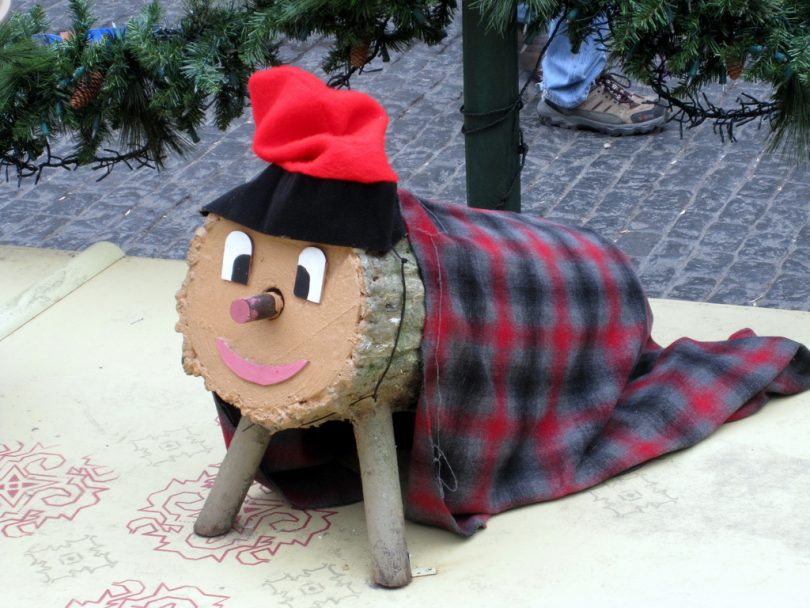
The family “feeds” the Tió with small treats, like fruits and cookies, in order to prepare it for the big day (Christmas Eve, either December 24 or December 25, depending on the family). It also has its own outfit: it is covered with a blanket, given a barretina (a traditional Catalonian hat) and a smiling face is painted on the log. Once the big day arrived, the children gently hit it with a stick while singing a song, and the Tió “poops” the gifts for the entire family.
When the song is over, the blanket is lifted and the gifts revealed: usually small treats or sweets. The lyrics of the “Caga Tió” song are as follows (excerpt):
Caga tió,
avellanes i torrons,
no caguis arengades,
que són massa salades,
caga torrons que són més bons.
Caga tió,
avellanes i torrons,
si no vols cagar, et donaré un cop de bastó!
/
Poop log,
hazelnuts and nougat,
don’t poop salted fish,
they’re too salty,
poop nougat that’s much better.
Poop log,
hazelnuts and nougat,
if you don’t want to poop, I’ll hit you with a stick!
(Image source: https://www.shbarcelona.fr/blog/fr/caga-tio/)
Source
The „Caga“ Tió: Catalonia’s Magical Christmas Tradition
https://www.catalunya.com/en/continguts/article/caga-tio-catalan-pooping-log-1731507242824
PDF-File:
Little Door Nr. 17
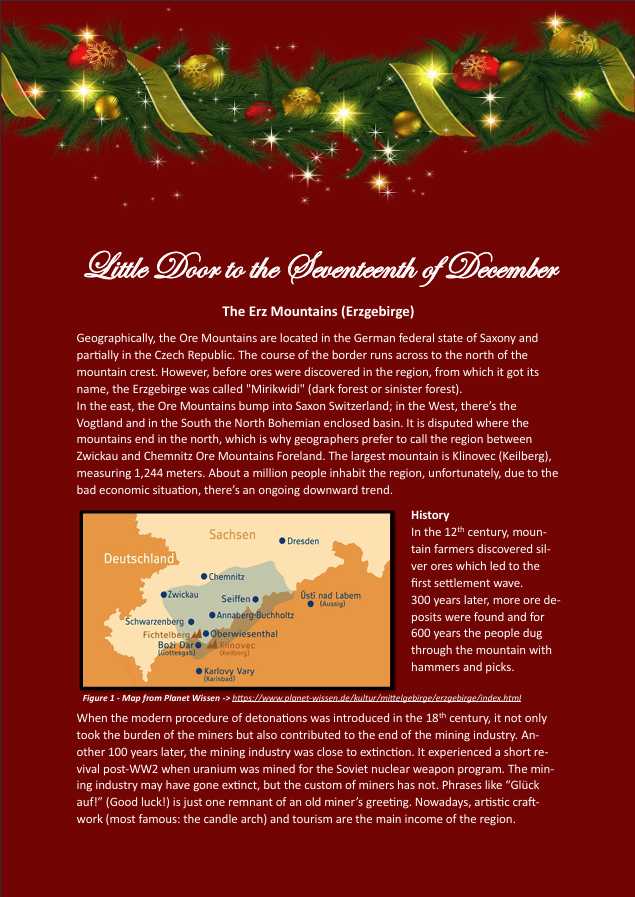
The Erz Mountains (Erzgebirge)
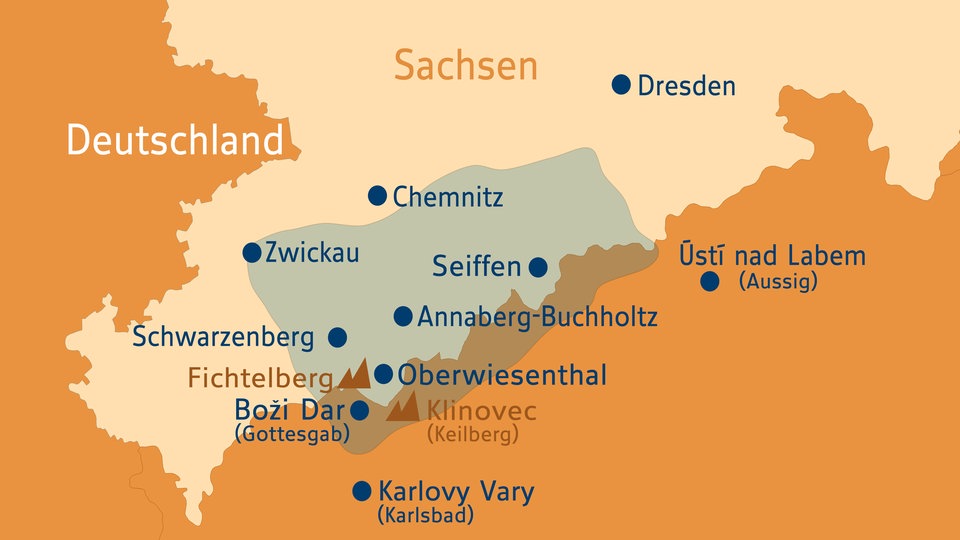
Geographically, the Ore Mountains are located in the German federal state of Saxony and partially in the Czech Republic. The course of the border runs across to the north of the mountain crest. However, before ores were discovered in the region, from which it got its name, the Erzgebirge was called „Mirikwidi“ (dark forest or sinister forest).
In the east, the Ore Mountains bump into Saxon Switzerland; in the West, there’s the Vogtland and in the South the North Bohemian enclosed basin. It is disputed where the mountains end in the north, which is why geographers prefer to call the region between Zwickau and Chemnitz Ore Mountains Foreland. The largest mountain is Klinovec (Keilberg), measuring 1,244 meters. About a million people inhabit the region, unfortunately, due to the bad economic situation, there’s an ongoing downward trend.
History
In the 12th century, mountain farmers discovered silver ores which led to the first settlement wave. 300 years later, more ore deposits were found and for 600 years the people dug through the mountain with hammers and picks.
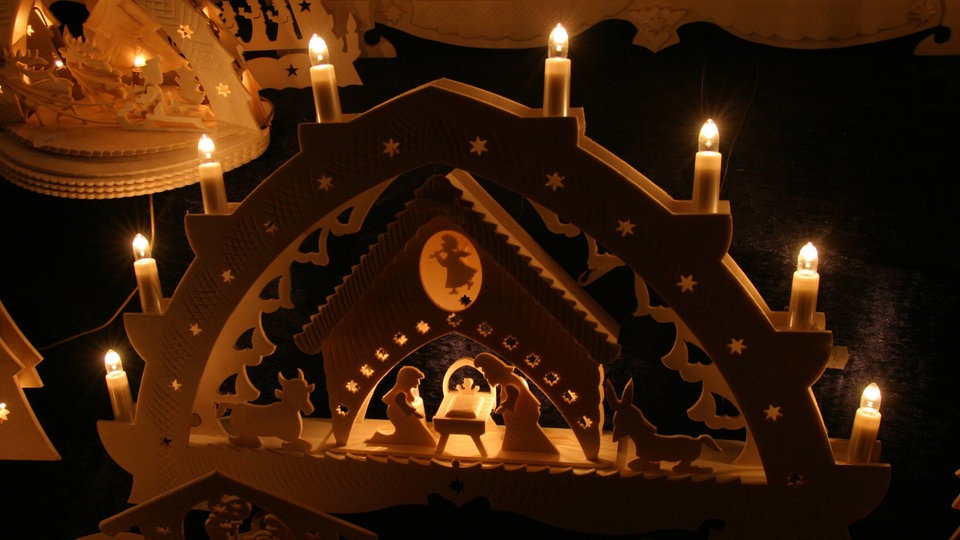
When the modern procedure of detonations was introduced in the 18th century, it not only took the burden of the miners but also contributed to the end of the mining industry. Another 100 years later, the mining industry was close to extinction. It experienced a short revival post-WW2 when uranium was mined for the Soviet nuclear weapon program. The mining industry may have gone extinct, but the custom of miners has not. Phrases like “Glück auf!” (Good luck!) is just one remnant of an old miner’s greeting. Nowadays, artistic craftwork (most famous: the candle arch) and tourism are the main income of the region.
-> Planetwissen
Source
Mittelgebirge: Erzgebirge (Language: German)
https://www.planet-wissen.de/kultur/mittelgebirge/erzgebirge/index.html
PDF-File:
Little Door Nr. 18
Sunset by Heinrich Heine
The glowing red sun descends
Into the wide, tremulous
Silver-gray ocean.
Ethereal, rosy tinted forms
Are wreathed behind him, and opposite,
Through the veil of autumnal, twilight clouds,
Like a sad, deathly-pale countenance,
Breaks the moon,
And after her, like sparks of light,
In the misty distance, shimmer the stars.
Once there shone forth in heaven,
Nuptially united.
Luna the goddess, and Sol the god.
And around them gathered the stars,
Those innocent little children.
But evil tongues whispered dissension,
And in bitterness parted
The lofty, illustrious pair.

(Malibu (city in California) sunset, source: https://www.peakpx.com/en/hd-wallpaper-desktop-kwfqc)
Now all day in lonely splendor
The sun-god fares overhead,
Worshiped and magnified in song,
For the excellence of his glory,
By haughty prosperity—hardened men.
But at night
In heaven wandereth Luna,
The poor mother,
With her orphaned, starry children;
And she shines with a quiet sadness,
And loving maidens and gentle poets
Dedicate to her their tears and their songs
Poor weak Luna! Womanly-natured,
Still doth she love her beautiful consort.
Towards evening pale and trembling,
She peers forth from light clouds,
And sadly gazes after the departing one,
And in her anguish fain would call to him, „Come!
Come! our children are pining for thee!“
But the scornful sun-god,
At the mere sight of his spouse,
Glows in doubly-dyed purple,
With wrath and grief,
And implacably he hastens downward
To the cold waves of his widowed couch.
Source
Sunset – textarchiv
https://www.textarchiv.com/heinrich-heine/sunset/index.html
PDF-File:
Little Door Nr. 19
The Creation of Humans in Sumerian Mythology
The Sumerians have fascinated me for a long time now and it is always exciting to learn about these ancient people! I hope to spark your curiosity too with this long excerpt:
The gods were dredging the rivers,
were piling up their silt
on projecting bends–
and the gods lugging the clay
began complaining (Jacobsen, Harps 154)
Nammu, who is either the sea or the goddess of the riverbed, goes to her son Enki, who is asleep in the deep (the Apsu) and entreats him to rise from his bed and „fashion servants of the gods“ (Kramer, History Begins 109). Enki, who after all is the god of wisdom, thinks of the germinating powers of the clay and water of the abyss, and he tells Nammu to have some womb-goddesses pinch off this clay and have some „princely fashioners“ thicken it, so she can mold it or give birth to it:
Mix the heart of the clay that is over the abyss,
The good and princely fashioners will thicken the clay,
You, [Nammu] do you bring the limbs into existence;
Ninmah [earth-mother or birth goddess] will work above you,
The goddesses [of birth] . . . will stand by you at your fashioning;
O my mother, decree its [the newborn’s] fate,
Ninmah will bind upon it the image (?) of the gods,
It is man . . . . (Kramer, History Begins 109)
Jacobsen translates these apparently difficult to decipher lines somewhat differently, seeing a „birth chair“ where Kramer sees the „image“ of the gods. Jacobsen’s translation also stresses that the fashioning of the newborn imitates in some way the growth of a fetus in the womb. Jacobsen translates the moment of birth like this (words and letters in brackets represent gaps in the original text):
[Without] the sperm
of a ma[le]
she gave [birth]
to offspri[ng.,]
to the [em]bryo
of mankind. (Harps 157)
Thus man was created to relieve the gods of their work. The gods then decide to have a feast to celebrate their new creation, and Enki and Ninmah begin to drink beer and start „to feel good inside.“
| There’s also a cool part where Enki finds a place in society for even the most handicapped people. |
Here I can include what was too much for the one DIN A4 page, as it is really interesting:
„Ninmah boasts that she, as the goddess of birth and gestation, is the one who determines whether „the build of men“ (Harps 158) turns out well or misshapen. Enki responds that he, the clever god, can find places in society for even the most handicapped people. Ninmah molds from the clay a man with shaking hands, but Enki places him as an attendant of the king. Ninmah next makes a blind man, but Enki makes him a singer of tales. Ninmah makes a person named „Hobbled-by-twisting-ankles,“ but Enki finds work for him with the metal workers (c.f. Hephaistos). Ninmah continues to make handicapped people: „a person unable to control his urine, a barren woman, a being with neither male nor female organs, and so forth, but in each case Enki was able to find a place in society for the [creature] and to ensure it a living“ (Jacobsen, Treasures 114). The woman who could not give birth, for example, was found a place overseeing the weavers in „the queen’s household“ (Harps 161), while the sexless being was to „stand before the king“ (Kramer, History Begins 109-110).
The part above could even be interpreted as an ideal to aspire to: that one day, all handicapped people are included in the community without completely separated workplaces, disabled-friendly infrastructure and given the chance to actively partake in society if they so desire. But this requires to actually listen to people, something too many politicians have unlearnt (unfortunately).
However, we go from something aspiring to something terrifying, as we move on:
Knowing that she cannot outsmart the clever Enki, Ninmah throws down the clay in defeat. Now Enki decides to make his own misshapen being, and he challenges Ninmah to „determine / the mode of being / of that newborn one!“ (Harps 162). Enki, in a manner which is not all that clear causes a creature to be born whose name is „the-day-was-far-off.“ In other words, the creature is born prematurely, before its fated birthdate. This creature is also extremely deformed: „its hands, having the shakes, / could not put food / to its mouth, / the spine was crushed, / the anus closed up, / the hips were brittle, / the feet (with their) skin breaking / unable to walk the fields “ (Harps 162). Ninmah tries to feed the creature some bread, but it is so weak and feeble that it cannot reach out for the loaves she offers it. It cannot sit or stand or even bend its knees. Ninmah is horrified at what Enki has made and curses him for it. The remainder of the tablet is broken, but apparently Ninmah realizes that if such unformed and deformed beings are born with any sort of regularity, people will stop worshipping her. Enki tries to appease her wrath by admitting that the deformed being „is lacking, in truth, / your work, Ninmah; [he] was born to me / incomplete“ (Harps 165). The poem ends with a song of praise for Enki’s male generative powers and for his cleverness, but the story itself seems to indicate that Enki cannot make a functional being without the help of the birth goddess Ninmah. Notice how the story starts with the gods needing to work for bread and ends with a creature unable to accept bread.“
Source
Sumerian Myths
https://faculty.gvsu.edu/websterm/SumerianMyth.htm
PDF-File:
Little Door Nr. 20
The Caribbean Island (technically) owned by Germany
History is full of peculiar stories, and this is one of them.
In a state visit to East Berlin in 1972, Fidel Castro made the promise to donate one of the 4,000 Cuban islands to the German Democratic Republic (GDR) to highlight the strong relations between the two communist nations. Before the island was renamed to Ernst Thälmann Island, its given name was Cayo Blanco de Sur. Thälmann ran unsuccessfully against Adolf Hitler in the 1932 election for the position of German president. He was the leader of the German Communist Party (KPD) and later arrested by the Gestapo. Before he was shot dead on Hitler’s orders in 1944, Thälmann spent a decade in solitary confinement.
In 1973, a bust of Ernst Thälmann was erected on the island. On East German state TV, the island was often lauded as a symbol of the close relations between the two nations.
The island is 15-kilometer (9-miles) long, 500-meter (1,640-foot) wide and still has mostly untouched beaches. It is home to several endangered species of fish and coral.
Initially, the GDR had ambitious plans to turn the island into a tourist destination for East Germans, but the project never took off due to the financial problems the nation was facing at the time. It would later become a backdrop for many music videos made by East German singer Frank Schöbel (December 11, 1942). In 1998, the bust of Ernst Thälmann was knocked over by Hurricane Mitch.
Since the GDR was absorbed into the BRD, the island would have technically changed hands to the now reunified Germany. However, and this is the important part and why I put “technically” in the title: Germany has never laid claim to the island. Both Cuba and Germany insist that this gift from Castro was ‘purely symbolic’.
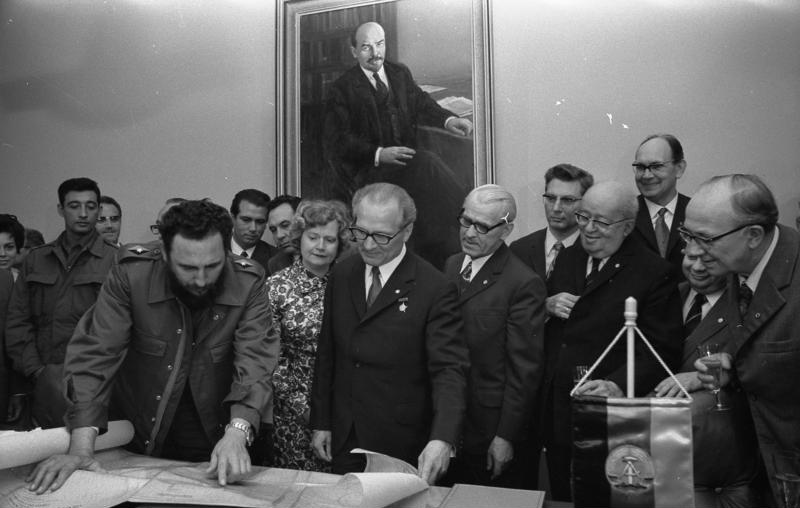
Fidel Castro (l.) überreichte nach der Unterzeichnung des Kommuniques am 19.6.72 Erich Honecker (Mitte) eine Landkarte der Republik Kuba. Sie zeigt eine Insel, die den Namen “ Ernst Thälmann“ trägt, und deren Südseite „Strand DDR“ heißt. An diesem Strand schlugen die kubanischen Patrioten an der „Schweinebucht“ die imperialistische Aggression erfolgreich zurück. Bei der feierlichen Übergabe des Geschenks waren u.a. Alfred Neumann, Friedrich Ebert, Werner Lemberz und Willi Stoph zugegen (v.l.n.r.) -> Quelle: Bundesarchiv
/ June 19, 1972: Fidel Castro (l.) hands over a map of the Republic of Cuba after the signing of the communique. It shows an island which carries the name „Ernst Thälmann“ and which southern side is called „Beach of the GDR“. On this beach, the patriotic cubans successfully fought back against the imperialist aggression at the Bay of Pigs. During the ceremonial transfer of the gift, Alfred Neumann, Friedrich Ebert, Werner Lemberz and Willi Stoph were present -> Source: Bundesarchiv (Description was part of the photo)
Source
Castro’s Caribbean island gift to East Germany
https://www.dw.com/en/castros-caribbean-island-gift-to-east-germany/a-36539460
Castro at East Berlin Rally (June 20, 1972)
https://www.nytimes.com/1972/06/20/archives/castro-at-east-berlin-rally.html
PDF-File:
Little Door Nr. 21
The Spoon Language (= Löffelsprache)
It is December the 21st, meaning the word gets too long which would mess up the title, hence there’s the number itself now instead of the written one (twenty-first).
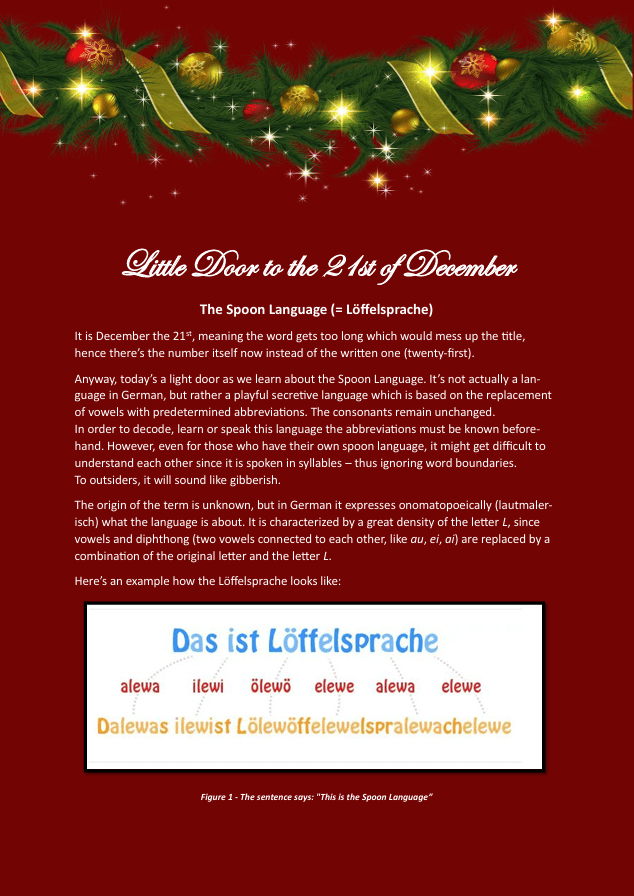
Anyway, today’s a light door as we learn about the Spoon Language. It’s not actually a language in German, but rather a playful secretive language which is based on the replacement of vowels with predetermined abbreviations. The consonants remain unchanged. In order to decode, learn or speak this language the abbreviations must be known beforehand. However, even for those who have their own spoon language, it might get difficult to understand each other since it is spoken in syllables – thus ignoring word boundaries. To outsiders, it will sound like gibberish.
The origin of the term is unknown, but in German it expresses onomatopoeically (lautmalerisch) what the language is about. It is characterized by a great density of the letter L, since vowels and diphthong (two vowels connected to each other, like au, ei, ai) are replaced by a combination of the original letter and the letter L.
Here’s an example how the Löffelsprache looks like:

Source
Wortwuchs – Löffelsprache
https://wortwuchs.net/loeffelsprache/
PDF-File:
Little Door Nr. 22

Hannah Arendt – German-American Philosopher
It is likely that you have already heard about her. Her most important publications are “Elemente und Ursprünge totaler Herrschaft” (= The Origins of Totalitarianism, 1951), “Vita active oder Vom tätigen Leben” (= The Human Condition, 1958), “Eichmann in Jerusalem. Ein Bericht von der Banalität des Bösen” (= Eichmann in Jerusalem: A Report on the Banality of Evil, 1963), „Über die Revolution“ (= On Revolution, 1963) and “Macht und Gewalt“ (= On Violence, 1970). Here’s the timeline of her life:
- 1906: Born on October 14 in a secular Jewish family in Linden (today a part of Hannover)
- 1909: Arendt’s family moves to Königsberg.
- 1924-1926: Arendt studies philosophy at the University of Marburg, taught by Martin Heidegger (1889-1976) with whom she has a love relationship.
- 1926: Studied in Freiburg under Edmund Husserl (1859-1938) and in Heidelberg under Karl Jaspers (1883-1969).
- 1929: Postdoctoral graduation under supervision of Karl Jaspers. In the same year, she meets Günther Anders (1902-1992) with whom she’s married until 1937.
- 1933: Arrested by the Gestapo for political participation in a Zionist organization, where she documented the persecution of the Jews. Later, she leaves Germany and flees to Paris.
- 1937: The national socialist government of Germany revokes her German citizenship.
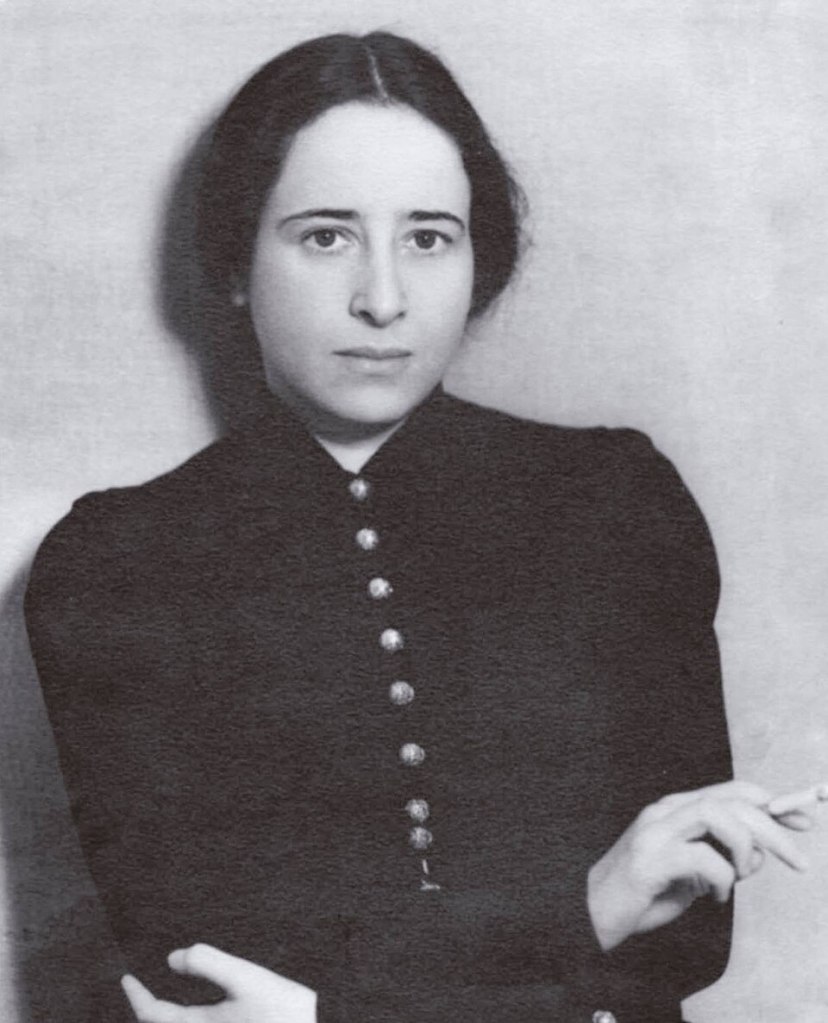
(Image source: Wikipedia)
- 1940: Internment in the nazi concentration camp Gurs (1939-1945, Southwest France). She was able to escape from the concentration camp.
- 1941: Arendt moves to New York.
- 1949-1950: For the first time in 17 years, Arendt travels to Germany. She meets Jaspers and Heidegger; she terminated the contact with the latter for his membership in the NSDAP.
- 1951: Arendt receives the American citizenship.
- 1953: Arent becomes professor at the Brooklyn College in New York.
- 1961: As a reporter, Arendt attends the court process against Adolf Eichmann (1906-1962) in Jerusalem.
- 1963-1967: Professorship at the University of Chicago
- 1967-1975: Professorship at the New School for Social Research in New York. The legacy of her works is stored there today.
- 1975: On December 4, Hannah Arendt dies at the age of 69 years in New York.
Source
philosophie magazin – Hannah Arendt zum 50. Todestag | Was tun, Hannah? | p. 46-49
PDF-File:
Little Door Nr. 23
Casper David Friedrich – German Painter
Casper was born on September 5, 1774 in Greifswald in Mecklenburg-Hither Pomerania.
He died on May 7, 1840 in Dresden in the Free State of Saxony.
He is considered to be the most important romantic painter of his generation, known for his vast landscape paintings where humans have a smaller presence. As an artist, his main interest was the contemplation of nature. You may already be familiar with the probably most famous painting of his: The Wanderer Above the Sea of Fog (1818).
However, today we will look at a different painting and let it convey its own message.
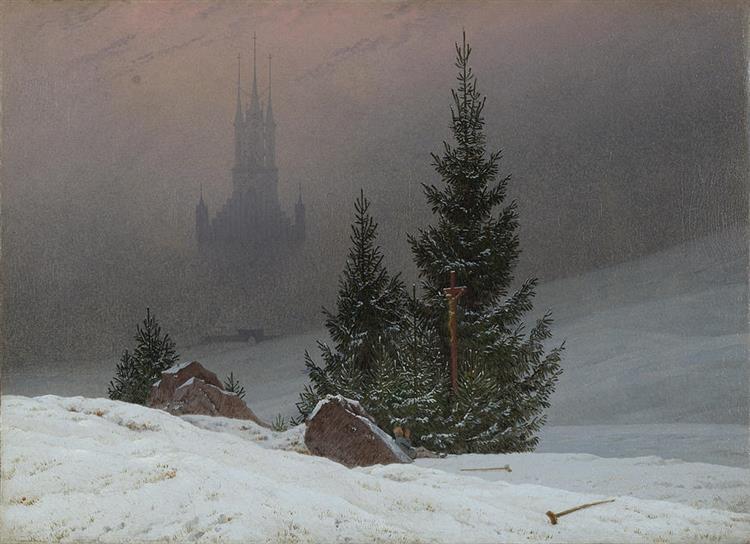
Source
Caspar David Friedrich – Wikiart
https://www.wikiart.org/en/caspar-david-friedrich
PDF-File:
Little Door Nr. 24
Coronation by Heinrich Heine
Oh songs of mine! belovèd songs of mine,
Up, up! and don your armor,
And let the trumpets blare,
And lift upon your shield
This youthful maiden
Who now shall reign supreme
Over my heart, as queen!
Hail! hail! thou youthful queen!
From the sun above
I snatch the beaming red gold,
And weave therewith a diadem
For thy consecrated head.
From the fluttering azure-silken canopy of heaven,
Where blaze the diamonds of night,
A precious fragment I cut:
And as a coronation mantle,
I hang it upon thy royal shoulders.
I bestow on thee a court
Of richly-attired sonnets,
Haughty Terzine and stately stanzas.
My wit shall serve thee as courier,
My fancy shall be thy fool,
Thy herald, whose crest is a smiling tear,
Shall be my humor.
But I myself, oh Queen,
Low do I kneel before thee,
On the cushion of crimson samite,
And as homage I dedicate to thee.
The tiny morsel of reason,
That has been compassionately spared me
By thy predecessor in the realm.

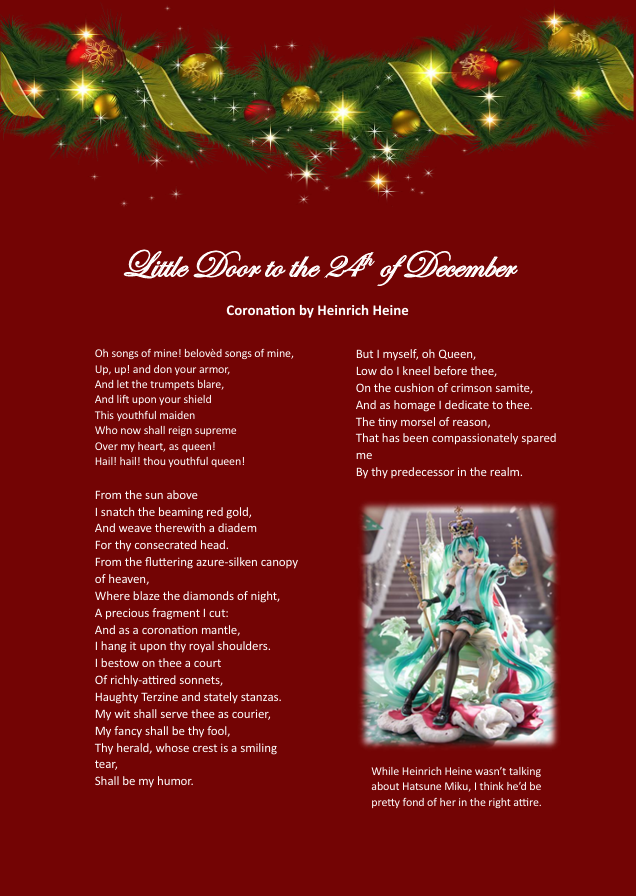
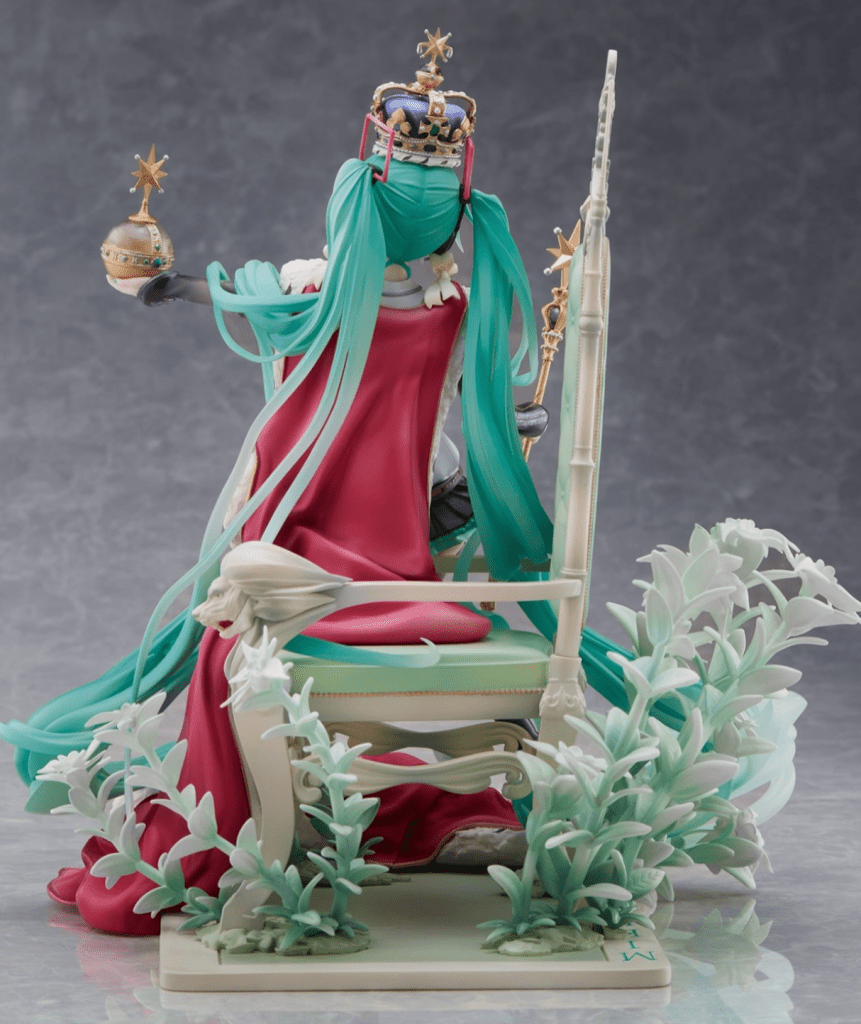
Surprise Miku at the end! You can’t escape her. The figure is really gorgeous, but also really expensive (ca. $270) and out of stock.

Sources
Coronation – textarchiv
https://www.textarchiv.com/heinrich-heine/coronation/index.html
Spiritale Hatsune Miku 1/7 Scale Figure – 39’s Special Day Ver.
https://otakumode.com/shop/640a97b9ea45080028dcb2a9/Spiritale-Hatsune-Miku-1-7-Scale-Figure-39-s-Special-Day-Ver
PDF-File:
I hope you had a Merry Christmas and I wish you a Happy New Year!

May our ships experience a less stormy sea in 2026, or remain largely intact should the storm get stronger than before. And the latter seems, unfortunately, most likely.
Bon voyage! And glory to Hatsune Miku (^~^)7
 Baroque