
It’s been four years now since Russia invaded Ukraine on February 24, 2022, and the second year of the Trump’s Administrations continual betrayal by putting immense pressure on Ukraine while rolling out the red carpet for the war criminal Vladimir Putin.
In this blog entry, we’ll take a look at the death economy of Russia and why so many Russians – largely from poor regions and individuals with barely any to no future prospects – sign up for the suicidal missions. We will discuss Marco Rubio’s speech and see why it doesn’t reflect a change in foreing policy. Lastly, we shall talk about the resilience of Ukraine and one possible adequate punishment for Russia after the war (next to Nuremberg-like trials).
The Deathonomics of Russia and her Dwindling Canon Fodder
Russia’s war of aggression has now been going on for longer than Hitler’s invasion of the Soviet Union which began on June 22, 1941 and ended on May 9, 1945. This milestone was reached on January 11, 2026 – the 1,418th day. Unlike in the Second World War, Moscow is now on the side waging a genocidal war against Ukrainians, seeking to wipe out their cultural identity and terrorizing them by deliberately targeting civilian infrastructure – from the energy grid to apartments, hospitals, kindergartens and cultural sites.
But how did Russia manage to mobilize that many Russians?
The short answer is: by targeting low-income individuals, ‚people who have lost their jobs, cannot pay off loans or desperately need to provide for their families‘ (source: ifri) and criminals. Especially in rural areas. People that are not an important resource for the Russian economy, thereby not directly destroying Russia’s human capital.
Now the long answer: the reason why the recruitment, most of the time a one-way ticket, is so attractive to the economically lower classes is the pay: „According to estimates by both Russian and European experts, the military salaries and death gratuities paid by the authorities, both when the soldiers are sent to the front and when they die there, now reach 3-4 trillion rubles annually, or close to 2% of Russia’s GDP.“ (French Institute of International Relations [ifri]) For an individual from the many poor Russian regions, this means he’d earn more by enlisting in the army, fighting for a year and then get killed in action (only with all the necessary evidence obtained) than he could have earned in over 15-20 years or sometimes even 25 years in the region where he lives. Hence, the invading Russian forces are more akin to mercenaries than contract service (as mobilizing on conscription or sending Russians from wealthier regions would be too risky for the Russian government). In Putin’s empire, death has become the economically most effective way to live one’s life. This dynamic has also allowed to make the war acceptable to Russians, as it ‚allows for the redistribution of considerable resources to depressed regions and low-income social groups‘ (ifri). The logistics of the war and the increased purchasing power, as a result of deathonomics, is what benefited the Russian economy in the short-term. All the negative consequences, from the demographic decline to the emerging technological regression, are postponed to the future.
It also strengthens Putin’s regime and Russian propagandists, since they can claim that the high amount of volunteers supposedly reflect self-sacrifice as a Russian „traditional virtue“.
It’s inhumane character creates a solid economic foundation for stability.
While there’s some increasing weariness in Russian society, it has neither translated into protests nor sustained rejection of Putin’s policy. This is where the depiction of this war as a „special military operation“ (as a comfortable lie) and those that have grown up in Soviet society – where war was associated with the complete disruption of normal way of life – come into play. Russians don’t have to experience what they force upon their Ukrainian neighbours: loss of homes and property, shortages, food insecurity (especially along the frontline regions), irregular working hours and restrictions on movements. So it’s highly unlikely there’ll be a collapse like in 1917 in the First World War or a revolutionary attempt like in 1905, after Russia nearly lost its entire navy in the war against Japan.
„According to U.N. World Food Programme monitoring, 72% of those who receive food assistance reported having to cut back on food, buy less nutritious food, skip meals or borrow money to feed their family. Across six frontline regions, almost one-third of all people are food insecure.
In areas close to the war, commercial supply chains are disrupted, infrastructure is often damaged or destroyed and the opportunities to earn money are scarce. Where supermarkets are accessible and stocked, many families cannot afford nutritious food. The cost of basic food items rose by 25% in the last year, with some staple vegetables more than doubling in price.
Since March 2022, the U.N. World Food Programme has provided assistance in Ukraine equivalent to 3.3 billion meals and distributed nearly 1 billion pounds of food. „
(source: World Food Program USA | February 24, 2025)
Russia’s Dwindling Cannon Fodder
However, it looks like Russia’s reckless war is about to reach its limits.
Since November, Russia suffered nearly 40,000 casualities a month while only being able to recruite 35,000 troops to maintain the invasion (source: Telegraph).
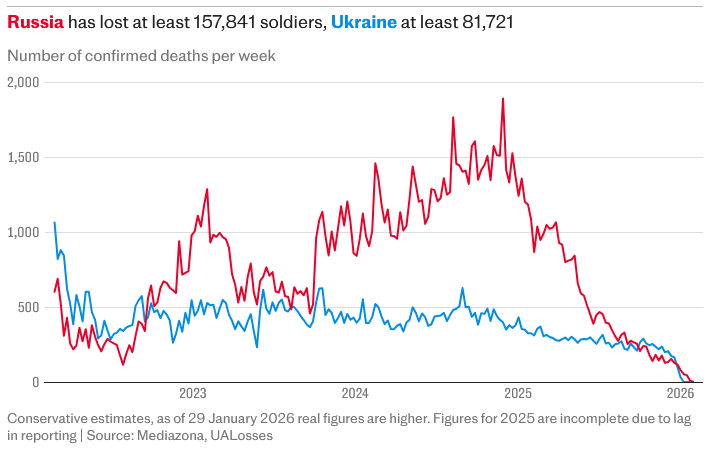
Here, the author also mentions the bonuses with which Russia tries to persuade volunteers from poorer regions. The bonuses accumulate to $50,000 (£40,000 / ~ €42,300).
Around 87% of Moscow’s losses came from drone strikes, and after Musk banned Russia from using his Starlink satellite-based internet service (the fact that they could used it for so long is quite infuriating) it only got worse for Russia. Many of their drones are severly impeded as they can no longer fly and troops have to communicate via radio which is easier to intercept. Once they got disconnected, the intensity of the Russians dropped as well. According to an Ukrainian soldier who spoke with The Telegraph, they „regained Sosnivka [in Dnipropetrovsk]“ in two days and are „on the way to Huliapole [in Zaporizhzhia]“.
Despite of this, Europe still needs to do more to fight against the hybrid war Russia is waging against us. Russia was apparently able to buy properties near military sites across Europe in order to better co-ordinate sabotage campaigns, such as a „suspicious property acquistion near the MI6 headquarters in south London and the nearby US embassy, and RAF Akrotiri in Cyprus“ (The Telegraph). Given the threat, it should be made mandatory to strictly examine the purchases and nullify them to protect us from Russian sabotage.
It’ll remain important to spread awareness about this hybrid warfare Russia is waging, and why even after a peace deal in the future (hopefully with Ukraine having the upper hand and being able to get at least most of the things they want, including NATO protection) there should be no interest in normalizing ties with the cybercrime capital Moscow.
This relentless attacks against us shan’t go unpunished!
Macro Rubio – Fake Reassurances
Since we are on the topic of comfortable lies people tell themselves, let’s talk about the Munich Security Conference and why Rubio is not any better than J. D. „Couch-lover“ Vance.
Do you remember when Mark Carney, the Prime Minister of Canada, talked in his speech at Davos about the Czech dissident Václav Havel (1936-2011) and how he wrote in his essay in 1978 how the communist system sustained itself? If not, then I’ll repeat it here:
„Every morning, this shopkeeper places a sign in his window: ‘Workers of the world unite’. He doesn’t believe it, no-one does, but he places a sign anyway to avoid trouble, to signal compliance, to get along. And because every shopkeeper on every street does the same, the system persist – not through violence alone, but through the participation of ordinary people in rituals they privately know to be false.
Havel called this “living within a lie”.
The system’s power comes not from its truth, but from everyone’s willingness to perform as if it were true, and its fragility comes from the same source. When even one person stops performing, when the greengrocer removes his sign, the illusion begins to crack. Friends, it is time for companies and countries to take their signs down.“
A similar thing occurred at the Munich Security Conference. Despite knowing that the Trump-Administration openly opposes the European Union (as it is impossible for their Big Tech donors to exploit a united and strong economic entity), and being aware that they made it clear that they will support far-right parties to weaken our democracies, Rubio received a full standing ovation from European politicians. The Atlanticists who run the Munich Security Conference, and a lot of the European politicians, seem to fall for the temptation to just sit the Trump Administration out. It is the path with the least resistance, and something the MAGA-movement would want the most in order to dictate policies.
Rubio spoke about the alleged „shared American-European culture“, but the attacks on the US‘ democratic system have been going on since the inauguration of Donald Trump in 2025. Purposefully sabotaging institutions through the Department of Government Efficiency (DOGE) that was run by Elon Musk; dismantling USAID which will lead to the needless suffering of millions of people (14 million additional deaths by 2030); underming the rule of by law by sending ICE thugs immigrant communities to arrest and deport people without a warrant and any legal procedure; threatening independent media outlets and even blocking access to the White House – as they did with the Associated Press (AP) – for refusing to all the Gulf of Mexico the „Gulf of America“; leaving 66 international organizations, even those that protected children and women in war zones; not to mention the Executive Orders that are meant to overwhelm the system and do as much damage as possible so it will be more difficult to reverse what has been done. If the post-1945 liberal order is to be taken as the shared American-European culture, then it no longer exists.
| Commentary on Rubio’s Speech |
| The first five paragraphs of the speech would probably be worth an analysis too, but I’ll leave that to someone else. I haven’t read any of Francis Fukuyama’s books, yet I take whatever Rubio claims about it with several grains of salt. Making the soup inedible. He talks about subsidies (as if the US and other western Nation don’t massively subsidize their economies, albeit not to the extent China does) and how their own global world order allegedly weakened them, even though the US absolutely dominates in the technological sector (see Microsoft, Amazon, Google, eBay, etc.) and service sector and, until recently, enjoyed soft power like no other country (Hollywood, fast food, etc.). „We increasingly outsourced our sovereignty to international institutions while many nations invested in massive welfare states at the cost of maintaining the ability to defend themselves.“ Contrary to this neoliberal mindset, you can indeed have a strong welfare state and a decently-sized military if you tax the incomes progressively. Sovereignty isn’t „outsourced“ to international institutions, it’s realizing that there are issues that can’t be solved alone (like the climate crisis, which he denies; or trade disputes, in the WTO). „To appease a climate cult, we have imposed energy policies on ourselves that are impoverishing our people […].“ A foul lie. Between 2019 and 2024, the employment in the electricity sector – including generation, transmission, distribution, and storage – rose by 3.9 million (3/4th of all energy job additions). The prinicipal driver of the demand was Solar PV which accounted for half of the created jobs (source: IEA). The only cult – and a death cult that is – we witness nowadays are those who suck up to the fossil fuel companies so their CEOs can squeeze out every last cent out of the people. Renewables not only help us in reducing our Co2-emissions, and therefore protecting our very livelihoods – from the fields where our food grows and landscapes that characterizer our nations and regions within our nations alike -, but also create secure jobs for generations. And those working in fossil fuel jobs don’t have to be left behind: „With targeted retraining, around two-thirds of oil and gas supply workers have the base skills needed to move readily into other parts of energy, the same is true for about half of workers connected to fossil fuel power supply chains.“ (IEA) „It was here in Europe where the ideas that planted the seeds of liberty that changed the world were born. It was here in Europe where the world — which gave the world the rule of law, the universities, and the scientific revolution.“ I already pointed out how the Trump Administration betrayed the Enlightenment and thus the very thing Rubio praises here. And „unapologetic in our heritage“ serves as a dog whistle to forget about the injustice done against minorities in the past, as the Trump Administration also already has shown. „Mass migration is not, was not, isn’t some fringe concern of little consequence. It was and continues to be a crisis which is transforming and destabilizing societies all across the West.“ It was just thrown in there, because if you leave it out it doesn’t change what comes afterwards. There’s no distinction between refugees (involuntarily leaving your country or moving within your country to safer places) and immigration (voluntarily leaving your country for a better life, to experience a different culture, or other reasons). It doesn’t address the 123.2 million people who were forcibly displaced by persecution, conflict, violence, human rights violations and other events severly disturbing public order (see: the Democratic Republic of Congo, South Sudan and Ukraine -> UNHCR). What needs to be a done is to establish a global migration center to coordinate the involuntary migration (refugees), not to build walls and scapegoat immigrants at every opportunity for short-term political gain and long-term loss of a people’s liberty. „We do not need to abandon the system of international cooperation we authored, and we don’t need to dismantle the global institutions of the old order that together we built.“ That’s what your government actually has done, bucko. „It [the UN] could not solve the war in Gaza.“ The Israel-Palestinian conflict has been an utter failure of the international community as a whole, and now Gaza is just treated as real estate. „It had not solved the war in Ukraine.“ Your country did worse, may I remind you of the following: „First, the US opposed a European-drafted resolution condemning Moscow’s actions and supporting Ukraine’s territorial integrity – voting the same way as Russia and countries including North Korea and Belarus at the UN General Assembly (UNGA) in New York. Then the US drafted and voted for a resolution at the UN Security Council which called for an end to the conflict, but contained no criticism of Russia.“ (source: BBC) „It was powerless to constrain the nuclear program of radical Shia clerics in Tehran.“ There was something called the Joint Comprehensive Plan of Action, aka the Iran Nuclear Deal. And Iran even followed it after Trump left the deal in his first term, at least around 2018 Iran still did: „In its last report in May, the IAEA had said Iran could do more to cooperate with inspectors and thereby „enhance confidence“, but stopped short of saying the Islamic Republic had given it cause for concern. Thursday’s report to member states seen by Reuters contained similar language. It said the Vienna-based U.N. nuclear watchdog was able to carry out all so-called complementary access inspections needed to verify Iran’s compliance with the deal.“ (source: Reuters) „And it was unable to address the threat to our security from a narcoterrorist dictator in Venezuela.“ He didn’t pose a threat to the US, Trump literally said it was just about the oil. It was a blatant violation of international law and didn’t change the nature of the regime in any way (with the exception that they sell oil to you now, congrats?). Rubio also goes on to talk about how Europe and the US, prior to the end of the Second World War, shared five centuries of expansion (meaning colonialism and imperialism) before the Cold War: „The great Western empires had entered into terminal decline, accelerated by godless communist revolutions and by anti-colonial uprisings that would transform the world and drape the red hammer and sickle across vast swaths of the map in the years to come.“ Next to it being a clear white supremacist world view, that all the others countries have to be subdued by „the west“, Rubio also willingly ignores the First World War which was a result of a multipolar world order (the British, French, German Austrian and Russian Empire) and the lack of multilateralism that existed at the time. „We do not seek to separate, but to revitalize an old friendship and renew the greatest civilization in human history.“ Every civilization has a place on the surface of this planet, some were able to contribute more to philosophy, mathematics and other subjects and others less. When knowledge was forgotten to an extent in medieval Europe, Islamic scholars preserved the writings of the ancient Greeks. When the Spanish arrived in Mexico, they eliminated Mayan literature too, leaving us in the dark what they philosophized about or how great their wealth of knowledge was. You can be proud of your country’s contributions without downplaying others, or clinging to fake superiority. „[…] what we have inherited together is something that is unique and distinctive and irreplaceable, because this, after all, is the very foundation of the transatlantic bond.“ The foundation of the transatlantic bond was the Cold War, when socialism (dominated by Soviet Russia) and capitalism (dominated by the US) were in a rivarly that led to countless proxy wars across Latin America, the Middle East, Africa and the Far East. The US quite literally pushed for open markets, alliances with shared responsibilities and whose checks and balances led to the downfall of Richard Nixon. This transatlantic bond, that Rubio praises, disintegrated with the unilateral dogma of the MAGA-movement. Sources MarcoRubio Address to the Munich Security Conference https://www.americanrhetoric.com/speeches/marcorubiomunichsecurityconference2026.htm World Energy Employment 2025 – Executive Summary https://www.iea.org/reports/world-energy-employment-2025/executive-summary Data and Statistics – Global Trends https://www.unhcr.org/global-trends US sides with Russia in UN resolutions on Ukraine https://www.bbc.com/news/articles/c7435pnle0go Iran is complying with nuclear deal restrictions: IAEA report https://www.reuters.com/article/world/iran-is-complying-with-nuclear-deal-restrictions-iaea-report-idUSKCN1LF1KP/ Maya books (destruction of) https://www.ebsco.com/research-starters/literature-and-writing/maya-books-destruction |
On Substack, Dave Keating wrote an amazing analysis which – for some reason – wasn’t paywalled when I read it on my mobile phone. It is called „Why the European establishment stood up and cheered Rubio after he insulted them“, from February 16. The question now is whether the European politicians – except for Viktor Orban, he already sucks up to Trump after sucking up to Putin for years – want to keep placing signs in their windows to avoid trouble (and wander the path into inevitable demise) or walk their own path to sovereignty.
The Resilience of Ukraine
During the first days and weeks of the invasion, it was believed that Russia would be able to quickly conquer Ukraine. On paper, it made sense. Before the full-scale invasion, Moscow deployed around 200,000 soldiers to the border – including elite forces (quite the contrast to what Russia deploys now to the front). The Russian air force outclassed that of Ukraine’s, same applied to the naval fleet. However, Russia would soon lose a lot of the territory in an Ukrainian counter-offensive and only make very little gains afterwards. Ukraine even managed to temporarily occupy Kursk (Kursk campaign), showing the incompetence of the Russian government once again. And now, four years later, the casualties of Russian soldiers may even be as high ash 1.2 million – with 325,000 dead (the conservative estimate puts it at 157,841). Russia lost 24,000 significant items of military hardware and the source of Russia’s wealth, the fossil fuels they extract, were not spared either by Ukraine. And just recently, on February 21, Ukraine managed to hit the Russian Votkinsk factory which produces Iskander ballistic missiles, often used in strikes against Ukraine. The factory is 1,400 kilometers (870 miles) away from Ukraine!
Alongside the support of Ukraine’s allies, which was sadly slow at times (Germany, France and occasionally the US, until the betrayal of the Second Trump Administration), the ongoing failure of Russia to reach their main objective is also the result of the courageous men and women fighting in the Ukrainian armed forces. They did not melt as once believed. Instead, they have grown stronger as this war is an existential one: their country under the threat of being absorbed by their imperialist neighbour; their democratic system in danger because an open society is a threat to the neighbouring autocracy; and their culture, family and friends in the very real endanger of being murdered by Russia.
Russia repeatedly made the empty threats to use tactical nuclear weapons, but never realized it. Most likely just psychological warfare to create hesitancy among Ukraine’s allies. China would probably not be happy either about a trigger-happy neighbour.
And Russia relies on China, due to the war the dependence on China only increased.
The territorial gains of Russia have also been very low: „In addition to its slow rate of advance, Russia’s territorial gains over the past two years have been modest. In 2024, Russian forces seized approximately 3,604 square kilometers of Ukrainian territory, or about 0.6 percent of Ukraine—an area smaller than the U.S. state of Delaware. In 2025, Russian forces made marginally larger gains, seizing approximately 4,831 square kilometers (about 0.8 percent of Ukraine) and retaking approximately 473 square kilometers in Russia’s Kursk Oblast.“
(source: Russia’s Grinding War in Ukraine – Massive Losses and Tiny Gains for a Declining Power | Center for Strategic & International Studies)
Russian War Crimes
According to Ukraine’s Prosecutor General Ruslan Kravchenko, over 240,000 criminal offenses related to the war have been registered in Ukraine. 211,000 of these criminal offenses were war crimes and includes killings, torture, sexual violence, the deportation of Ukrainian children, the massive strikes on civilian infrastructure and looting.
The National Police, security services, and investigators from the Office of the Prosecutor General carry out the investigations. Registering and documenting the crimes committed by Russia is not the only thing they do, though. The justice system of Ukraine conducts absentia proceedings, in accordance with international standards, to collect testimonies from victims and witnesses – since over time they may pass away – and to transform war crime suspects into convicted fugitives. 800 indictments have been admitted to court so far, and 240 verdicts have already been delivered by Ukrainian courts where some were rendered in absentia. Ukraine also cooperates with the International Criminal Court in The Hague and the Court ‚has already issued six arrest warrants against members of Russia’s leadership, including Vladimir Putin, who is suspected of the unlawful deportation of Ukrainian children and organizing systematic attacks on civilian infrastructure‘.
A Special Tribunal, or what I referred to as a Nuremberg-like trials given the similarities to Hitler’s invasion of Soviet Union, needs yet to be established. It is already well underway with the International Centre for the Prosecution of the Crime of Aggression against Ukraine already operating in The Hague, continued support is crucial.
It shouldn’t end there, though. Currently, Russia threatens Europe through its military exclave Kalinigrad by deploying Iskander-M ballistic missiles to this military outpost disguised as a Russian province. „The Iskander-M is a ballistic missile that travels at Mach 6-7 (7,400-8,600 kmh). It measures 7.3 meters in length, with a 0.9-meter diameter, weighs up to 3,800 kilograms, and carries a 480-kilogram warhead.“ (source: Kyiv Independent)
Russia may soon even house as many as 100 tactical nuclear warheads at a suspected nuclear weapons storage facility, increasing the danger drastically.
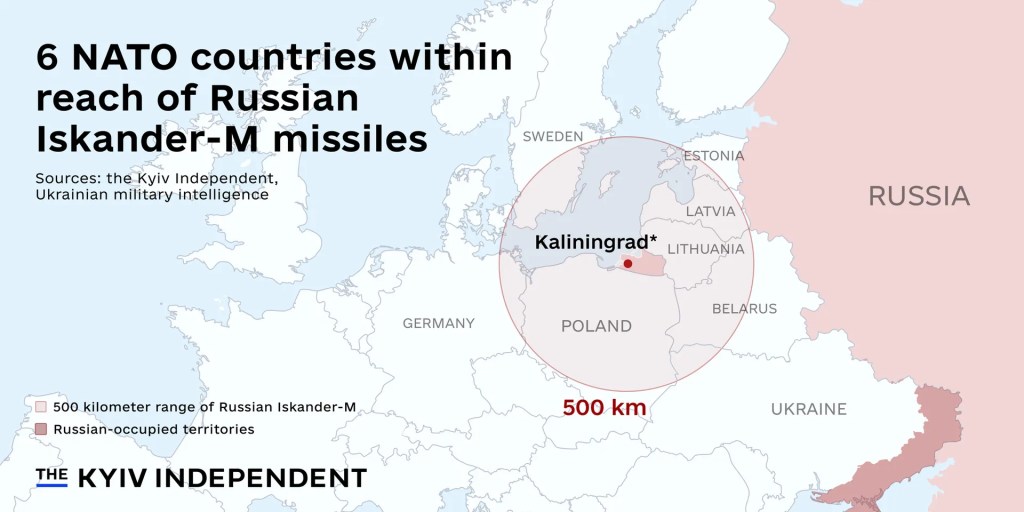
In its war against Ukraine, Russia already has shown that they will attack civilian infrastructure too – not just military targets.
In order to secure long-lasting peace, Kalinigrad should be turned into an international zone after the war. The citizens of Kalinigrad would be allowed to keep their Russian passports, but the region should face complete demilitarization and only have a police force that is adequate for a region of that size. Administratively, Kalinigrad would then be turned into a fully autonomous zone – prohibited from joining Russia ever again.
An independent organization, perhaps just with members from Poland, Lithuania, Latvia, Estonia and Sweden, should oversee its development and ensure a peaceful transition.
But that’s just an unripe idea of mine.
Sources
Ukraine War Has Gone On Longer Than The Soviet’s Fight In WWII
https://www.forbes.com/sites/petersuciu/2026/01/16/ukraine-war-has-gone-on-longer-than-the-soviets-fight-in-wwii/
Three Years Into the War in Ukraine, One-Third of Population in Frontline Regions Struggle to Find Enough to Eat
https://wfpusa.org/news/three-years-war-ukraine-one-third-population-frontlines-hunger/
Russian soldiers being killed faster than Kremlin can recruit them
https://www.telegraph.co.uk/world-news/2026/02/24/russian-soldiers-killed-faster-than-kremlin-can-recruit/
USAID officially closes, attracting condemnation from Obama and Bush
https://www.bbc.com/news/articles/c307zq8ppj6o
These are the 66 global organizations the Trump administration is leaving
https://apnews.com/article/trump-administration-global-organizations-un-daaa4c9f459d7a492536a1a4e3b7697c
Dave Keating
https://substack.com/@davekeating
Kursk campaign
https://en.wikipedia.org/wiki/Kursk_campaign
Ukraine: Busted Myths After Four Years of War
https://cepa.org/article/ukraine-busted-myths-after-four-years-of-war/
Ukraine strikes a key industrial site deep inside Russia
https://apnews.com/article/russia-ukraine-war-drone-missile-factory-bdbce412526d3f9b32bedb8092cd642f
Russia’s Grinding War in Ukraine
https://www.csis.org/analysis/russias-grinding-war-ukraine
211,000 War Crimes in Four Years: Ukraine’s Prosecutor General on the Scale of Russian Aggression
https://slovoproslovo.info/en/211-000-war-crimes-in-four-years-ukraine-s-prosecutor-general-on-the-scale-of-russian-aggression/
International Centre for the Prosecution of the Crime of Aggression against Ukraine
https://www.eurojust.europa.eu/international-centre-for-the-prosecution-of-the-crime-of-aggression-against-ukraine
Russian Iskanders in Kaliningrad — should NATO be worried?
https://kyivindependent.com/russia-saber-rattles-with-iskander-missiles-in-kaliningrad-oblast-during-zapad-drills-should-nato-be-concerned/
 Baroque