The following statements originate from a publication from the Schweizerische Märchengesellschaft SMG (Swiss Fairy Tale Society), I merely translated them into the English language. It is likely that the one or other also heard about the gruesomeness that can be found in the fairy tales of the Grimm Brothers and other German folklore, so you may be wondering how it has been perceived in Germany and German-speaking countries. If you did, you came to the right place. Let’s hear what the experts had to say!
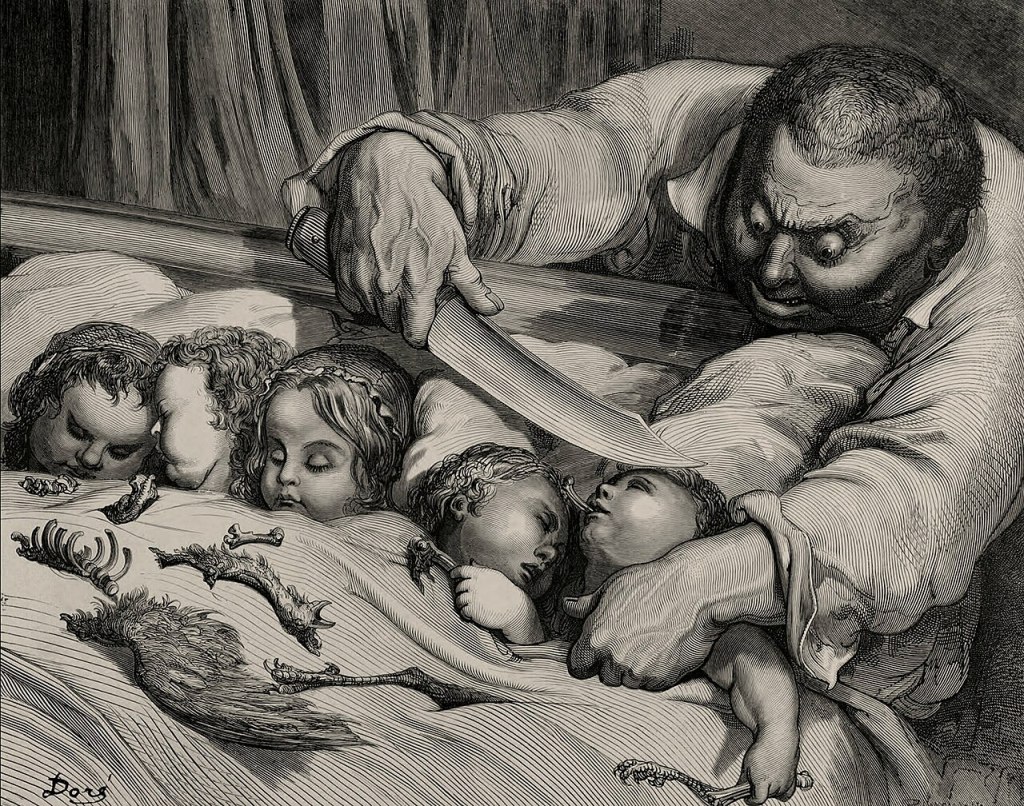
(Image Source: Wikipedia)
At the end, I’ll talk a little bit about the Ogre in folklore as well as Gustave Doré (January 6, 1832 – January 23, 1883).
Without further ado, let’s begin.
Cruelties in Folklore
Elisa Hilty, Taleteller and Folklore Pedagogue
As a speaker, it’s common that at least one person asks me more or less aggressive questions in each lecture. The questions always revolve around the gruesomeness in folktales. I think the objections are understandable, but I’m of the opinion that in todays day and age, in particular children, need role models who teach them how to deal with the evil. Since the adults themselves are often overwhelmed by it.
Nowadays, the criticism from parents focus on the evil characters. The good things, the curative parts and the trust, is often declared as being unrealistic and wishful thinking.
But aren’t children in need for role models who strengthen the trust to take difficult paths too? Role models that encourage to solve the seemingly impossible tasks?
When I narrate fairy tales for adults, like Vom Machandelbaum (= The Juniper Tree) or a variant of Mädchen ohne Hände (= The Girl Without Hands), the following question often emerges: Do you narrate these stories for children too?
And should under the circumstances of today, where so much violence is depicted in the media landscape and there’s an increase of violence on the recess grounds, fairy tales even be told anymore?
I narrate so-called gruesome fairy tales also for children. Moreover, said evil exists in nearly every fairy tale for small children. However, unlike adults, children have no trouble with these so-called gruesome acts in folktales. Unconsciously, they „understand“ that the life threatening situations the heroes and heroines find themselves in belong to their path of development and get the events into motion.
What’s fascinating to children often scares adults.
Fairy tales are the blueprint of a world that never excludes evil.
[…]
The witch in Hänsel und Gretel (= Hansel and Gretel) is usually seen as being one-sided evil and insidious. How would that change if we changed our point of view and saw it as the witch testing the children? Through her evilness she facilitates the development of the children, first and foremost of Gretel.
In contrast to the stepmother, the witch also displays the good motherly side in her actions. Her house is made out of bread which is a staple food and a maternal symbol.
Hansel and Gretel first experience paradise: they are being spoiled and fall peacefully asleep in her home. On the next day, everything changed. Staying for too long in the maternal paradise would lead to death – of the personhood -. Superficially, the actions of the witch give the impression of a devious chess move; in a subtle way she fulfills a law of nature, in a way Mephisto talks about it in Goethe’s „Faust“: I’m a part of the force which constantly wants the evil and always creates the good.
When a fictional character arrives in the kingdom of a witch, a magician or a Drakin, we can almost always conclude that a rite of passage underlies the fairy tale. Gretel is tested by the witch. If she hadn’t recognized her intentions and hadn’t recognized the evil, the danger, the children would have been annihilated.
Enriched, the children return to the father. The dependency on the maternal has been overcome.
[…]
Needless to say, I cannot recommend that you should narrate more of these gruesome fairy tales. Because the most important rule for a narrator is the following: the narrator should like the fairy tale they read.
Excerpts from: Elisa Hilty: …in glühenden Schuhen zu Tode tanzen
(first published in January 2003)
Cruelties in Fairy Tales
Lutz Röhrich, Folklorist and Narratologist (1922-2006)
A lot of things we adults view as gruel isn’t experienced like that by children.
For a child, it goes without saying that the hero of the fairy tale kills the dragon or the fiery dog. No child would even think about mourning over the poor giants. Children do not even consider it animal torture when the old goat slits open the belly of the wolf, filling its stomach with stones instead of little goats. They do not even question the fact that the little goats escape from the wolfs belly without harm. Death is a foreign concept to them. For the fairy tale there’s no actual death, there’s a constant transition from life to death and from death to life, from the darkness to the light and from the evil to the good. Even in the real world, what we experience as childish brutality is often not gruesomeness, it’s just the state of not knowing.
Fairy tales speak in images; from the threatening to the redemptive, from the evil and from the good, from the shortcoming and the abundance, from the cheerful to the sorrowful, from beauty and from ugliness. And it tells it in images that are immediately accepted by the child without explanations.
Moreover, not all fairy tales are the same. That’s why we should be careful which book of fairytales we give to our children. It is certain, however, that the fairy tales themselves do not glorify atrocities. But, and naturally so, we became more sensitive to these questions due to our experiences in recent history and today.
Origin: Lutz Röhrich: Märchen und Wirklichkeit
(5. Auflage 2001, S. 157)
Cruelty and the Fears of Children
Barbara Gobrecht, Narratologist
Cruelty is defined as being „arbitrary, unjustified infliction of pain, suffering or death“.
The cruelties in the fairy tales of the Grimm Brothers – Jacob (1785–1863) and Wilhelm (1786–1859) -, which was the most translated book of the German language, has led to repeated fierce criticism, especially after the Second World War (1939-1945).
The English occupation forces even prohibited the reprinting of fairy tales and justified it by claiming that the German people became cruel due to their fairy tales. Concerned Americans saw in the oven of Hansel and Gretel the death camp Auschwitz symbolized.
And yet, cruelties in folklore aren’t a special German phenomenon. One only has the to read the French version of Rotkäppchen (= Little Red Riding Hood) or Charles Perrault Dornröschen (= The Sleeping Beauty) where a man-eating stepmother appears.
Compared to that, the counterparts of the Grimm Brothers look very moderate. Of course, neither Perrault nor France have a „monopoly“ on violence in fairy tales. It’s a fact that violence and cruelties are a part of all fairy tales.
The punishment of villains in Grimms „Kinder- und Hausmärchen“ is described more detailed than the fortune of the heroes. It seems to be a prerequisite for the fortune of the hero, and in some fairy tales it even makes the end a happy one to begin with, when the villains are eliminated – often in a cruel way.
Fairy tales love the extreme cases. The most effective narrative technique is always the most gruel and extraordinary punishment. At least when it comes to the point of view from children as listeners to the story, Lutz Röhrich was in the right when he noted: „The extremely enhanced case of gruelty is not as real as the one in actuality; it goes head over heels and thus becomes a part of the fictional world of the fairy tale“.
The antagonists who are punished do not complain about the cruelties that are inflicted upon them, and nothing is written about their suffering. Even when the hero himself experiences something horrible, like in Wasser des Lebens (= The Water of Life) where his heel was cut off or when he sacrificed a piece of flesh from his leg to feed the helper bird, we neither learn about his pain nor any disabilities that’d result from these injuries.
The fairy tale projects emotions on the surface, puts them in images, abstracts them. Only the rationalist can claim that fairy tales have a harmful impact, because according to Lutz Röhrich „the fairy tale itself does not ask the question of cruelty in a rational way. It doesn’t waste a thought on it. It takes no notice from the horror that occurs. This is the reason why children do not interpret the gruesomeness of fairy tales as cruel.“
From 1968 onwards, there were increasing concerns among pedagogues about fairy tales. Fairy tales like Hansel and Gretel could reinforce the fears of children (e.g. withdrawal of affection from parents) or fixate them (e.g. fear of the forest). We narratologists, on the other hand, believe that through the personification of the children fears (wolve, witch, dragon) and the plot of the fairy tale they can overcome their fears, since these fears already existed within the mind of a child. In other words: fairy tales offer through fear processing educative support to overcome them.
The topic of „gruesomeness“ has polarized and polarizes to this day. Even so, the understanding of many parents, that children who grow up without fairy tales are withheld important steps in development, has grown. Hence, one should narrate or read out loud fairy tales – even those of the Grimm Brothers -, fairy tales you can get behind.
Important for small children: the narrator has to be physically present. When fairy tales are consumed through an audio tape, a CD or even a video the only things that are conveyed are the tension and the excitement, without the important feeling of security, the comforting „Nothing bad can happen to you!“.
Listening to and understanding a completed adventure creates a sensation of self-confidence. Whatever occurs in fairy tales: the trust in a happy end remains steadfastly.
This why the good ending to a fairy tale is a necessity, in a literal sense in a „twist of hardship“.
The insistence on a pedagogy freed from fears is understandable, but some weird flowers blossomed out of it. Fairy tales were re-narrated and belittled, instead of the witch burning in the oven she was sent into a nursing home. Or dragons that turned into lovable and small creatures that were as fearful as children. I personally think that minimizations and belittlements like these are not sensible.
Excerpts from: Barbara Gobrecht: Märchenreise nach Griechenland
(Veröffentlichungen der SMG, Band 8, 2007)
Children and Gruesomeness in Fairy Tales
Ursula Kübler, Psychologist
Whether you are an adult or a child: there are always phases in our life where we have to wrestle for our mental balance, when we feel torn apart and shaken from inner struggles and have to deal with our own negative and destructive-demonic forces.
Children in particular are exposed to extreme emotions of fear, envy, jealousy and hatred on their path of development without a matured, sculptured self. Fairy tales teach us how do deal with these forces in their archaic-archetypical metaphorical language, where those intensive, but often tabooed emotions take their rightful place in the story.
They are lived out and a solution is shown. By projecting one’s own destructive tendencies on the characters of the fairy tale, it helps to dismantle tensions, unburdens the conscience and become gradually integrated – let’s not be in denial about it, that’s a life-long process! – to a certain point.
Fairy tales are also a mediator of hope and trust; they help to build up the resources to reach one’s own sources of strength. Children often have a relibale instinct when it comes to figuring things out, which can be quite helpful when they are confronted with the difficult task of dealing with their dark sides. This is why fairy tales can be one option out of several that the child can use. However, fairy tales should never be forced up on a child. Otherwise it could have a destructive effect.
Statement
(September 2011)
Gruesomeness in Fairy Tales
Katalin Horn, Librarian i. R. and Narratologist
In next to no other literary genre is the manner of abuse, torture, murder and execution so gruesome as in fairy tales.
Let’s bring to our minds some of the key points regarding this from the Enzyklopädie des Märchens (= Encyclopedia of Fairy Tales – Berlin/New York):
Aggression; decapitation; torture; gruesomeness; remorselessness; hatred; execution; corpse; the corpse that was killed several times; murder; murder parents; murder stories; attempted murder with a hatchet; nail-keg; heads on stakes; crucification; nights of agony; etc.
It’s possible that the frequency is interrelated with the structure and purpose of the genre of fairy tales, in the genre where infliction of damage plays a big role
(cf. Vladimir Propp: Morphologie des Märchens, München 1972).
It makes one contemplative that even – or especially – children tales contain a lot of gruesomeness. It’s likely not a coincidence that Walter Scherf, the author of the book Das Märchenlexikon ( = The Fairy Tales Encyclopedia | 2 Bände, München 1995), devoted an entire monography to this topic in 1987: The Challenge of the Demon. Form and Function of gruesome children tales. A folkloric and depth analysis depiction. (Original: Die Herausforderung des Dämons. Form und Funktion grausiger Kindermärchen. Eine volkskundliche und tiefenpsychologische Darstellung.)
The importance of this subject also explains the diverse approaches: legal history, pedagogical, depth analysis, literary and structuralist interpretations deal with it.
Statement
(August 2011)
Ethical Laws of Gruesomeness
Wilhelm Solms, Germanist and Grimm Researcher
As Max Lütni emphasized it, the fairy tale is „action-oriented“. The plot is the hero’s path to fortune. When the narrator recounts the story line, he’s on the side of the hero from the beginning to the end. If his listeners or readers share the egocentric attitude of the fairy tale, then they will be sympathetic to the hero who’s an outcast at the beginning or in an emergency or danger. What happens to the minor characters is forgotten, ignored are the cruelties the hero committs and joy may even be found in the punishment of his opponents.
Hence, the brutalities told by the narrator will only be partly seen as cruel as empirical studies have shown. If the hero or heroine is killed (Schneewitchen = Snow White, Die drei Schlangenblätter = The Three Snake Leaves) or imprisoned (Der goldene Vogel = The Golden Bird), it is seen as a crime that demands atonement. If his older brothers or sisters, who did no evil, die (Das Meerhäschen = The Sea-Hare, Fitschers Vogel = Fitschers Bird) it is unfortunate but not of further interest and sometimes even quickly forgotten. If their rivals are branded (Aschenputtel = Cinderella, Frau Holle = Mother Hulda), then it results in gratification. And if the opponent is tortured to death in a cruel way, the fortune of the hero, the narrator and the listeners and readers is complete.
The acts of violence in fairy tales not only have an epic, but also a moral function, that I consider questionable. Whether they are or aren’t perceived as gruesome depends on whether they are morally justified. They are morally justified if it affects „the evil“, meaning the individual characterized as evil by the narrator. And that’s those who stand in the way of the hero instead of helping him. If the narrator changed the point of view and look at the plot, the race to fortune, from the eyes of the opponent then the hero, who uses his wondrous helpers and illict maigc, would appear as evil.
[…]
The folktales are not only a mirror of „naive aesthetics“ (Klotz), but especially a mirror of „naive morality“ (Jolles). They are adequate and have been used for teaching moral attitudes to children that are born without, but acquired it, to reinforce them. That’s why pedagogues shouldn’t be appalled by the gruesomeness of the fairy tale, but the gruesomeness of morality that are conveyed by the fairy tales.
from: Wilhelm Solms: Die Moral von Grimms Märchen
(Darmstadt 1999, S. 174-175)
Source
Sind Märchen (zu) grausam?
Märchenfachleute nehmen Stellung zu dieser oft gestellten Frage
(PDF: 6 pages)
https://www.maerchengesellschaft.ch/fileadmin/kundendaten/maerchen/maerchenkunde/grausamkeit/maerchen_grausamkeiten.pdf
Schweizerische Märchengesellschaft SMG
https://www.maerchengesellschaft.ch/ueber-uns/ueber-die-smg
The Ogre in Fairy Tales and Folklore
The ogre is a being that feeds on humans. In the late 17th century it was popularized by the French poet, pose writer and storyteller Charles Perrault (January 12, 1628 to
May 15/16, 1703), author of of Contes de ma mère l’oye (Tales of Mother Goose).
Ogres have appeared in many stories afterwards, such as „Tom Thumb“ (English folklore); Hansel and Gretel where the witch is a type of ogre due to her intention to eat the children; and Little Red Riding Hood where the wolf resembles an ogre (at least according to Encyclopedia Britannica that includes them).
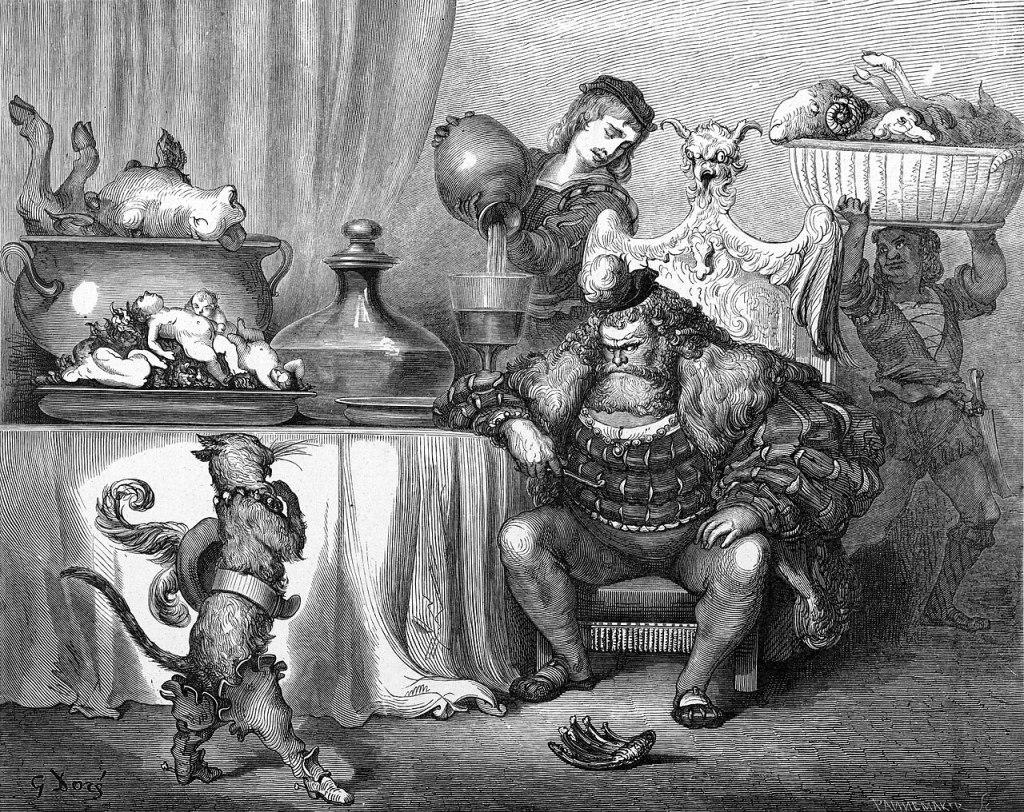
(Image source: Wikipedia)
Encyclopedia Britannica also writes about a broader and more metaphorical meaning of ogre in literature: „The seducer who devours his or her victims in a sexual sense is a kind of ogre, as is a political tyrant or dictator who controls and exploits others and in a sense swallows them up. The dictator causes lives to be consumed through promulgating wars and acts of brutality such as those perpetrated by the Nazi regime. The association of ogres with Nazis was made in Michel Tournier’s novel Le Roi des aulnes (1970; The Ogre).“
Shrek, the green ogre that is probably familiar to a lot of readers, was a creation from the American author William Steig (November 14, 1907 to October 3, 2003).
Given it has a medieval setting, it’s not a surprise that some characters are terrified of Shrek after hearing about the hunger of orgs for human flesh for their entire lives.
Sources
Charles Perrault
French author
https://www.britannica.com/biography/Charles-Perrault
Ogre
Mythological character
https://www.britannica.com/topic/ogre
Ogre
https://en.wikipedia.org/wiki/Ogre
William Steig
https://en.wikipedia.org/wiki/William_Steig
Gustave Doré
Paul Gustave Doré (6 January, 1832 in Strasbourg to 23 January, 1883 in Paris) was a French painter and graphic artist, especially has an illustrator he made a name for himself.
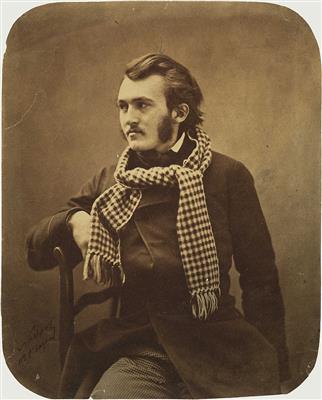
(source: Wikiart)
His talent as an illustrator was already recognized when he was a pupil. Moreover, when he was 7-years old he began to play several instruments, among them the violin he mastered virtuoso. At the age of 9 years, he tried to to illustrate Dante Alighieris „The Divine Comedy“. When he was 13 years old, he moved to Paris in France and two years later he got a job as an illustrator at Le journal pour rire. In the same year, his first work about the Adventures of Hercules were published in the Paris publishing company Aubert.
In 1853 he received the opportunity to contribute illustrations to the works of Lord Byron. 10 years later he illustrated 370 illustrations for the French edition of Miguel de Cervantes’ Don Quijote. The oversized edition of Edgar Allan Poes narrating poem in 1884 was accompanied by 25 steel engravings from Doré.
The success of his Bible illustrations in 1866 made it possible for Doré to hold an event in London where he presented his works. It led to the creation of the Doré-Gallery in the Covelant Bond Street. In 1869, the English journalist William Blanchard Jerrold and Doré were tasked with making a comprehensive portrait of London.
He signed a Five-Year-Agreement with the publishing company Grant & Co.
During the entire duration of the project he had to stay in the city for at least three months every year, he was well compensated with a sum of £10,000 each year.
In 1872, the book was published under the title London: A Pilgrimage.
Although the 180 engraved illustrations were commercially a success, he was subject of harsh criticism. Most of the critics accused Doré that he primarly focused on deprived areas of the city and thus the proletariat. Despite that, the artist received many more commissions in Great Britain.
He died on January 23, 1883 in Paris due to the aftermath of a heart attack at the age of 51 years. His final resting place is at the graveyard Père Lachaise (Division 22).
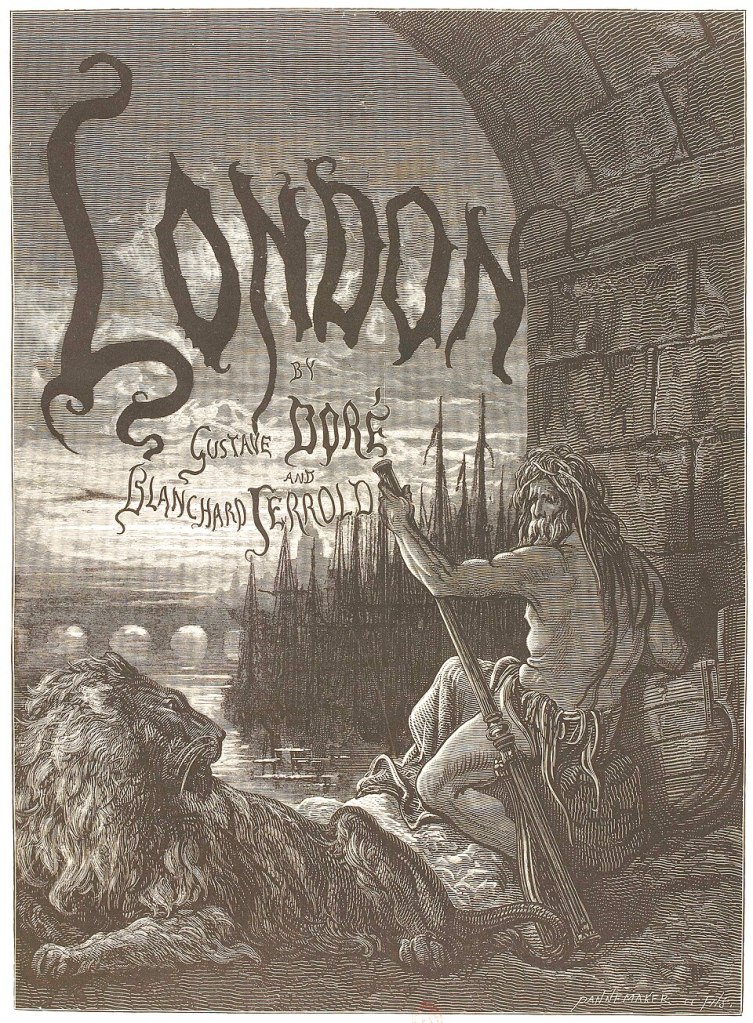
(Imae source: Wikipedia)
Sources
Gustave Doré
https://www.wikiart.org/de/gustave-dore
London: A Pilgrimage
https://en.wikipedia.org/wiki/London:_A_Pilgrimage





Kommentar verfassen