In a statement published on May 20, 2026, the Intergovernmental Panel on Climate Change discussed the reports of the media about a paper that apparently came to the conclusion that the worst case scenario, known as SSP5-8.5, was no longer plausible.
This was falsely attributed to the IPCC!
The IPCC does not conduct its own research, neither does it run models nor make measurements. Because that’s not the task of the IPCC. What they do is assessing the available scientific, peer-reviewed literature relevant to climate change which amounts to 50,000 papers and studies each year. The paper mentioned will be part of AR7, though. For more details about the different scenarios and the full statement, see below.
50,000 papers/studies a year means about 137 each day, throughout the 365 days.
That’s, of course, just an average (50,000 divided by 365 days, no indepth analysis) and in reality the amount of published papers probably fluctuates. However, it better helps to understand the amount of work the IPCC puts in each assessment.

(source: Pixabay | geralt)
A recap on the different climate scenarios.
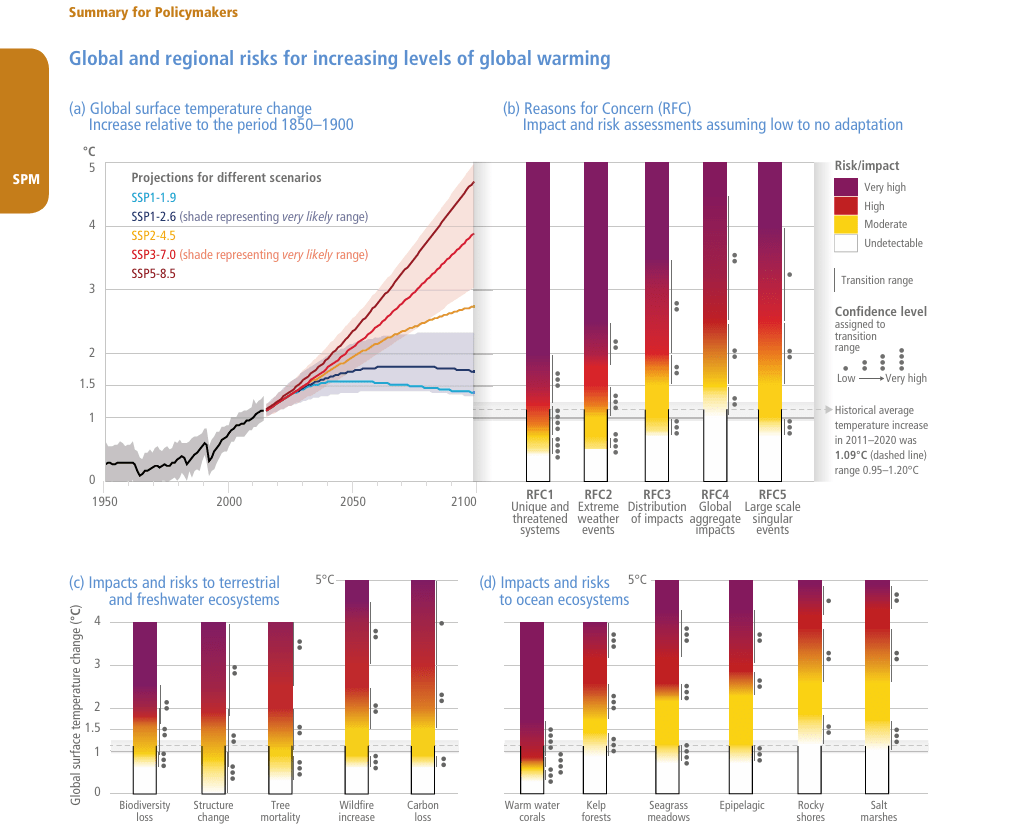
Background
These climate scenarios, where the SSP stands for „Shared Socioeconomic Pathways“, don’t show how the future will look like, they tell us how the world could look like.
The primary aspect of these scenarios is the emissions of greenhouse gases that result, since it will determine the future of our climate. However, there’s more to that as „Our World in Data“ explaines in their article: IPCC Scenarios Data Explorer.
„To understand how our emissions might evolve we need to know how the world might change from a socioeconomic and technological perspective. These scenarios therefore differ in their assumptions about socioeconomic and technological development in the coming decades.
The socioeconomic and technological factors that the SSPs include are: population growth, economic growth, urbanization, trade, energy, and agricultural systems.“
So, even when one scenario would cease to apply due to progression or regression it is either good news for everyone or bad news for everyone. In order to understand why, let’s take a look at the description of the five different scenarios.
SSP1: Sustainability – Taking the Green Road (Low challenges to mitigation and adaptation)
“The world shifts gradually, but pervasively, toward a more sustainable path, emphasizing more inclusive development that respects perceived environmental boundaries. Management of the global commons slowly improves, educational and health investments accelerate the demographic transition, and the emphasis on economic growth shifts toward a broader emphasis on human well-being. Driven by an increasing commitment to achieving development goals, inequality is reduced both across and within countries. Consumption is oriented toward low material growth and lower resource and energy intensity.”
SSP2: Middle of the Road (Medium challenges to mitigation and adaptation)
“The world follows a path in which social, economic, and technological trends do not shift markedly from historical patterns. Development and income growth proceeds unevenly, with some countries making relatively good progress while others fall short of expectations. Global and national institutions work toward but make slow progress in achieving sustainable development goals. Environmental systems experience degradation, although there are some improvements and overall the intensity of resource and energy use declines. Global population growth is moderate and levels off in the second half of the century. Income inequality persists or improves only slowly and challenges to reducing vulnerability to societal and environmental changes remain.”
SSP3: Regional Rivalry – A Rocky Road (High challenges to mitigation and adaptation)
“A resurgent nationalism, concerns about competitiveness and security, and regional conflicts push countries to increasingly focus on domestic or, at most, regional issues. Policies shift over time to become increasingly oriented toward national and regional security issues. Countries focus on achieving energy and food security goals within their own regions at the expense of broader-based development. Investments in education and technological development decline. Economic development is slow, consumption is material-intensive, and inequalities persist or worsen over time. Population growth is low in industrialized and high in developing countries. A low international priority for addressing environmental concerns leads to strong environmental degradation in some regions.”
SSP4: Inequality – A Road Divided (Low challenges to mitigation, high challenges to adaptation)
“Highly unequal investments in human capital, combined with increasing disparities in economic opportunity and political power, lead to increasing inequalities and stratification both across and within countries. Over time, a gap widens between an internationally-connected society that contributes to knowledge- and capital-intensive sectors of the global economy, and a fragmented collection of lower-income, poorly educated societies that work in a labor-intensive, low-tech economy. Social cohesion degrades and conflict and unrest become increasingly common. Technology development is high in the high-tech economy and sectors. The globally connected energy sector diversifies, with investments in both carbon-intensive fuels like coal and unconventional oil, but also low-carbon energy sources. Environmental policies focus on local issues around middle and high-income areas.”
SSP5: Fossil-fueled Development – Taking the Highway (High challenges to mitigation, low challenges to adaptation)
“This world places increasing faith in competitive markets, innovation and participatory societies to produce rapid technological progress and development of human capital as the path to sustainable development. Global markets are increasingly integrated. There are also strong investments in health, education, and institutions to enhance human and social capital. At the same time, the push for economic and social development is coupled with the exploitation of abundant fossil fuel resources and the adoption of resource and energy-intensive lifestyles around the world. All these factors lead to rapid growth of the global economy, while global population peaks and declines in the 21st century. Local environmental problems like air pollution are successfully managed. There is faith in the ability to effectively manage social and ecological systems, including by geo-engineering if necessary.”
SSP1 is the most optimistic potential development where we stay below 2 °C warming.
We will probably miss that goal if we don’t put a lot of effort into mitigation (of damage), prevention (of future emissions) and restoration (should carbon capture become feasible one day, until then we should reforest and reswamp, for example).
Not only would it save our prosperity of today, but also enrich the current and future generations as they could take energy generation in their own hands with solar parks and wind turbines – creating long-term jobs, strengthening the local economy and gaining independence from fossil fuel companies and authoritarian petrol states.
It’s a difference, after all, if you have to import the fluid that runs the engines of your economy every year or only need to buy the materials every 20 to 30 years to manufacture your own machine that produces the fluid.
SSP5 is the worst case scenario where humanity abandons enviromental protection and renewable energies altogether (what the Trump-Administration, other far-right groups and parties like the AfD in Germany, the fossil fuel industry and billionaires like Musk want), the destruction caused by this would very likely cause a sixth mass extinction with disastrous consequences to the ecosystems – locally, where you live, too – worldwide.
Just without anything positive that is mentioned in the report, as „strong investments in health, education, and institutions“ strongly contradicts the selfish goals of the aforementioned groups (see Hungary under Oban with its massive corruption, Russia under Vladimir Putin and the US under Trump). Given the isolationistic tendencies, you could also cross out the sentence: „Global markets are increasingly integrated.„
It would still be great news if the last scenario was indeed no longer plausible, but I haven’t read the study. SSP3 (7.0 °C) and SSP2 (4.5 °C) seem to come the closest to our current development, maybe it’s a mixture – hopefully not the former.
At any rate, if taken at face value it’s still no reason to lean back and do nothing anymore. Just because your house is safe from being annihilated by a landslide, its location near a river, that is known for causing floods in the past after intense rainfall, doesn’t protect it from flood damage. You’d build dams like the Dutch and create areas where the river can expand into to protect your house and your community.
Statement of the IPCC
GENEVA, May 20 – In relation to some of the recent media and social media reporting, the Intergovernmental Panel on Climate Change (IPCC) wishes to clarify that, in several instances, the paper on climate scenarios authored by the Scenario Model Intercomparison Project (https://wcrp-cmip.org/mips/scenariomip/), which inputs assumptions to part of the Coupled Model Intercomparison Project (CMIP) process, has been incorrectly attributed to the IPCC.
The paper belongs to the broader body of scientific literature produced by the international research community, under the coordination of the World Climate Research Program, not the IPCC. It aims at producing a set of future illustrative scenarios that can be used by climate modellers to simulate the response of the Earth System to common greenhouse gas emissions.
The IPCC does not conduct its own research, run models or make measurements. It does not own the scenarios described in the mentioned paper, nor does it own any of the scenarios assessed in the Sixth Assessment Report (AR6). The IPCC’s role is to assess the available scientific, peer-reviewed literature relevant to climate change, currently running at approximately 50,000 papers and studies per year. The mentioned paper is within the scope of the IPCC’s next assessment.
Some of the recent media and social media reporting has focused on the scenario known as SSP5-8.5, previously referred to as RCP8.5. This was one of five illustrative scenarios (the most extreme in emissions until 2100) assessed in the IPCC’s Sixth Assessment Report covering the range of possible future developments of drivers of climate change found in the scientific literature, and is further explained in IPCC AR6 Working Group I FAQ page.
The illustrative scenarios included in AR6 describe potential society and emission evolutions starting in 2015. More recent literature reflecting the last decade of developments, such as CMIP7 scenarios, will be considered in the Seventh Assessment Report (AR7).
IPCC’s Sixth Assessment Report stated that human activities, principally through emissions of greenhouse gases, have unequivocally caused global warming, with global surface temperature reaching 1.1°C above 1850–1900 in 2011–2020. Continued greenhouse gas emissions will lead to increasing global warming, with the best estimate of reaching 1.5°C in the near term in considered scenarios and modelled pathways.
The IPCC’s last report also warned that every increment of global warming will intensify multiple and concurrent hazards. Deep, rapid, and sustained reductions in greenhouse gas emissions would lead to a discernible slowdown in global warming within around two decades and also to discernible changes in atmospheric composition within a few years.
During the current, seventh assessment cycle, IPCC will once again assess new contributions to the scientific literature, including the mentioned paper.
In order to avoid the risk of pre‑empting the outcomes of its assessment process, IPCC does not comment on individual papers or publications.
For more information, contact:
IPCC Press Office, Email: ipcc-media@wmo.int;
Andrej Mahecic, +41 22 730 8516; Werani Zabula, +41 22 730 8120.
Sources
IPCC Scenarios Data Explorer
https://ourworldindata.org/explorers/ipcc-scenarios?Metric=GDP&Rate=Per+capita&Region=Global&country=SSP1+-+Baseline~SSP2+-+Baseline~SSP3+-+Baseline~SSP4+-+Baseline~SSP5+-+Baseline
IPCC News Comment
https://www.ipcc.ch/2026/05/20/ipcc-news-comment-scenarios/
Summary for Policy Makers of AR6
Pages: 34 (PDF-File)
Conclusion
Thank you for your attention, until next time. Have a good one!





Kommentar verfassen